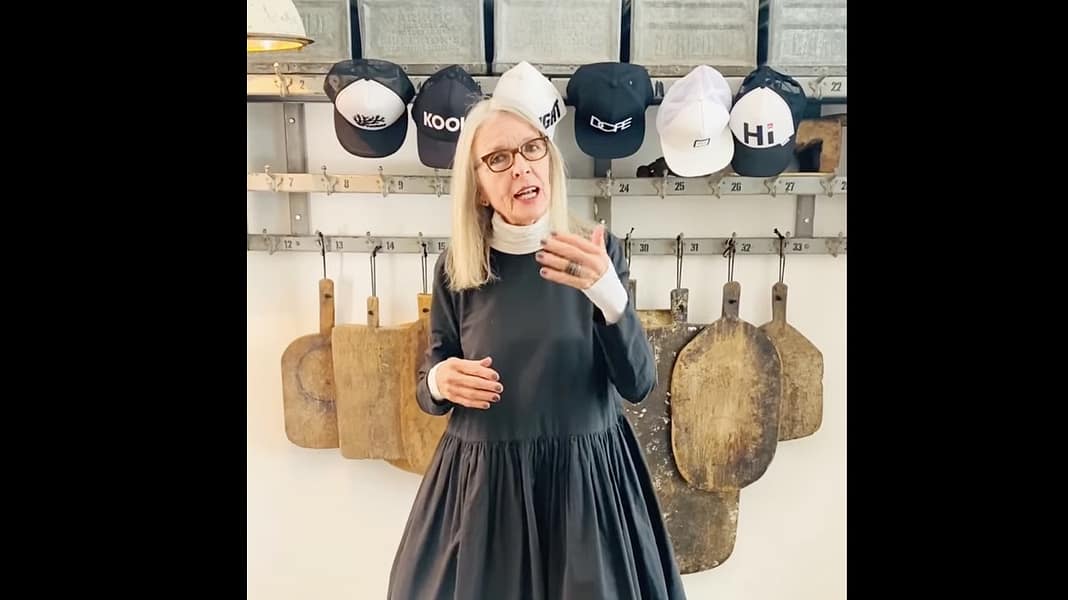
Diane Keaton’s Home: The Beautiful Discipline of a Life Collected
Diane Keaton did not merely decorate houses. She edited them, argued with them, rearranged them, rescued them and, in her own wonderfully peculiar way, turned them into self-portraits. Long before “curated” became the most exhausted word in interiors, Keaton was living inside a collage of her own making: black and white, rustic and refined, comic and severe, deeply Californian but never blandly sunny.
Bonhams’ auction, Diane Keaton: At Home with Diane, gives admirers and collectors a rare chance to step inside that world. Not in the celebrity-house-tour sense, with its polished surfaces and suspiciously untouched fruit bowls, but through the objects she actually chose to live with: rustic cutting boards from her kitchen, Monterey-style furniture, black-and-white kitchen decorations, California pottery, photography books, Navajo weavings, farmhouse tables, ladders, signs, lampshades and the odd item that looks as if it might have been waiting patiently in a junk shop until Keaton walked in and recognised its destiny.
The sale is part of Bonhams’ wider Diane Keaton: The Architecture of an Icon series, a title that gets closer to the truth than the usual Hollywood memorabilia language. Keaton’s career made her famous, but her eye made her singular. She was an actor, director, photographer, author, preservationist, collector and home obsessive. She understood that taste was not about luxury. It was about seeing.
Advertisement:
The Kitchen as Character
Among the most charming lots in the auction are the vintage rustic wood cutting boards from Keaton’s Sullivan Canyon kitchen. They are ordinary objects, at least at first glance. That is their magic. In another sale, they might be background props. Here, they become clues.
A chopping board carries marks. It darkens with use, absorbs the weather of a kitchen, and becomes less a utensil than a surface of memory. Keaton’s boards fit neatly into her broader interiors vocabulary: wood with scars, objects with labour in them, pieces that look better for having lived a life before arriving in hers.
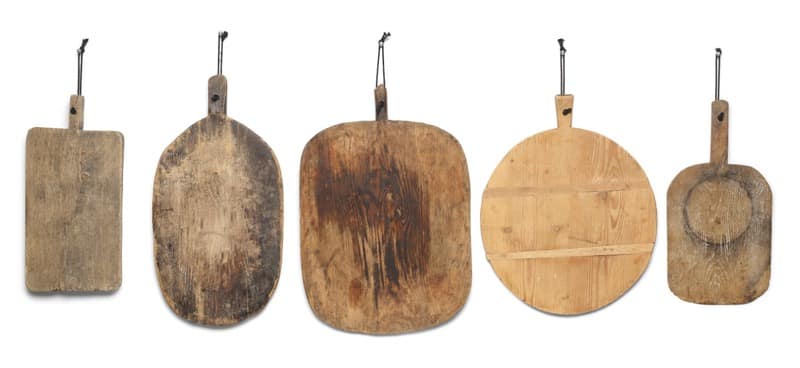
The lots of five rustic boards in the Bonhams sale, shown above, sold for US$2,432 inc. premium. You may not be able to own or afford Diane Keaton’s collection of chopping boards, but the inspiration is there for you to start your own collection at a fraction of the price.
Not everyone can bid on museum-grade art or a major piece of furniture, but a cutting board from Diane Keaton’s kitchen offers a different kind of intimacy. It is domestic, tactile and faintly absurd in the best possible way. Hollywood auctions often sell glamour. This one also sells breakfast.
One thing that I’ve picked up from reviewing this auction … Diane Keaton was about inspiring others. You don’t have to own Keaton’s chopping boards unless you want to pay a couple of thousand dollars for the privilege of saying “these were Keaton’s.” BUT now that you know that old, rustic, primitive boards look great as a mini-collection, you have something to keep an eye out for as your stroll through life’s bric-a-brac stalls. Thanks, Diane!
The boards also speak to Keaton’s gift for elevating utilitarian things. She had a fondness for objects that were practical, graphic and sculptural all at once. A wooden board leaning against a white wall becomes a shape. A row of boards becomes rhythm. A kitchen becomes a still life.
“Nothing is just one thing, is it, ever?” Diane Keaton asks. What is the collective noun for chopping boards? If you win these at auction, they may well be a Keaton of chopping boards!
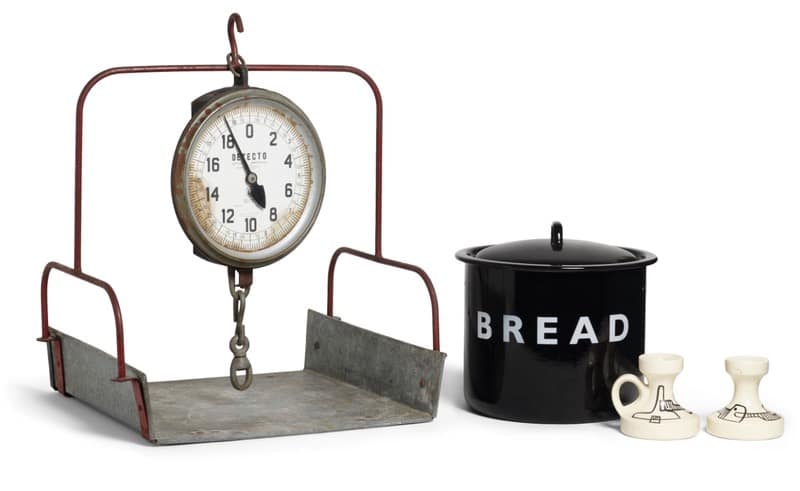
A GROUP OF KITCHEN DECORATIONS from Diane Keaton’s kitchen in her Sullivan Canyon home – a Detecto kitchen scale, a Reisswerke black enamel covered pot inscribed BREAD, and a pair of candlesticks sold or US$2,048.
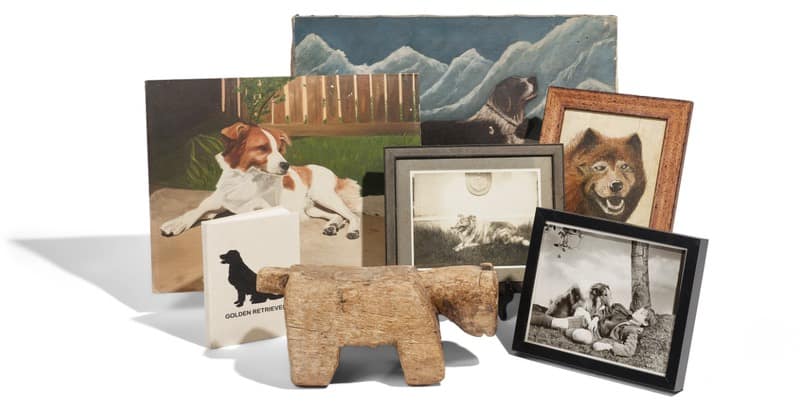
These dog themed decorations, including three paintings of dogs, two black and white photographs of dogs, and a Golden Retriever notebook, adorned Diane Keaton’s kitchen in her Sullivan Canyon home at 13215 Riviera Ranch Rd, Los Angeles, CA 90049. They sold for US$2,048 at auction.
Black, White and No Apology
Keaton’s homes, like her wardrobe, often moved in a disciplined register of black, white, cream, weathered timber and strong graphic contrast. But it was never cold minimalism. Her black and white had warmth, wit and muscle. It could be farmhouse, Spanish Colonial, industrial, Western, modernist and comic, sometimes in the same room.
The auction includes black-and-white kitchen decorations, black-and-white lampshades from the Diane Keaton x Aidan Gray collaboration, California Hillside Pottery pieces with black-and-white tile insets, and books arranged with a collector’s eye for tone as much as subject.
Even Keaton’s clutter had structure. It was not chaos. It was composition with a pulse.
This is what made Keaton’s interiors so recognisable. She did not chase prettiness. She liked contrast, repetition, scale and surprise. A white wall could hold a dark frame. A rustic table could sit beneath industrial lighting. A black object could behave like punctuation. She understood the old photographer’s truth: the eye loves edges.
Keaton’s visual world also owed much to photography. She collected images, made photographs, published photography books and lived with pictures as if they were active companions. Her rooms were full of looking. Not passive looking, but Keaton-looking: alert, mischievous, a little haunted, ready to rescue the overlooked thing from oblivion.
The Wall
Then there is The Wall. Keaton’s long-running collage project was not a neat artwork in the polite gallery sense. It was an evolving field of images, clippings, postcards, photographs, signs, oddities and personal fragments pinned together over time.
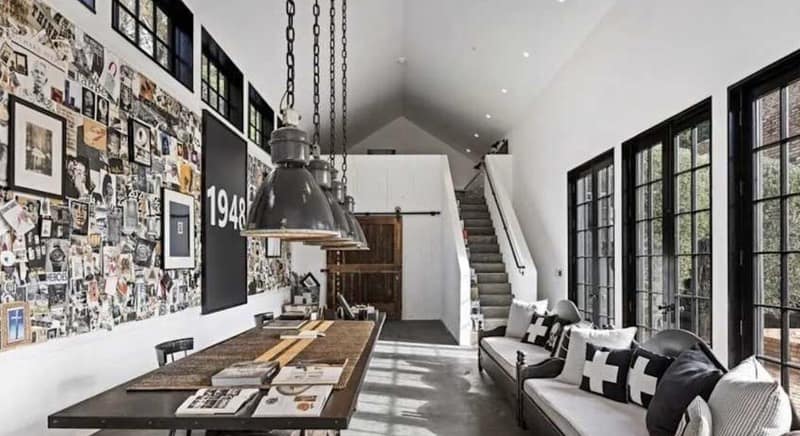
Bonhams and journalists who previewed the collection described a vast collage from her five-bedroom, seven-bathroom 1920s-era Sullivan Canyon abode, with one exhibited section representing only part of an original wall said to measure about eight by thirty feet. That is not a mood board. That is a weather system.
The Wall drew on a habit Keaton had cultivated since childhood and carried into adulthood. Her mother, Dorothy Hall, kept journals and scrapbooks, and Keaton herself became fascinated with collage early. She later described herself not grandly as an artist, but as someone who cut out paper, found old photographs at swap meets and put things on the wall.
As usual with Keaton, the understatement is almost suspicious. The Wall was a private archive, a studio, a diary, a visual filing cabinet and a map of attention. Its contents reportedly included photo booth images, Victorian mugshots, bingo cards, ephemera, found photographs and images taken by Keaton herself.
Some material connected to The Wall and the wider collage practice appears in the Bonhams presentation and auction series, offering collectors a chance to own not just a thing Keaton possessed, but a fragment of the way she saw.
The large billboard “1948” was the centrepiece of Keaton’s collage, and it sold for US$5,120 at Bonham’s auction of her estate. Collectors are scouring the other items depicted for their incredible provenance as owned by the Hollywood legend.
Keaton’s taste was never only decorative. It was narrative. She liked objects that asked questions. Who made this? Who used it? Why was it kept? Why was it discarded? What happens if it is placed beside this other thing?
She arranged her homes like conversations between the living, the dead and the almost-forgotten.
“Inspiration Chair” by Mitchell Gold + Bob Williams
Among the most personal pieces in the sale is a white-and-black upholstered “Inspiration Chair” by Mitchell Gold + Bob Williams, taken from Diane Keaton’s reading room in her Sullivan Canyon home. It sold for US$3,840.
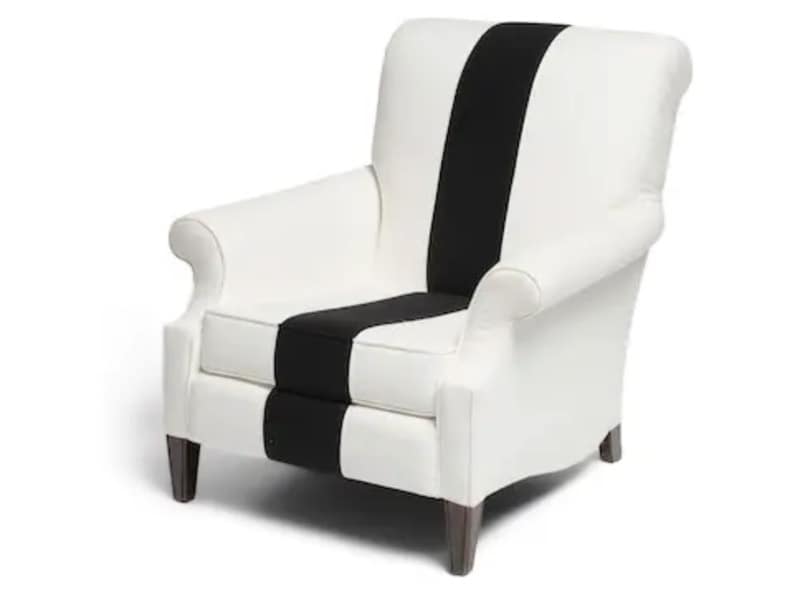
The chair also had its own Hollywood moment, appearing in Book Club before Keaton brought it home after production — exactly as the film’s designers suspected she might.
In The House That Pinterest Built, the chair appears in one of the home’s most striking spaces: a circular reading nook where the walls are covered with the words of Gerald Stern’s poem Lucky Life, turning a comfortable chair into the centrepiece of a private literary shrine.
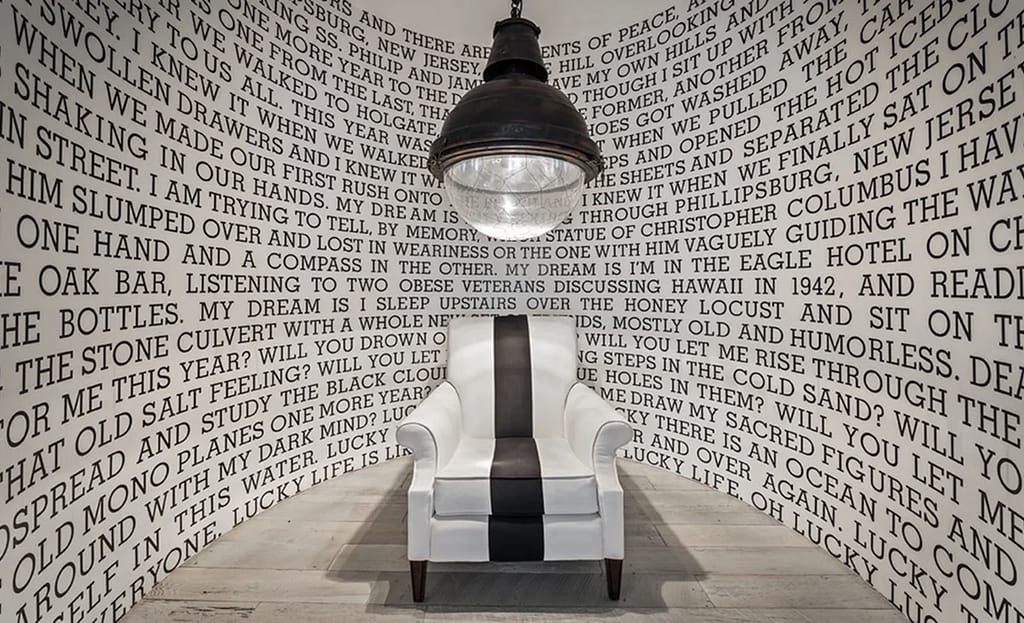
Diane Keaton’s Mitchell Gold + Bob Williams “Inspiration Chair” sat at the heart of a circular reading room in her Sullivan Canyon home, surrounded by walls inscribed with Gerald Stern’s poem Lucky Life. Featured in The House That Pinterest Built and later used in the film Book Club, the chair neatly captures Keaton’s gift for making interiors feel both theatrical and deeply personal.
Advertisement:
California, But Make It Keaton
Keaton’s interiors were deeply rooted in California, but not the California of beige sofas and ocean-view clichés. Her California had Spanish Colonial bones, ranch-house grit, Monterey furniture, desert shapes, weathered timber, black metal, pottery, old signs, photographs and books. It was sunlit, yes, but also graphic and shadowed.
She was famously involved in restoring and reimagining houses, and her books on design and architecture helped spread her influence beyond cinema. In The House That Pinterest Built, she explored the process of making a home through images and inspirations, which was entirely consistent with her lifelong collage instinct. She gathered, sorted, compared, pinned, moved and remade. A house, for Keaton, was never finished. It was always becoming.
That helps explain the emotional pull of this auction. These are not merely “celebrity belongings.” They are tools and traces from a working eye. A farmhouse table is not just a table. A ladder is not just a ladder. A black-and-white vase is not just a vase. In Keaton’s hands, these things became part of a larger visual grammar.

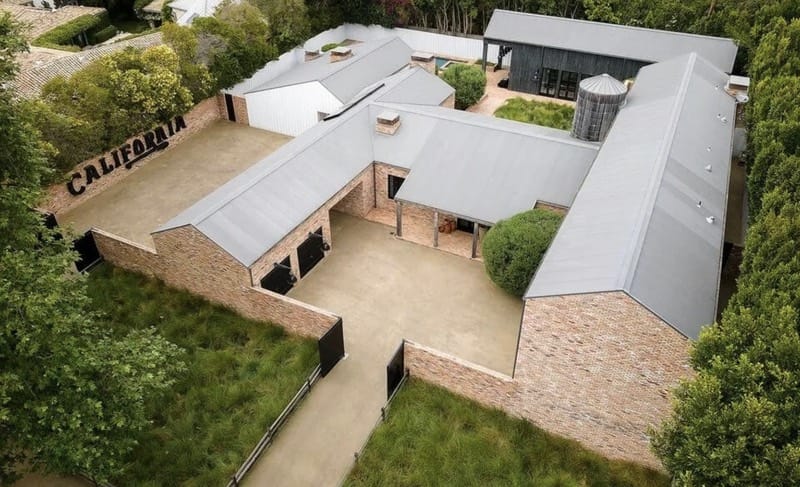
The large metal sign originally came as HOTEL CALIFORNIAN, but Keaton decided to split the signs as HOTEL and CALIFORNIA, retaining, but removing the ‘N’. From Diane Keaton’s courtyard in her Sullivan Canyon home, the ‘C’ measures approximately 62 x 49in, the ‘R’ approximately 75 x 182in, each remaining letter from ‘CALIFORNIA’ approximately 48 x 24-48in; each letter from ‘HOTEL’ approximately 36 1/2 x 33inches. It sold for US$8,960 including premium
Keaton for Collectors
Collectors will come to this auction from several directions. Film lovers will be drawn by the Keaton name. Design devotees will recognise the strength of her interiors. Photography people will understand her appetite for images and books. Others will simply want a small piece of her world: a cutting board, a kitchen object, a decorative piece, something that does not scream celebrity but quietly carries her touch.
That is the interesting thing about the At Home with Diane sale. It is democratic, at least compared with the rarified end of art and memorabilia auctions. Some lots are estimated in the hundreds rather than the thousands. That gives the sale a warmth many celebrity auctions lack. It allows someone to bid not on fame, but on affinity.
The danger, of course, is sentiment. Once an object has belonged to Diane Keaton, the market may briefly lose its hat, gloves and common sense. But the better way to look at the auction is through Keaton’s own method: choose what you truly see. The prize is not necessarily the most expensive lot. It may be the object that would have stopped her in her tracks at a flea market.
A rustic board. A black-and-white vessel. A photograph. A strange little thing with a past. Diane Keaton’s style should inspire yours.
A Home Made of Looking
Diane Keaton’s great subject, across film, fashion, photography and interiors, was individuality. She made oddness elegant without sanding off its edges. She let things remain slightly awkward, funny, worn, graphic, useful or mysterious. That is why her homes felt alive. They were not showrooms. They were accumulations of attention.
Bonhams’ auction offers the chance to own a piece of that attention. Not just a souvenir, but an object selected by someone who spent a lifetime looking harder than most people. Keaton knew that style was not about having more. It was about noticing better.
And if one of her old cutting boards ends up in a new kitchen somewhere, leaning against a wall, marked by use and surrounded by black, white, wood and a little disorder, it will be doing exactly what she seemed to love most: turning everyday life into composition.
Related stories
“Paris is always a good idea” & other quotes about Paris
Was courtesan Mata Hari really a spy?
Marilyn Monroe’s Final Photo Session by Bert Stern for Vogue
Hunter S. Thompson’s elk heart prank on Jack Nicholson
Tiny Homes: A Small Answer to a Growing Housing Crisis
From Australian Spinifex Arts desert to New York art galleries
Beat Generation writer Gerald Stern’s Lucky Life
Advertisement: