Walking the Line: Satire, Censorship and the New Culture-War Referees
The Australian Press Council’s ruling against The Age and The Sydney Morning Herald over a Cathy Wilcox cartoon called “Grass roots” should not be dismissed as another skirmish in the endless outrage wars. Nor should it be lazily waved away as “cancel culture”.
The cartoon, published on 7 January 2026. was found to have breached the Council’s Standards of Practice because its imagery encoded an antisemitic trope: the suggestion that Jewish or Israeli power secretly manipulates political events, media narratives or public campaigns. We have chosen not to show the cartoon, but it is still on the cartoonist’s Bluesky.
1EarthMedia is a member of the Press Council through our membership of LINA and we can see why the Council ruled as it did. Antisemitism is real. Racism is real. Religious prejudice is real. Editorial cartoonists, columnists, artists and academics cannot pretend that old hatreds become harmless simply because they have been redrawn with fresh ink.
But the ruling also lands in a much wider and more dangerous cultural moment. Across Australia, the public square is getting smaller. Writers’ festivals have been shaken by withdrawals, cancellations and codes of conduct. Speakers have been dumped. Academics have complained of being chilled, warned off, or made to tiptoe around Israel, Gaza, Zionism, antisemitism, Islamophobia and Palestinian rights as if every sentence is wired to an alarm.
The result is not healthy debate. It is nervous speech. And nervous speech is bad for journalism, bad for universities, bad for the arts, and fatal to public understanding.
UPDATE 24 August 2026: Political cartoonist Cathy Wilcox took a voluntary redundancy and leaves Sydney Morning Herald as early as this week. “She has cocked her skeptical eyebrow & poked her inky nib at pretty much any subject you care to name,” wrote Media Week.
Advertisement:
Is the anti-Semitic trope offensive?
In their story headlined ‘Calls for controversial One Nation senator to resign’ the InDaily wrote about anti-Semitic tropes peddled by One Nation Senator Malcolm Roberts, specifically “about a social media post shared by Senator Roberts in 2024 of a mural that repeated an anti-Semitic trope about Jews controlling global finance and politics.”
The story was also covered by Sydney Morning Herald – Cathy Wilcox’s publisher.
“It’s shameful that one of One Nation’s most senior MPs should endorse and share this notorious anti-Semitic slur,” Independent MP Allegra Spender wrote on X, formerly known as Twitter. “Will Pauline Hanson or Barnaby Joyce ever hold him to account?”
If the far-right use the exact same trope and the left calls for their resignation, then surely the left cannot use the trope with impunity …?
The cartoon crossed a line — but where is the line?
Ms. Wilcox’s cartoon’s intended target appeared to be the political campaign for a Royal Commission. It depicted a supposed grassroots movement being carried along by political and public figures, while a figure resembling Israeli Prime Minister Benjamin Netanyahu beat a drum nearby.
The intended point may have been about astroturfing: the manufacture of public pressure by powerful interests. That is a legitimate subject for satire. Political movements should be scrutinised. Lobbying should be scrutinised. Public grief should not be turned into a no-go zone for journalists.
But the Press Council found that this particular visual metaphor carried a poisonous implication: that the push for a Royal Commission was being orchestrated by Netanyahu, a Jewish Israeli leader, and that Australian figures were marching to his beat.
That is where the cartoon stumbled from political criticism into something much older and uglier. The image risked reviving the conspiracy-laden idea of hidden Jewish control — of politics, media, governments and public movements.
The Council was right to take that seriously. Yet the harder question remains: how do editors, cartoonists and writers criticise power without being accused of bigotry by those who benefit from power? That question is now central to the culture wars.
The rise of the self-appointed referee
One of the defining features of modern public debate is the rise of organisations and lobbyists who claim not merely to participate in argument, but to police its boundaries.
Some do this from the right. Some from the left. Some from religious communities. Some from activist networks. Some from industry. Some from foreign-policy pressure groups. All arrive with the same whistle around the neck.
They do not simply say: “We disagree.” … They say: “This must not be said.”
They do not simply argue: “That is offensive.” … They argue: “That is unsafe.”
And once a word like “unsafe” enters the room, institutions panic. Festivals flinch. Universities issue statements. Publishers call emergency meetings. Sponsors quietly ask whether the whole thing is worth the trouble. The modern cancellation does not always arrive with a censor’s stamp. Sometimes it arrives as a risk assessment.
The venue gets nervous. The board gets nervous. The donor gets nervous. The vice-chancellor gets nervous. The insurance people are summoned from whatever fluorescent-lit bunker they inhabit. Soon the talk is postponed, the session is reframed, the speaker is “mutually unavailable”, and everyone pretends the furniture moved itself.
This is how censorship works in polite society. No one bans the book. They simply make the launch impossible.
Advertisement:
Criticism is not hatred
The problem is especially acute around Israel and Gaza, where language is now patrolled with forensic aggression.
Criticism of Hamas is not Islamophobia.
Criticism of the Israeli government is not antisemitism.
Criticism of Zionism is not automatically antisemitism.
Criticism of Palestinian political movements is not automatically racism.
But each of these statements requires care, context and intellectual honesty. The difficulty is that public debate now rewards the opposite: speed, denunciation, tribal loyalty and screenshots stripped of meaning.
There is a line between criticising a government and vilifying a people.
There is a line between criticising a lobby group and invoking a conspiracy theory.
There is a line between condemning a war and blaming Jewish Australians for the actions of Israel.
There is a line between defending Jewish communities from antisemitism and using antisemitism as a shield against all criticism of Israeli state power.
That line must be defended from both directions.
If antisemitism is minimised, Jewish Australians are left exposed.
If antisemitism is weaponised to silence all criticism, public debate is corrupted.
Both things can be true. In fact, both things are true. That is precisely why this issue is so difficult — and why slogans are such poor substitutes for thought.
The wider problem
Australia’s literary and academic worlds have already felt the chill. At Bendigo Writers Festival, more than 50 writers and moderators withdrew after concerns were raised about a code of conduct and its effect on discussion of the war in Gaza. The opening night gala was cancelled. In Adelaide, controversy over the removal of Palestinian academic Randa Abdel-Fattah triggered a wave of withdrawals and a wider crisis for Writers’ Week.
These are not small matters. Writers’ festivals are supposed to be places where difficult subjects are aired, not quietly smothered under the soft pillow of “community safety”. The point of a writers’ festival – and political cartoons – is not that everyone leaves comfortable.
The point is that people encounter ideas — sometimes bracing, sometimes confronting, sometimes wrong, sometimes brilliant, sometimes infuriating. That is why the tickets are cheaper than therapy and more useful than a religious sermon.
Universities face the same challenge. Academic freedom cannot mean freedom only for approved opinions. It cannot mean freedom only until a donor, lobby group or minister complains. If scholars cannot analyse war, nationalism, colonialism, religion, race, law and power, then the university has become a branding exercise with sandstone.
Of course institutions must protect students and audiences from harassment and vilification. But protection from hatred is not the same as protection from discomfort. A democracy that cannot tell the difference is already in trouble.
The Press Council ruling does not say Netanyahu is beyond criticism or that political cartoons must be polite. It does not say lobbying around a Royal Commission is beyond scrutiny. It says publications must take reasonable steps to avoid causing or contributing materially to substantial offence, distress or prejudice.
That is not censorship. That is editorial responsibility. The trouble is that we now live in a culture where every pressure group wants to convert its preferred interpretation into the official ruling before publication. They want to be critic, complainant, prosecutor, judge and executioner — preferably before breakfast. Editors must resist that. But they must also do their jobs.
The editor’s dilemma is not whether to offend — journalism and satire must sometimes offend — but whether the target is clear, the argument is sound, and the work avoids lazy imagery that drags old prejudice back onto the page.
Free speech does not mean consequence-free speech, and editorial responsibility does not mean surrendering the pen to lobbyists, donors or self-appointed referees. The hard task is to criticise power precisely: name the government, the lobby group, the media empire, the political opportunist or the public figure being scrutinised, then make the case without smearing a whole people or faith.
Advertisement:
The line, the whistle and the nervous room
Cathy Wilcox’s “Grass roots” cartoon stepped into the culture war minefield. It had every right to question the politics behind calls for a Royal Commission; provocation is not a defect in a cartoon, it is the engine. A political cartoon that offends no one is usually just an illustration in sensible shoes.
But in today’s culture-war minefield, offence is often no longer the end of an argument. It is the beginning of a campaign. A lobbyist, advocate or aggrieved reader can seize on an image, frame it through the most damaging possible lens, and dare institutions to defend it.
That does not mean every complaint is cynical. Some expose real harm, prejudice or editorial blind spots. But every complaint now arrives in a climate of pressure, fear and institutional self-protection.
The Press Council did not discover a sacred boundary marked clearly for all time. It accepted that a line had been crossed. That line between criticism and prejudice is real — but it is also contested, political and increasingly patrolled by those who claim the referee’s whistle.
The lesson is not that cartoonists, writers or editors should avoid Israel, Gaza, Zionism, antisemitism, lobbying or political influence. That would be surrender. The lesson is to criticise with precision: name the politician, the government, the lobby group, the media empire, the hypocrisy — then make the case.
A free society cannot be forced to choose between reckless provocation and obedient silence. It needs editors with courage, critics with precision, cartoonists with teeth, and institutions able to tell the difference between dangerous prejudice and a dangerous idea.
We contacted Cathy Wilcox for her comment …
Cathy Wilcox is the current president of the Australian Cartoonists Association and one of Australia’s most decorated editorial cartoonists, with her work appearing for decades in The Sydney Morning Herald (SMH) and The Age. Cathy is a four time Walkley Award winner, along with Stanley, Kennedy and Museum of Australian Democracy Political Cartoonist of the Year honours.
Sky News, whose owner Rupert Murdoch was depicted in the cartoon marching to the beat of Netanyahu’s drum while carrying the grass roots campaign, contacted Ms. Wilcox. Their questions were not included in their story, but Wilcox’s answers were: “Why in God’s name do you think I would answer the questions of Murdoch’s petty little propaganda operation, to give them more fuel for their campaign of hatred?”
“Remind the boss about much they cared about free speech when one of theirs was in the spotlight,” Sky News reported Ms. Wilcox as saying.
We also sought comments from Ms. Wilcox via Bluesky: “Hi Cathy, do you have a comment about the APC ruling for this story?” she replied “Yes. Who drew the cartoon for your article?”
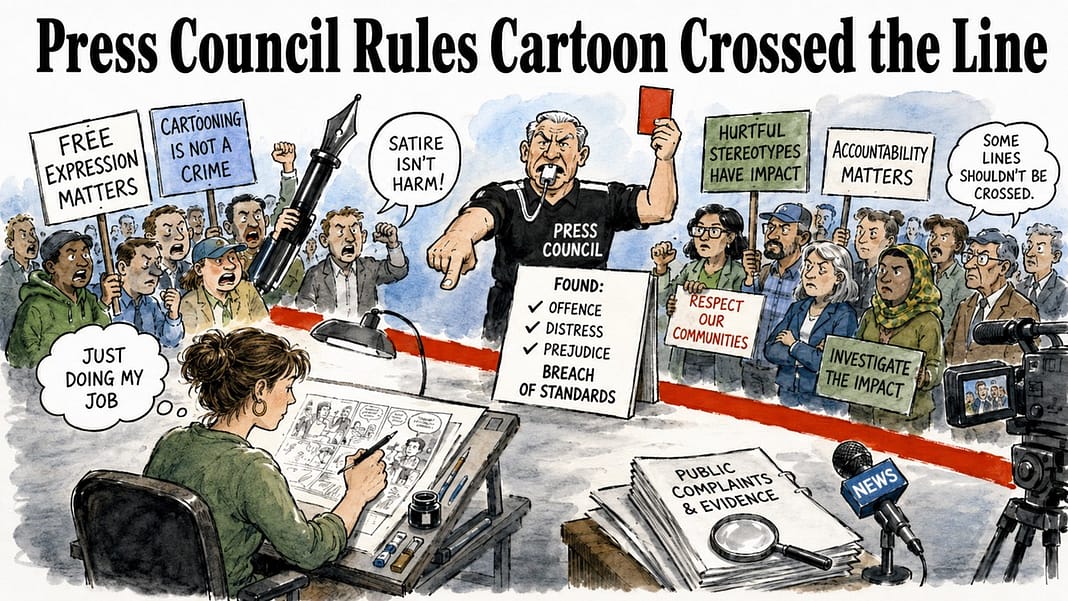
“Fair question. It’s an AI-generated placeholder image, mainly because I didn’t want to reproduce your cartoon or ask another cartoonist to draw a cartoon about your cartoon. I’d still genuinely value any comment you’d like to make about the ruling, cartooning, and the current climate for satire,” I replied.
“I have many thoughts but you’ll understand that I’m not going to say them here, as anything I say can and will be used against me,” Cathy responded.
Michael West also worked at the SMH before starting his own independent publisher. “MWM understands that the Press Council received scores of anonymous complaints. Cathy Wilcox was never allowed to know the identity of her accusers, nor invited to defend herself, while being vilified on social media as an antisemite,” Mr. West wrote in his coverage, without directly quoting Ms Wilcox.
The ruling has not settled the matter. Despite the Press Council finding the cartoon was likely to cause substantial offence, distress and prejudice, Wilcox has left the cartoon on her social media — a quiet but unmistakable signal that she does not accept that the work should simply disappear.
Other independent media outlets have also criticised the Council, with Michael West Media accusing it of yielding to pressure, while Crikey and others have pointed to the Council’s uneven record in judging controversial cartoons. If one cartoon is condemned while another is defended as fearless satire, the rules begin to look less like standards and more like culture-war weather.
But that is precisely why this story should not become another round of tribal combat. The issue is bigger than one cartoon, one complaint, one cartoonist or one ruling. Australia’s public debate is being pulled into a machine that turns offence into content, complaint into leverage, and every hard argument into a loyalty test.
The way out is not reckless provocation, and it is not obedient silence. It is a more difficult discipline: defend the right to criticise power, take real prejudice seriously, demand consistency from standards bodies, and refuse to let every disagreement become another clickbait story or a call to the referee.
Related stories
Climate Cartoon People’s Choice Award goes to Cathy Wilcox
Who Is Randa Abdel-Fattah — and Why Are Festivals Cutting Ties?
Meta tried to stop Careless People book by Sarah Wynn-Williams
Press Council finds Daily Telegraph breaches Standards of Practice
Press Council rules against Courier Mail opinion writer
Why Musk closed the Global Engagement Center
Environmental Journalists Face Rising Threats
Hays Code, “Thou Shalt Not” by Whitey Schafer
Megan Herbert wins inaugural Climate Council Cartoon Award
PHOTO Australia Closes: A Curtain Falls on a Rising Festival
Hergé and the Timeless Adventures of Tintin
Inside Out Photo Project: A Global Art Initiative
Advertisement: