Homer’s Odyssey Through the English Language
Nearly three thousand years after Homer’s tales were first sung, The Odyssey is again entertaining the masses.
Christopher Nolan’s lavish screen adaptation, starring Matt Damon as the long-suffering Odysseus, opened in July 2026 with a global box-office haul of more than US$264 million. Evidently, audiences are still willing to follow a weary Greek veteran as he battles storms, monsters, seductive women, angry gods and catastrophic navigational decisions on his way home from work.
Yet Homer’s influence on everyday English is strangely difficult to measure. Shakespeare scatters his fingerprints across ordinary conversation.
We break the ice, refuse to budge an inch, laugh ourselves into stitches, pursue wild-goose chases and complain that we have seen better days—all expressions either coined, popularised or memorably preserved in Shakespeare’s plays.
But what of Homer? The Iliad and The Odyssey are foundational works of Western literature. Their heroes, monsters and gods have endured in painting, theatre, opera, novels, psychology, politics and now blockbuster cinema.
Surely their language should be everywhere. It is—but often in disguise.
Advertisement:
The Mentor Who Became a Role Model
Of all Homer’s characters, Mentor may have achieved the most remarkable afterlife.
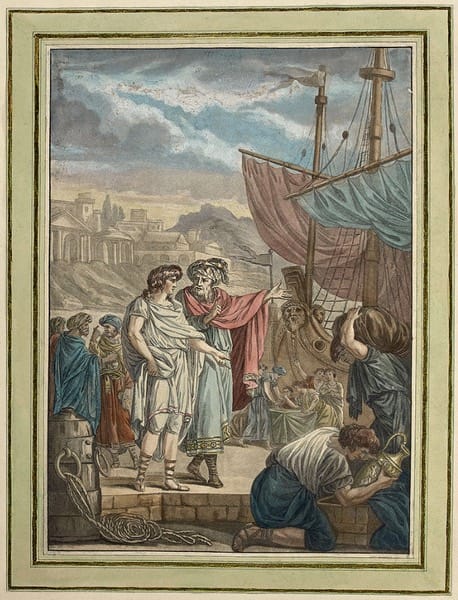
In The Odyssey, Mentor is an old friend of Odysseus entrusted with watching over his household while the king is away at Troy. The goddess Athena sometimes assumes Mentor’s appearance while advising Odysseus’s son, Telemachus.
Today, a mentor is any experienced and trusted adviser who guides someone younger or less experienced. The character’s proper name has become a common noun, a verb and an entire corporate industry.
We have mentors, mentees, mentoring programs and people on LinkedIn offering “transformational executive mentorship” before breakfast.
There is, however, a twist worthy of Odysseus himself. The modern meaning of menor was strengthened not simply by Homer but by François Fénelon’s enormously popular 1699 French novel The Adventures of Telemachus, in which Mentor plays a far more sustained role as a wise teacher.
The illustration of Mentor and Odysseus’ son Telemachus shown is from a 1785 edition of Aventuras de Telémaco by François Fénelon, valued at 35,000 Euro.
Homer supplied the character. Later Europe gave him the job description.
Achilles and the Heel Homer Never Mentioned
Achilles has also entered the language through his “Achilles heel”: the single vulnerability capable of bringing down an otherwise powerful person, organisation or system.
But the famous heel is not actually in The Iliad. Homer’s Achilles is a magnificent but mortal warrior. His death is foretold, but it does not take place within the poem. The English expression “Achilles heel” did not become established until the nineteenth century.
Achilles was the son of Peleus, a mortal Greek king, and Thetis, an immortal sea goddess. Later traditions of the story say that his immortal mother could not bear the thought that she would one day outlive her son, so she tried to make him invulnerable by dipping him into the River Styx. But the heel by which she held him never touched the water, leaving one small vulnerable spot—his “Achilles heel”—that would ultimately prove fatal.
Brad Pitt’s Achilles meets his end in battle in the 2004 film Troy, struck by arrows that appear to confirm the familiar legend of his fatal heel. It is a neat piece of Hollywood storytelling, but not Homer: The Iliad ends before Achilles dies, and the heel tradition emerged in much later accounts.
There is also the Achilles tendon, the thick cord connecting the calf muscles to the heel. So Achilles has certainly entered the modern lexicon, but his most famous anatomical feature reached us by a long and indirect route.
An Odyssey Without Odysseus
The title Odyssey has itself become an English noun: a long, eventful journey involving hardship, discovery or personal transformation.
A politician can describe an election campaign as an odyssey. A musician’s career may be called a musical odyssey. A traveller who misses two flights and loses a suitcase in Dubai may begin using the word before reaching the baggage counter.
It is not as common in casual speech as “journey,” but it remains instantly understood. It carries more weight than an ordinary trip. A trip is what happens when everything goes to plan. An odyssey generally involves delays, disasters, temptations, revelations and several regrettable decisions.
The curious thing is that Odysseus himself is less visible in English than the journey named after him.
Part of the reason is that English inherited two versions of his name. The Greek is Odysseus; the Latin form is Ulysses. As a result, the hero’s cultural identity became divided. Homer gave us Odysseus, Rome gave us Ulysses, James Joyce gave us a famously difficult novel, and modern medicine and behavioural economics gave us the “Ulysses pact.”
Advertisement:
Tied to the Mast
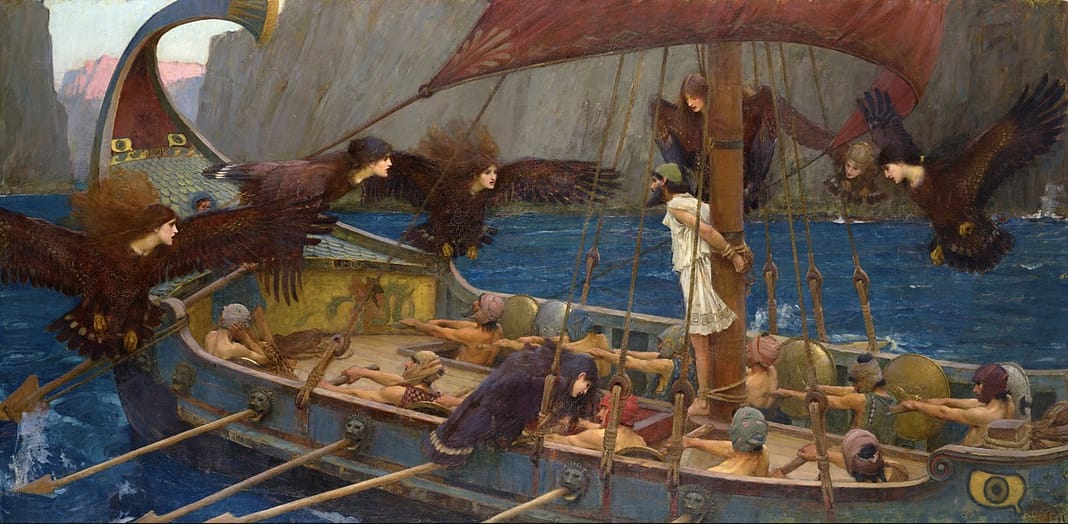
A Ulysses pact—or Ulysses contract—is a decision made in advance to prevent one’s future self from acting against one’s considered interests. The name comes from Odysseus’s encounter with the Sirens.
Knowing their song would overpower his judgement, Odysseus orders his sailors to plug their ears with wax and bind him to the mast. He commands them not to release him, no matter how desperately he begs. Once the Sirens begin singing, he does indeed demand freedom, but his crew obeys the instructions issued by his earlier, rational self.
The story has become a model for self-binding.
Someone trying to stop gambling may arrange to be excluded from betting services. A person anticipating a future mental-health crisis may prepare an advance directive. A dieter may decline to keep chocolate in the house, thereby preventing midnight Odysseus from overruling sensible morning Odysseus.
“Tied to the mast” is therefore recognisably Homeric, even when used without the hero’s name. “Tied to the mast of a ship of fools” is a vivid modern hybrid: Odysseus lashed to one tradition and Plato’s misgoverned vessel sailing in from another. ‘Ship of Fools’ first appeared in Plato’s Republic in 375BC.
The Siren Song
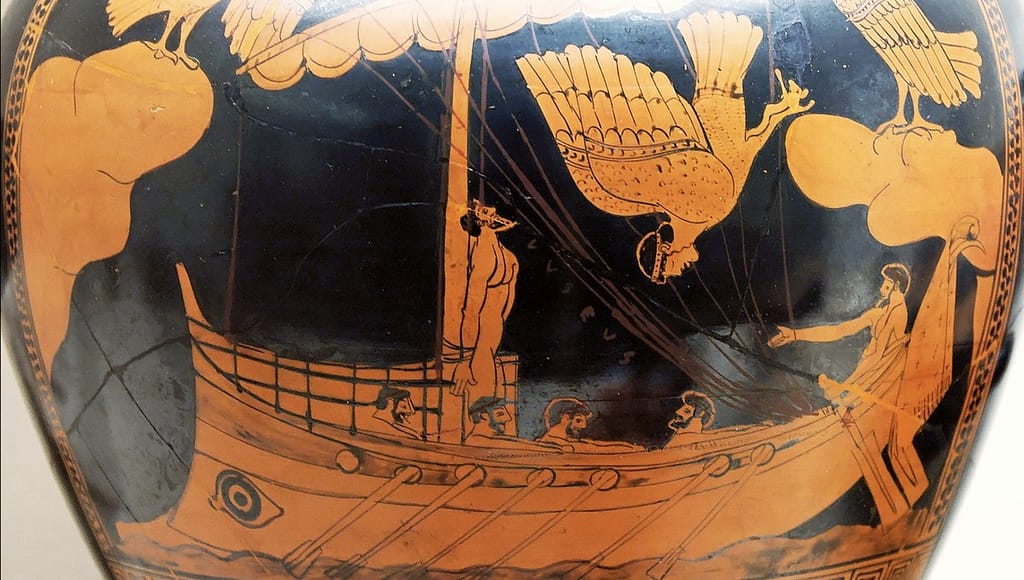
The Sirens have enjoyed an even more prolific afterlife. A “siren song” is an attractive but dangerous appeal: the promise of easy money, political popularity, forbidden pleasure or a beachfront investment with mysteriously vague planning approval.
The word “siren” can describe a dangerously seductive woman. It also names the shrieking warning device fitted to ambulances, fire engines and police cars. That meaning developed from the Sirens’ attention-commanding sound, although modern emergency sirens are designed to make people flee danger rather than sail directly towards it.
The original Homeric Sirens were not merely courtesans or temptresses. Their power was intellectual as well as erotic. They promised Odysseus knowledge—everything that had happened at Troy and across the fertile earth. Their temptation was not simply pleasure, but the fantasy of hearing and knowing all things.
That makes the Sirens particularly well suited to the digital age. Every glowing screen promises one more revelation, one more headline, one more video and one more piece of information before the ship hits the rocks.
Beware the Trojan Horse
The Trojan horse is now one of Homeric mythology’s most familiar contributions to everyday speech.
It describes something introduced under innocent or attractive pretences but intended to weaken, infiltrate or destroy from within. In politics, a seemingly modest reform may be attacked as a Trojan horse for a much larger agenda. In cybersecurity, a Trojan is malicious software disguised as a legitimate program.
Yet here again, the famous story sits just outside Homer’s main narrative. The Iliad ends before the fall of Troy and contains no wooden horse. The Odyssey refers retrospectively to the horse and to Odysseus’s role in the deception, but the fullest surviving ancient account familiar to modern readers comes from Virgil’s Aeneid, written centuries later.
The warning “Beware of Greeks bearing gifts” is also Virgil rather than Homer. It paraphrases the Trojan priest Laocoön’s suspicion of the abandoned horse.
Suspicions of the USA accepting a personal jet for their president from Qatar reference Odysseus’s cunning deception, although in this matter, the jet itself may not carry the enemy’s payload.
Nevertheless, the Trojan horse belongs to the Homeric world. Homer’s poems created the imaginative territory in which later poets completed the war.
Today a Trojan is the last thing anyone wants inside a computer—although the Trojan condom company has given the name an entirely different reputation for entering securely fortified places.
Between Scylla and Charybdis
“Between a rock and a hard place” is not directly derived from Homer, but it expresses almost exactly the dilemma faced by Odysseus when he must sail between Scylla and Charybdis.
Scylla is a many-headed monster lurking among the rocks. Charybdis is a deadly whirlpool. Avoiding one brings the ship dangerously close to the other. Odysseus must choose between two evils, knowing that some loss is unavoidable.
The older classical expression “between Scylla and Charybdis” survives in formal writing, although it has largely surrendered everyday conversation to the rock and the hard place.
The Homeric version is harsher. A rock and a hard place merely trap you. Scylla eats six members of your crew while Charybdis attempts to swallow the ship. It is less an awkward choice than history’s worst performance review.
Victor Hugo uses the French equivalent, tomber de Charybde en Scylla, in Les Misérables (1862) to describe the political dangers of the Paris uprising. He even titles a chapter “The Charybdis of the Faubourg Saint-Antoine and the Scylla of the Faubourg du Temple.”
In the Lap of the Gods
“In the lap of the gods” is genuinely Homeric. Versions of the phrase appear repeatedly in The Iliad, expressing the belief that an outcome ultimately rests with divine powers rather than human planning. It remains useful whenever people have done all they can and must wait for forces beyond their control.
An election result may be in the lap of the gods. So may a medical diagnosis, a court judgement or the success of a film costing hundreds of millions of dollars. The expression survives because it captures a permanent human condition: the point at which preparation ends and uncertainty begins.
Advertisement:
The adjective “protean”
The adjective “protean,” meaning versatile, adaptable or able to assume many forms, comes from Proteus, the shape-shifting Old Man of the Sea. In The Odyssey, Menelaus captures him and holds on as he transforms repeatedly, eventually forcing him to reveal that Odysseus is still alive.
The Face That Launched a Thousand Ships
When Paris stole Helen from King Menelaus and took her to Troy, a vast Greek armada set sail to recover her, sparking the Trojan War. Modern pop culture—including the latest film adaptation of The Odyssey—still recalls her as “the face that launched a thousand ships.”
Yet while Homer established Helen’s mythic allure, it was Christopher Marlowe who coined the iconic phrase more than 2,000 years later. In his late 16th-century masterpiece Doctor Faustus, the title character is confronted by a demonic phantom disguised as Helen:
“Was this the face that launch’d a thousand ships,
And burnt the topless towers of Ilium?
Sweet Helen, make me immortal with a kiss.”
Though inspired by Lucian’s ancient Dialogues of the Dead, Marlowe’s line is frequently stripped of its eerie context. Faustus is mesmerized not by Helen herself, but by a demonic fake—and his wonder carries an unmistakable undercurrent of hesitation, questioning if this illusory vision truly lives up to the legend.
Penelope’s Web
Penelope, Odysseus’s wife, has not become a common noun in quite the way Mentor has, but “Penelope’s web” or “Penelope’s work” once described a task that is repeatedly undone and therefore never completed.
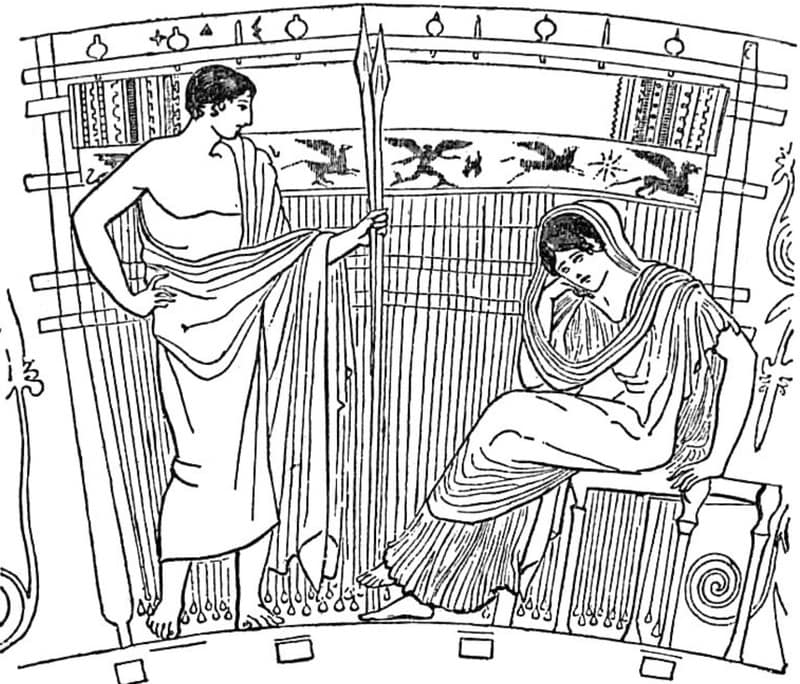
During Odysseus’s absence, Penelope is besieged by suitors demanding that she choose a new husband. She promises to decide after completing a burial shroud for her father-in-law. Each day she weaves; each night she secretly unravels the work.
The image is ideal for government committees, roadworks, website redesigns and any household renovation involving more than one tradesperson.
“Penelopean” can still mean endlessly repetitive or perpetually undone, although it now belongs more to literary than conversational English.
Hectoring and Myrmidons
Several figures from The Iliad have entered English so thoroughly that their Homeric origins are easily missed.
To “hector” someone is to bully, intimidate or harangue them. The word comes from Hector, prince of Troy, although the meaning is deeply unfair to Homer’s character. Hector is a formidable warrior, but he is also a loving husband, father and defender of his city. Later theatrical portrayals helped transform his name into that of a swaggering bully.
A “myrmidon” is a loyal subordinate who carries out orders unquestioningly, often for an unscrupulous master. The original Myrmidons were the warriors commanded by Achilles. The word now tends to suggest a henchman, political operative or obedient thug.
“Stentorian,” meaning extremely loud and powerful, comes from Stentor, the Greek herald whose voice Homer says was as powerful as that of fifty men.
These words demonstrate that Homer’s influence is not confined to famous quotations. Characters themselves have dissolved into adjectives, verbs and common nouns.
Rage, Hubris and the Homeric Hero
Some words strongly associated with Homer do not originate specifically in his poems.
“Hubris,” meaning excessive pride or self-confidence leading towards ruin, is an ancient Greek concept rather than a Homeric coinage. Nevertheless, it describes the behaviour of several figures in the epics and has become central to modern readings of heroic tragedy.
“Nemesis,” “fate,” “oracle,” “muse” and “epic” likewise belong to the wider classical inheritance. Homer did not necessarily give English these words directly, but his poems helped preserve the imaginative world that gives them meaning.
Even “Homeric” has entered the language as an adjective. A Homeric struggle is vast and heroic. Homeric laughter is loud, unstoppable laughter, derived from descriptions of the gods laughing in The Iliad and The Odyssey. A Homeric simile is an extended comparison that expands into a miniature scene of its own.
A Homeric hangover presumably lasts ten years and prevents you from finding your house.
Lotus-Eaters and Comfortable Oblivion
The Lotus-Eaters are among Homer’s most recognisable figures, though the term is less common than it once was.
Odysseus’s men land among people who consume a mysterious lotus that causes them to forget home and abandon all desire to continue their journey. Odysseus must force his affected sailors back aboard the ship. A “lotus-eater” consequently became a person devoted to pleasure, idleness or dreamy indifference to practical life.
The phrase has often carried a moral judgement, particularly when used by industrious societies to criticise those allegedly living in comfort without contributing very much. But Homer’s episode is more disturbing than simple laziness. The lotus removes memory, ambition and attachment. Its victims do not merely rest; they forget who they are and where they were going.
In modern terms, the Lotus-Eaters may represent intoxication, escapism, endless entertainment or any comfortable oblivion capable of making us abandon the voyage.
Advertisement:
Why Homer Is Less Obvious Than Shakespeare
Homer’s linguistic influence differs from Shakespeare’s because Homer did not write in English. Shakespeare worked inside the language we still speak, even though four centuries have changed its rhythms and meanings. His phrases could pass directly into English conversation.
Homer’s poems reached English through layers of translation—Greek into Latin, French and English, followed by centuries of adaptation. One translator gives us a “wine-dark sea”; another a “wine-looking sea”; another may avoid wine altogether. The characters and situations remain, but the precise wording changes.
Homer therefore influenced English less through quotable sentences than through narrative patterns, archetypes and names.
We still recognise the long journey home, the faithful spouse, the irresistible temptation, the fatal weakness, the deceptive gift, the impossible choice, the forgotten purpose and the decision placed in the lap of the gods.
These are Homer’s linguistic survivors.
Homer Lives On—Even in Springfield
The name Homer lives on as a Simpson. Matt Groening reportedly chose the name Homer for his cartoon patriarch from his own father, Homer Groening, rather than directly naming him after the ancient poet. Yet the joke remains irresistible.
The author traditionally imagined as the fountainhead of Western literature now shares his name with a yellow, doughnut-eating nuclear power plant employee whose personal odysseys generally involve beer, barbecue and getting home to the couch.
Perhaps that is not such a fall from classical greatness. Odysseus, after all, spends ten years trying to get home. Homer Simpson rarely wants to leave it.
The ancient Homer’s influence on English may not be as immediately visible as Shakespeare’s, but it lies deep beneath the language. His characters have become advisers, bullies, henchmen, temptresses and vulnerabilities. His adventures have given us deceptive gifts, impossible choices, self-binding contracts and journeys so difficult that an ordinary word such as “trip” will not do.
Homer’s heroes did become immortal. They simply changed their names, slipped into our dictionaries and continued their voyage without us noticing.
Related stories
Beat Generation writer Gerald Stern’s Lucky Life
Hunter S. Thompson’s elk heart prank on Jack Nicholson
“Paris is always a good idea” & other quotes about Paris
Banjo Paterson’s classic Eaglehawk poem Mulga Bill’s Bicycle
Was courtesan Mata Hari really a spy?
Marilyn Monroe’s Final Photo Session by Bert Stern for Vogue
The Charge of the Light Brigade poems by Tennyson – Kipling
Why do we Remember Remember the 5th of November?
David Bowie’s 100 Favourite Books
Advertisement: