
Mulga Bill Rides Again at Eaglehawk
Imagine a time when bicycles were still exciting new machines. When Banjo Paterson wrote Mulga Bill’s Bicycle 130 years ago in 1896, most people travelled by foot, horse, cart, train or boat. Cycling was becoming fashionable, but a bicycle could still seem strange and slightly daring — especially on rough country roads.
Mulga Bill comes from Eaglehawk and thinks he can ride anything. He has handled horses, bulls and the hard tracks of the bush, so he is certain a bicycle will be easy. That is where the trouble begins.
Mulga Bill’s bicycle was one of the famous penny-farthing — the tall bicycle with one enormous front wheel and one tiny rear wheel. They looked spectacular, but they were not easy to ride.
The rider sat high above the road, close to the large front wheel, and could be thrown forward if it struck a stone, rut or obstacle. Going downhill took nerve, balance and strong brakes — or, in Mulga Bill’s case, perhaps more confidence than sense.
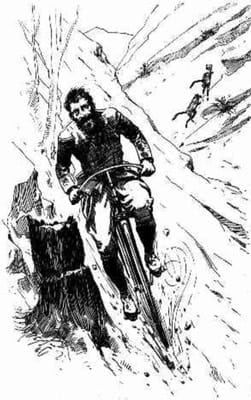
The illustration published with Mulga Bill’s Bicycle in 1896 shows Bill on a penny-farthing – shown here. That makes his wild ride even funnier: he is perched high in the air on a machine that would have been hard enough to control on a smooth street, let alone charging down a rough bush track towards Dead Man’s Creek.
The poem was first published in The Sydney Mail and New South Wales Advertiser on 25 July 1896. It is funny because Bill is so sure of himself before he starts. But once the bicycle races downhill, it seems to turn into a wild creature of its own — dodging trees, frightening animals and carrying Bill towards Dead Man’s Creek.
Read it aloud if you can. The words gather speed just like Mulga Bill’s runaway ride.
Advertisement:
MULGA BILL’S BICYCLE
By A. B. “Banjo” Paterson
’Twas Mulga Bill, from Eaglehawk, that caught the cycling craze;
He turned away the good old horse that served him many days;
He dressed himself in cycling clothes, resplendent to be seen;
He hurried off to town and bought a shining new machine;
And as he wheeled it through the door, with air of lordly pride,
The grinning shop assistant said, “Excuse me, can you ride?”
“See here, young man,” said Mulga Bill, “from Walgett to the sea,
From Conroy’s Gap to Castlereagh, there’s none can ride like me.
I’m good all round at everything as everybody knows,
Although I’m not the one to talk — I hate a man that blows.
But riding is my special gift, my chiefest, sole delight;
Just ask a wild duck can it swim, a wildcat can it fight.
There’s nothing clothed in hair or hide, or built of flesh or steel,
There’s nothing walks or jumps, or runs, on axle, hoof, or wheel,
But what I’ll sit, while hide will hold and girths and straps are tight:
I’ll ride this here two-wheeled concern right straight away at sight.”
’Twas Mulga Bill, from Eaglehawk, that sought his own abode,
That perched above Dead Man’s Creek, beside the mountain road.
He turned the cycle down the hill and mounted for the fray,
But ere he’d gone a dozen yards it bolted clean away.
It left the track, and through the trees, just like a silver streak,
It whistled down the awful slope towards Dead Man’s Creek.
It shaved a stump by half an inch, it dodged a big white-box:
The very wallaroos in fright went scrambling up the rocks,
The wombats hiding in their caves dug deeper underground,
As Mulga Bill, as white as chalk, sat tight to every bound.
It struck a stone and gave a spring that cleared a fallen tree,
It raced beside a precipice as close as close could be;
And then as Mulga Bill let out one last despairing shriek
It made a leap of twenty feet into Dead Man’s Creek.
’Twas Mulga Bill, from Eaglehawk, that slowly swam ashore:
He said, “I’ve had some narrer shaves and lively rides before;
I’ve rode a wild bull round a yard to win a five-pound bet,
But this was the most awful ride that I’ve encountered yet.
I’ll give that two-wheeled outlaw best; it’s shaken all my nerve
To feel it whistle through the air and plunge and buck and swerve.
It’s safe at rest in Dead Man’s Creek, we’ll leave it lying still;
A horse’s back is good enough henceforth for Mulga Bill.”
First published in The Sydney Mail and New South Wales Advertiser, Saturday, 25 July 1896, p. 183.
Advertisement:
The Bicycle as a Bushranger
Banjo Paterson was one of Australia’s best-loved writers because he could make a story feel alive. In this poem, the bicycle is not just a bicycle. It becomes a “two-wheeled outlaw” — like a bushranger with handlebars.
Mulga Bill is not really a villain, and he is not exactly foolish either. He is brave, tough and proud. But he has one problem: he thinks being good at one thing means he must be good at everything. Plenty of people have made that mistake — perhaps before trying a skateboard, rollerblades, a surfboard or a new computer game.
The poem is full of fast, noisy action. It whistles through the trees, leaps over obstacles and frightens wallaroos and wombats. When read aloud, the words seem to gallop downhill with Bill hanging on behind them.
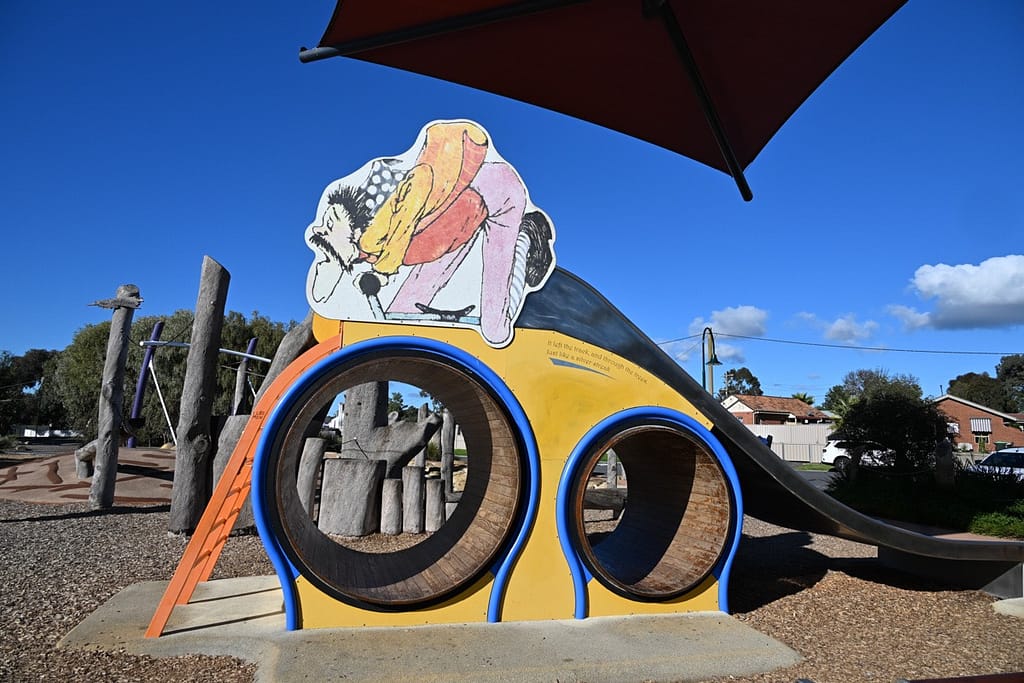
More than 125 years later, Eaglehawk has given Mulga Bill a proper tribute. The Eaglehawk Playspace beside Lake Neangar has custom-built equipment inspired by the poem, including a huge eagle-hawk-shaped structure and play areas that invite children to climb, balance and test their courage — preferably without plunging into any creeks.
The nearby Mulga Bill Bicycle Trail begins at the playspace and circles Lake Neangar before heading across Simpsons Road and toward the Greater Bendigo National Park.
To find it, head to The Mulga Bill Play Space on Napier Street, Eaglehawk beside Lake Neangar, about 10 minutes north-west of Bendigo’s city centre. It is a fine place to read the poem, ride a bike, or look at the water and wonder whether Mulga Bill’s bicycle is still down there somewhere.
Bendigo Council runs the annual Mulga Bill Writing Award to honour writers of short stories and poetry.
Who was Banjo Paterson?
Banjo Paterson — Andrew Barton Paterson — was one of Australia’s great storytellers: a lawyer, journalist, war correspondent and poet whose ballads gave the bush its own lively voice. His 1895 ballad “Waltzing Matilda” is considered to be Australian national song. His poem “Clancy of the Overflow” (1889) is another classic and “The Man from Snowy River” (1890) was made into a successful movie.
He wrote famous tales of riders, drovers, races and characters larger than life, but Mulga Bill has a special claim on Eaglehawk. Here, the hero is not a fearless horseman charging through the high country, but a proud local man brought undone by a shiny new bicycle. That is why the poem has lasted: it is funny, fast and kind-hearted, and it reminds us that even the boldest bushman can meet his match — sometimes on two wheels.
Related stories
The Charge of the Light Brigade poems by Tennyson – Kipling
Beat Generation writer Gerald Stern’s Lucky Life
Why do we Remember Remember the 5th of November?
David Bowie’s 100 Favourite Books
Advertisement:


