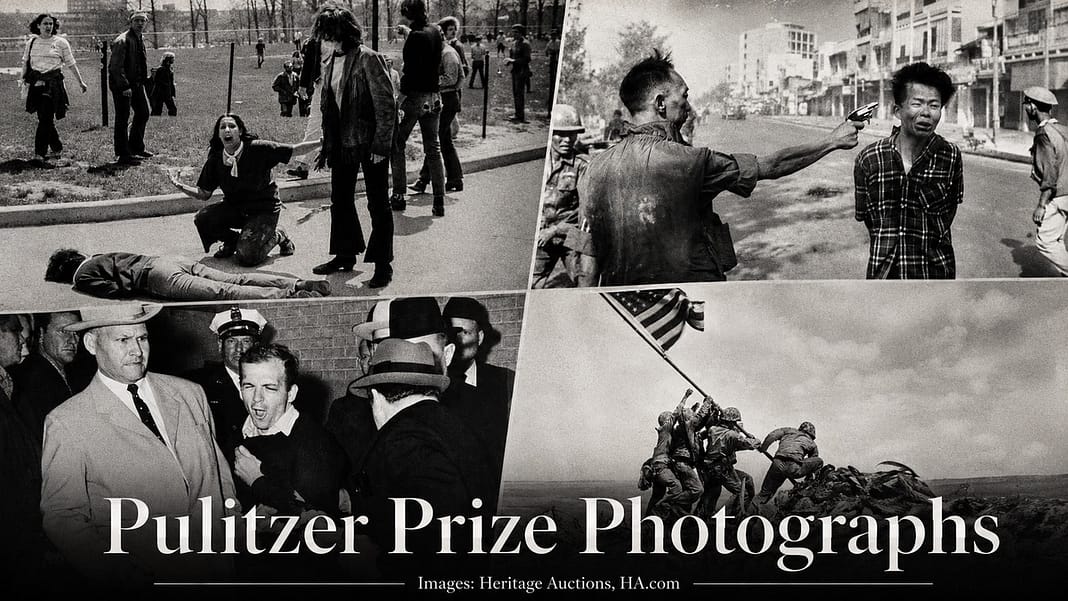
Pulitzer Prize Photographs: The Images That Stopped History in Its Tracks
Some photographs report the news. Others become the news. A rare collection of Pulitzer Prize photographs coming to auction through Heritage Auctions on July 1 gathers some of the most famous, harrowing and culturally defining images of the 20th century — pictures that did not merely illustrate history, but helped shape how history was understood.
Presented as Moments: The Pulitzer Prize Photographs Showcase Auction, the sale brings together original photographs used in the making of the book Moments: The Pulitzer Prize Photographs, by Sheryle and John Leekley. According to Heritage Auctions, the photographs were printed exclusively for the authors by the Pulitzer Prize-winning photographers themselves, or, when that was not possible, supplied by the printing labs of the media organisations for which they worked at the time of the award.
These are not decorative reproductions of famous pictures. They are physical objects connected to the editorial, historical and publishing life of the photographs: gelatin silver prints, press prints, later prints, wire photographs and working images that once passed through the hands of photographers, editors, publishers and historians. They also carry a larger story about photojournalism itself.
The Pulitzer Prize in Photography was established in 1942, recognising the camera’s ability to witness public events with an immediacy no written account can quite match. In 1968, the prize was divided into two categories: Feature Photography, for sustained visual storytelling, and what would later become Breaking News Photography, for images made in the volatile instant when history is still unfolding.
The photographs in this auction span war, assassination, civil rights, protest, political violence, humanitarian disaster and national mythology. They ask uncomfortable questions. They expose brutality. They freeze the exact second before a life changes, a crowd erupts, a nation mourns or the world looks away too late.
As Nigel Russell, Director of Photographs at Heritage Auctions, says: “These photographs are much more than award-winning images. They are primary historical documents that helped shape how entire generations understood the world around them.”
Advertisement:
Joe Rosenthal: Raising the Flag on Iwo Jima 1945
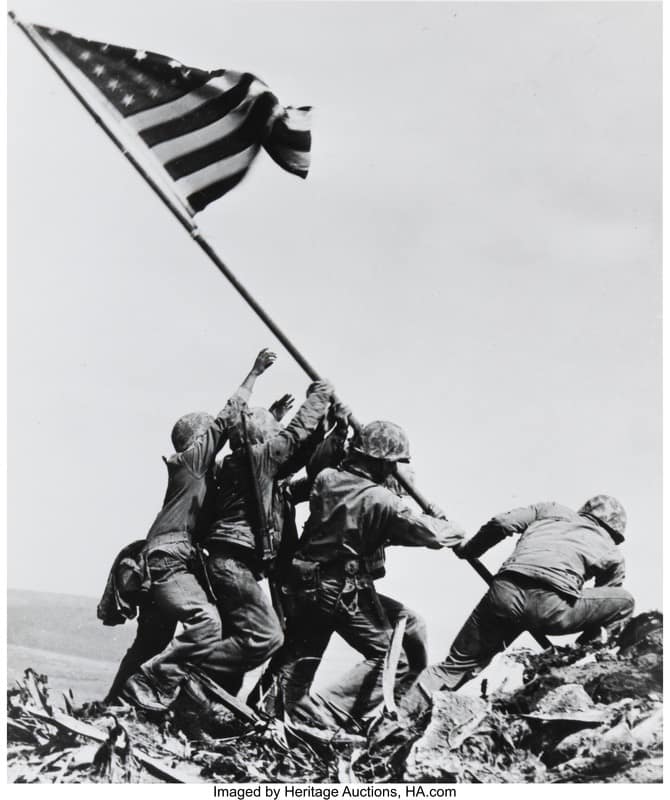
Joe Rosenthal: Raising the Flag on Iwo Jima
Few photographs have travelled so far from the battlefield into the symbolic life of a nation as Joe Rosenthal’s Raising the Flag on Iwo Jima.
Made in 1945 for the Associated Press, the image shows U.S. Marines raising the American flag atop Mount Suribachi during the Battle of Iwo Jima. The composition is almost impossibly perfect: men leaning into the same diagonal, bodies straining together, the flag rising above a blasted volcanic landscape.
It became one of the defining images of the Second World War and an instant emblem of courage, sacrifice and collective effort. Reproduced in newspapers, posters, stamps and monuments, it was later immortalised in the Marine Corps War Memorial in Arlington, Virginia.
But part of its power lies in its paradox. The picture looks staged because history, for once, arranged itself with theatrical precision. It was not a studio construction but a battlefield moment, seized in a fraction of a second by a photographer who understood instinctively when to press the shutter.
The print offered by Heritage is a later gelatin silver print, its image measuring 7-7/8 x 6-1/2 inches on a 10 x 8 inch sheet. Small in physical size, vast in cultural reach.
Advertisement:
Max Desfor: Flight of Refugees Across Wrecked Bridge in Korea 1950
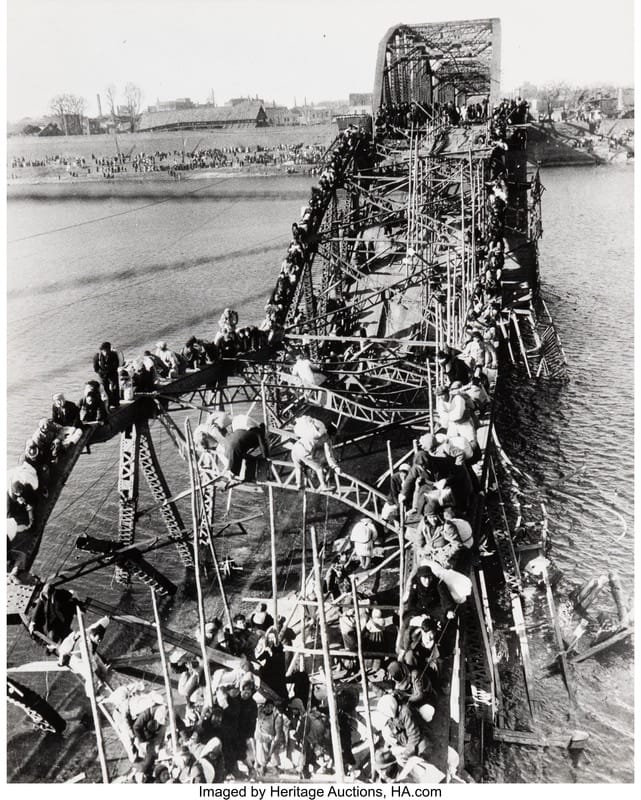
Max Desfor: Flight of Refugees Across Wrecked Bridge in Korea
Max Desfor’s Korean War photograph, Flight of Refugees Across Wrecked Bridge in Korea, is a picture of desperation in motion.
Taken in 1950 for the Associated Press, the image shows civilians crossing the broken remains of a bridge amid the wreckage of war. The bridge is not merely a structure; it is a thin, dangerous thread between terror and survival. The people moving across it are not symbols in the abstract. They are the human cost of geopolitics — families, children, the elderly and the displaced forced to negotiate death one careful step at a time.
Desfor’s photograph won the 1951 Pulitzer Prize in Photography and remains one of the great images of civilian suffering in modern war. It reminds us that military maps are always incomplete. Behind every arrow of advance or retreat are people carrying bundles, holding hands, fleeing homes they may never see again.
The auction print is a gelatin silver photograph measuring 9-1/4 x 7-5/8 inches on a 10 x 8 inch sheet, with a Wide World Photos stamp on the verso.
Advertisement:
Robert H. Jackson: Jack Ruby Shoots Lee Harvey Oswald 1964
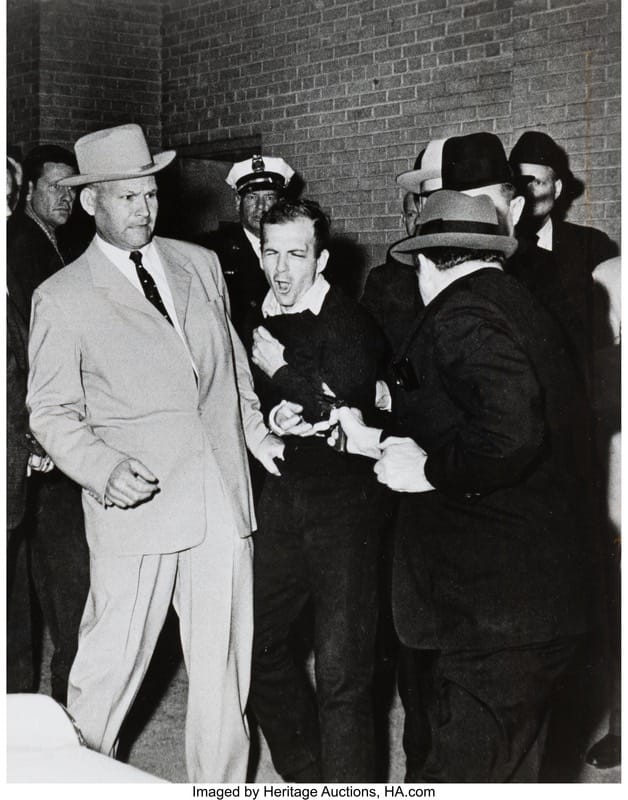
Robert H. Jackson: Jack Ruby Shoots Lee Harvey Oswald
Robert H. Jackson’s photograph of Jack Ruby shooting Lee Harvey Oswald is one of the most astonishing reflex images in the history of news photography.
Taken inside Dallas police headquarters on November 24, 1963, just two days after the assassination of President John F. Kennedy, the photograph captures the exact moment Ruby lunges forward and fires into Oswald’s abdomen. Oswald grimaces. Detectives react. The crowd compresses. History folds in on itself.
The image won the 1964 Pulitzer Prize in Photography and became one of the defining photographs of the 1960s — an image of violence, conspiracy, confusion and institutional failure all contained in a single frame.
Part of its enduring power is that it appears almost too dramatic to be real. It has the composition of a crime film and the force of a public trauma. In one image, America saw not only the accused assassin of a president being killed in custody, but the collapse of any tidy narrative about justice, truth and closure.
The Heritage auction includes a later gelatin silver print, 8-3/4 x 6-7/8 inches on a 10 x 8 inch sheet. Make your bid here.
Advertisement:
Eddie Adams: Street Execution of a Viet Cong Prisoner, Saigon 1969
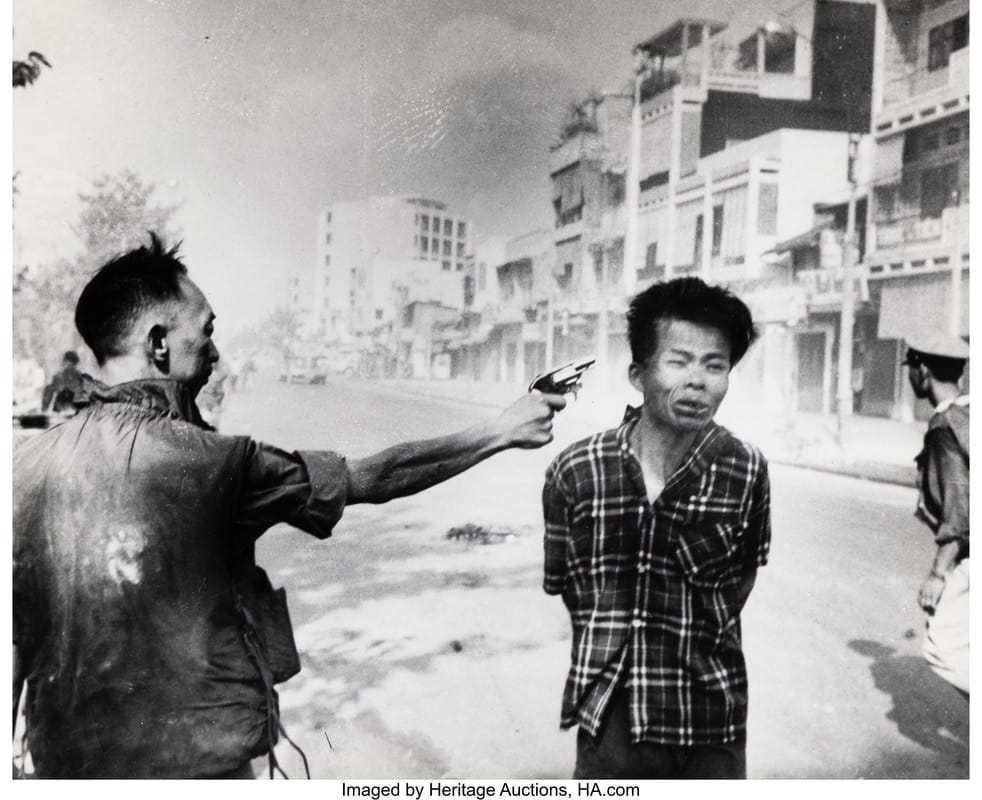
Eddie Adams: Street Execution of a Viet Cong Prisoner, Saigon
Eddie Adams’ Street Execution of a Viet Cong Prisoner, Saigon is one of the most confronting photographs ever published.
Made in 1968 for the Associated Press during the Vietnam War, the image shows South Vietnamese police chief General Nguyễn Ngọc Loan executing prisoner Nguyễn Văn Lém in a Saigon street. Adams caught the instant of death: the pistol extended, the prisoner’s face contorted, the bystanders suspended in shock.
The photograph won the 1969 Pulitzer Prize in Photography and became one of the most influential images of the Vietnam era. For many viewers, it stripped away the abstractions of war — policy, containment, communism, strategy — and replaced them with a single human being at the moment his life was taken.
Adams later wrestled with the consequences of the image and the way it simplified a complicated war into one unforgettable frame. That, too, is part of the photograph’s importance. Great photojournalism can reveal truth, but it can also become a burden: for the subject, for the photographer, and for public memory.
The print in the auction is a later ferrotyped gelatin silver print, 7-1/2 x 9-1/4 inches on an 8 x 10 inch sheet, with a Wide World Photos stamp on the verso.
Advertisement:
John Filo: A God-Awful Scream 1971
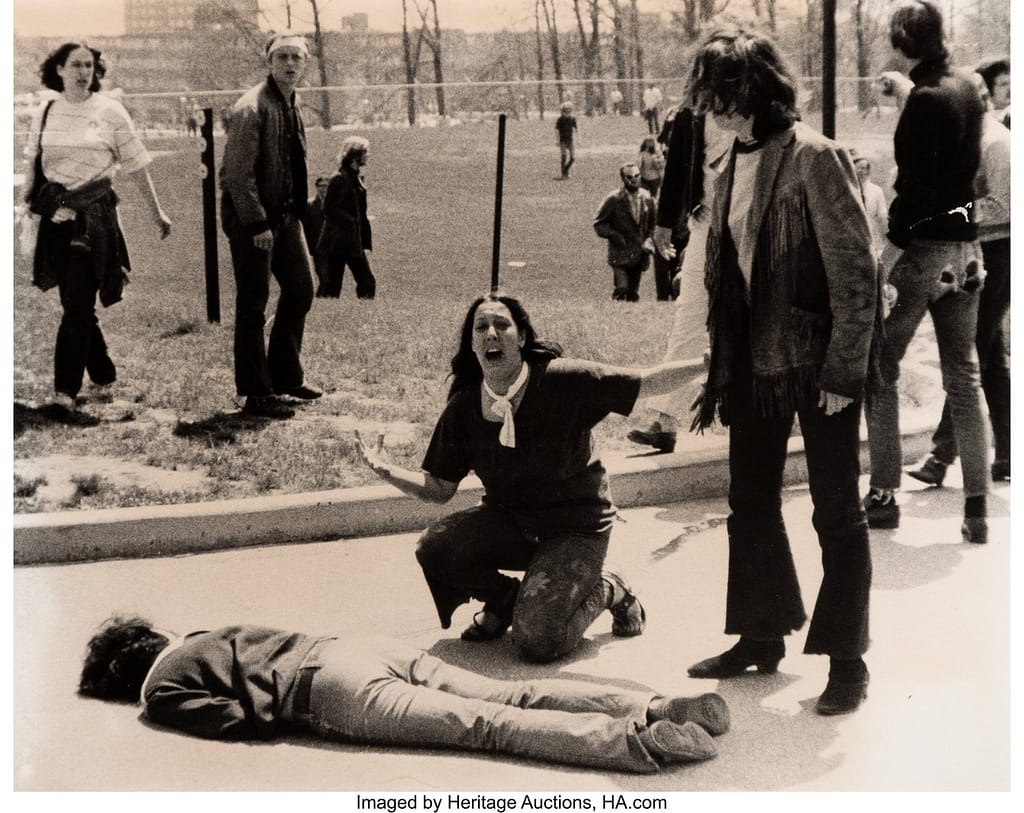
John Filo: A God-Awful Scream
John Filo’s A God-Awful Scream is the photograph by which many people remember Kent State. Taken on May 4, 1970, after members of the Ohio National Guard opened fire on students protesting the Vietnam War, the photograph shows 14-year-old Mary Ann Vecchio crying out over the body of Jeffrey Miller, one of four students killed that day.
The picture won the 1971 Pulitzer Prize in Photography. It became an emblem of generational fracture, state violence, protest and grief. There is no battlefield here, no foreign war zone. The horror is domestic. A university campus has become a scene of death.
The image’s force comes from the rawness of Vecchio’s gesture. Her arms are thrown out, her face opened in anguish, her body forming a human exclamation mark. Around her, others seem stunned, unsure how to move in a world that has just changed shape.
Filo’s photograph remains a warning about what happens when political division, militarised authority and public fear collide. It is not only a picture of one death. It is a picture of a country hearing itself scream.
The auction print is a gelatin silver photograph measuring 7-5/8 x 9-1/2 inches on an 8 x 10 inch sheet, credited in ink and bearing the Valley News Dispatch stamp on the verso.
Advertisement:
Nick Ut: The Terror of War
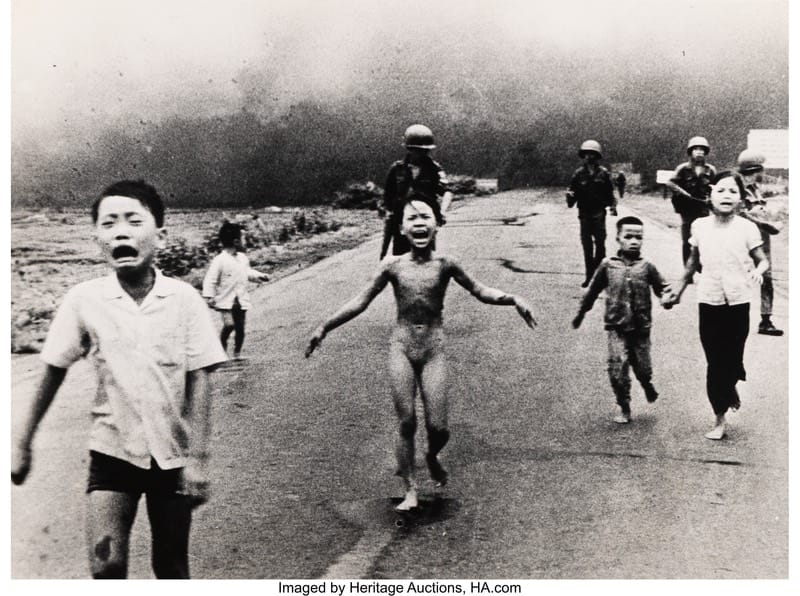
Nick Ut: The Terror of War
Known around the world as the “Napalm Girl” photograph, The Terror of War is among the most famous and devastating images in the history of photojournalism.
The photograph, credited to Associated Press photographer Nick Ut, shows children fleeing a napalm attack near Trảng Bàng in South Vietnam in 1972. At the centre of the frame is nine-year-old Phan Thị Kim Phúc, naked, burned and screaming, running directly toward the camera.
The image won the 1973 Pulitzer Prize in Photography and helped bring the human reality of the Vietnam War into homes around the world. It is almost unbearable to look at, which is precisely why it could not be ignored.
In recent years, however, the photograph has also become the subject of renewed controversy. The documentary The Stringer challenged the long-accepted attribution to Nick Ut, arguing that the image may have been taken by Vietnamese stringer Nguyễn Thành Nghệ. The Associated Press investigated the claim and has continued to credit Ut, while acknowledging the complexity of reconstructing the events more than half a century later. World Press Photo, meanwhile, suspended the attribution while not reassigning authorship.
That dispute should not be treated as a footnote. It raises serious questions about credit, archives, race, local stringers, institutional memory and who gets written into the history of journalism. But the photograph’s moral force remains unchanged: a child is fleeing a firestorm created by adults.
The Heritage auction lists the work as a 1973 Pulitzer Prize-winning photograph by Nick Ut for the Associated Press, a ferrotyped gelatin silver print measuring 7-1/4 x 9-1/2 inches on an 8 x 10 inch sheet.
More Than Collectible Photographs
There is an uneasy grandeur in seeing these photographs enter the auction market. On one hand, they are collectible objects: rare prints, historically significant, connected to one of journalism’s highest honours.
On the other, they are records of suffering, death, resistance and public witness. Their value cannot be measured only by bids, premiums or provenance. That tension is part of the story.
Photojournalism has always lived between public service and private possession. Newspapers publish images for millions, but the prints themselves may later pass into archives, museums or collections. The best of them become part of a civic memory bank. They remind us what happened, what was hidden, what was denied, and what one person with a camera managed to preserve before the moment vanished.
In an age of artificial imagery, synthetic media and algorithmic doubt, these photographs carry renewed urgency. They come from a world of film, chemistry, risk and witness. They are not neutral, because no photograph is. But they are evidence. They tell us where a photographer stood, what the camera saw, and what editors believed the public needed to confront.
Related stories
Reuters and AP Photographers Win 2024 Pulitzer Prizes
Auckland Commonwealth Games 1990, AAP Picture Editor’s Story
Guide to Collecting Vintage Film Cameras
Master of Photography reading list
Photography Appraisals, Auction Agent and Authentication
Wire service photography ripping yarns …
Advertisement: