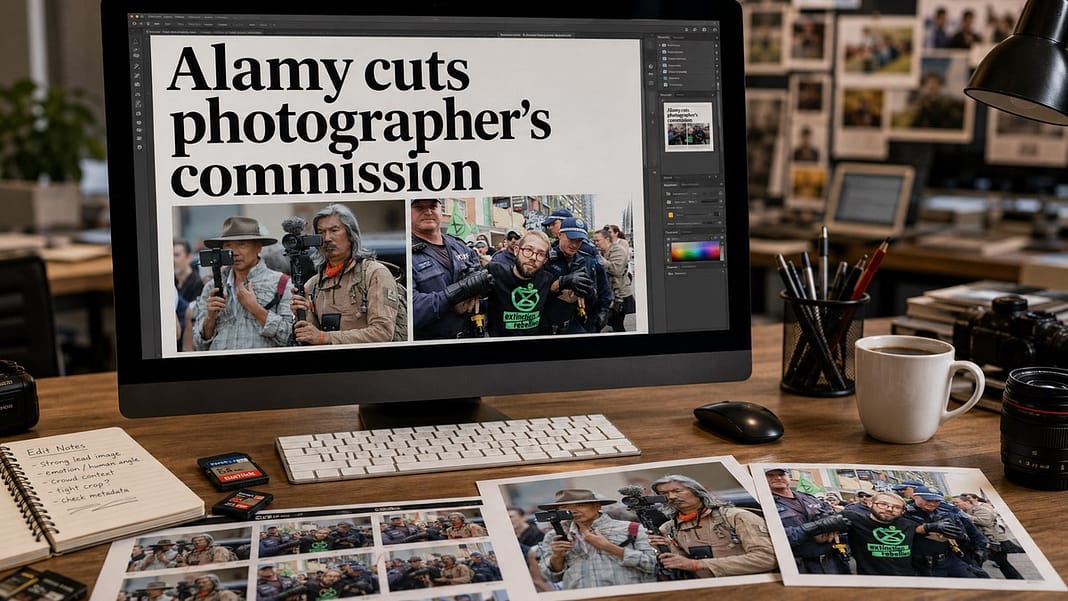
Alamy’s Commission Cut Lands Another Blow on Photographers
For professional photographers, the latest message from Alamy arrived wrapped in the familiar language of corporate optimism—and with no invitation to negotiate.
The stock photography agency called its announcement “Building a Stronger Alamy for the Future”. It spoke of investment, growth, sustainability and a changing marketplace. The new contributor contract, however, was presented as a fait accompli: it will take effect on September 1, 2026.
Then photographers reached the commission table.
From September 1, 2026, Alamy will introduce a new Bronze tier paying contributors just 15 per cent of qualifying sales. More controversially, photographers will need to generate more than US$3,000 in annual gross licence fees to remain on the Gold tier and continue receiving 40 per cent.
Those earning between US$250 and US$3,000 will be placed on Silver and receive only 20 per cent.
For a photographer who currently earns US$2,000 a year in gross Alamy sales, the agency’s share of a direct licence could therefore rise from 60 per cent to 80 per cent. The photographer’s share would be cut in half—not because the photographer produced fewer pictures, submitted poorer work or breached the contract, but because Alamy did not sell enough of those pictures to reach its new threshold.
That distinction lies at the heart of the anger now boiling through the agency’s contributor forum.
Alamy controls the search system, negotiates the prices, grants the licences and determines which photographs buyers see. Yet under the new arrangement, photographers carry much of the penalty when sales decline.
As one contributor put it, photographers are being punished for decisions over which they have little or no control.
Advertisement:
From Gold to Silver Overnight
Alamy’s previous structure placed contributors earning at least US$250 a year on the Gold tier, where they received 40 per cent of direct sales. Those below the threshold were moved to Silver and received 20 per cent.
Under the new structure, US$250 merely lifts a contributor from Bronze to Silver. Gold will require more than US$3,000 in gross annual licence fees, while Platinum—paying up to 50 per cent on eligible exclusive images—will continue to require US$25,000.
The important word is gross.
A photographer must generate more than US$3,000 before Alamy’s commission is deducted. Someone earning 20 per cent at Silver would receive no more than about US$600 from that US$3,000 in direct licences, depending on the types of sales involved.
There are also affiliate fees, distributor commissions, refunds and other deductions that can reduce the photographer’s final return.
Alamy has further increased its monthly payment threshold from US$50 to US$75. Contributors will not be paid until their cleared balance exceeds that figure. For photographers receiving small licences and a 15 or 20 per cent share, reaching the threshold may take months—or considerably longer.
The revised contract also states that contributors are solely responsible for costs and damages arising from complaints or claims relating to their content. That transfer of risk has attracted particular concern among photographers asking whether accepting 15 or 20 per cent of a licence remains worthwhile when they may still carry substantial legal exposure.
One contributor summed up the calculation bluntly: the small amount of income would not be missed, but allowing Alamy to retain 80 per cent while the photographer continued to carry liability was no longer worth the risk.

Building for Whose Future?
Alamy has been wholly owned by Britain’s PA Media Group since February 2020, when the news and information company acquired 100 per cent of the stock agency.
That ownership provides an important backdrop to the latest changes. Contributors are not dealing with the independent Alamy many of them helped build during its first two decades, but with a subsidiary of a much larger media group.
The new contract, which takes effect on September 1, 2026, has been presented to photographers as a completed decision rather than a proposal for consultation. Contributors who generate less than US$3,000 in gross annual licence fees will generally see their share of direct sales fall from 40 per cent to 20 per cent.
In other words: not earning enough? Alamy has devised a guaranteed way for you to earn even less.
The company describes the move as part of “building a stronger Alamy for the future”. Chief executive Lira Mendonça’s announcement speaks the polished dialect of modern corporate restructuring: investment, sustainability, growth, innovation and long-term opportunity.
To many contributors, however, these phrases sound less like a strategy than a cushion placed beneath a falling axe.
The photographers supplied the pictures, paid for the equipment, travelled to the locations, obtained releases, processed the files, wrote the captions and spent untold unpaid hours adding keywords. Their work created the enormous library Alamy now promotes as one of its principal commercial assets.
Many therefore find it particularly offensive to be told that reducing their share is necessary to build the company’s future. They believe their labour has already built it.
The contributor forum quickly became a rolling record of fury, disbelief and resignation. The discussion ran to dozens of pages as photographers calculated their losses, questioned whether it remained worthwhile uploading new work and accused the agency of rewarding loyalty with another reduction in income.
A stock library is an unusual corporate asset. Its value was largely produced by people who were never employees, received no salary and paid their own production costs. The company retains the marketplace, customers and technology; contributors retain copyright but have little influence over prices, search placement or contract terms.
When their commission is halved by decree, photographers are entitled to ask whose future is actually being strengthened.
“Rust”, the Tier Below Bronze
The response on Alamy’s forum has ranged from detailed financial analysis to gallows humour.
One photographer suggested the agency’s next contract might introduce a tier called “Rust”, under which Alamy keeps 100 per cent.
Another mocked the announcement’s reassurance that contributors would continue to own their copyright: how generous, photographers observed, to be permitted to retain ownership of work they created and financed themselves.
Others were less playful. The changes have been described as brutal, rotten, disrespectful and a money grab. Long-standing contributors have said they will stop uploading, remove exclusivity or terminate their accounts.
One photographer, who had contributed for 18 years and uploaded more than 16,000 images, said producing stock involved not only the cost of shooting but the unpaid hours required to edit, caption, keyword and upload photographs—only to see some licences sold for a few dollars.
Another contributor said a change to Alamy’s internal search had already reduced monthly sales by about one-third. After building a collection of 6,800 images and exceeding US$3,000 only once, the photographer concluded that continuing to upload was no longer viable under the proposed commission structure.
Perhaps the most telling comment came from a contributor who recalled gross annual Alamy sales of US$69,000 nearly two decades ago. In July 2026, that photographer reported receiving one distributor sale worth US$17.
That is not merely one person’s disappointing month. It is a miniature history of the stock photography industry.
Advertisement:
Alamy’s Argument
Alamy says the changes are necessary to strengthen the company in a difficult market. Its revised contract will also prohibit contributors from submitting images created using generative AI tools, treating such submissions as a material breach. It has introduced a separate “Access Only” category for public-domain material, press photographs, publicity handouts and similar content.
The agency’s position is not impossible to understand.
Stock libraries face enormous storage and technology costs. They must manage hundreds of millions of files, maintain international sales operations, invest in search tools, police copyright infringements and compete against rival agencies, subscription services, free-image sites and generative AI.
Alamy also operates in a market where the supply of photographs vastly exceeds demand. Digital cameras and smartphones have made image production universal. Contributors can upload thousands of photographs at relatively little direct cost, while buyers expect faster searches and lower prices.
But that abundance is precisely why photographers fear the balance of power has become hopelessly one-sided.
Alamy does not need every individual contributor. If several thousand photographers leave, the agency will still possess an immense library. Photographers, however, may have spent years building portfolios that cannot easily be transferred elsewhere because captions, keywords, releases and sales histories are tied to the platform.
The agency can alter the commercial terms governing millions of existing photographs with 45 days’ notice. A contributor’s practical choices are to accept the new arrangement or remove the work.
That may satisfy the letter of a contract. It does little to preserve trust.
The AI Competition Alamy Cannot Ban
Alamy’s prohibition on contributor-supplied AI images may help protect the integrity of its collection, but it cannot protect photographers from AI-generated competition elsewhere.
Businesses that once purchased a stock photograph of an office worker, tropical beach, futuristic city or happy family can now generate one in seconds. The result may be anatomically dubious, culturally hollow or legally uncertain, but for many low-cost commercial uses it is apparently considered good enough.
A 2026 survey of photographers, agencies and image buyers found that 56.6 per cent of media organisations planned to use AI-generated images or video. Among respondents working in advertising and public relations, 65.2 per cent expected AI to reduce their purchases of archive imagery. In journalism, 40.4 per cent expected fewer photographic assignments and archive acquisitions.
Those figures go directly to the pressure facing Alamy contributors.
The agency may exclude AI-generated submissions from its own library, yet its customers remain free to create synthetic alternatives elsewhere. Photographers are therefore being asked to surrender a larger proportion of earnings at the very moment demand for conventional stock imagery may be shrinking.
Real photography still carries qualities AI cannot reliably manufacture: documentary truth, eyewitness value, recognisable places, identifiable people, historical evidence and the unexpected details of actual life.
But even these strengths depend on buyers being willing to pay for them.
Advertisement:
Publishers Are Closing the Door as Well
Photographers and publishers of their work are also suffering from changes to the way their own websites are discovered.
For years, a photographer, publisher or specialist archive could attract visitors through Google Search. Someone searching for an event, building, celebrity, historical subject or travel destination would be presented with a list of websites. The photographer might gain a reader, a licensing enquiry, an advertising impression or a direct print sale.
Google’s AI Overviews increasingly place a generated summary above those links. The search engine absorbs information from multiple websites, gives the user a ready-made answer and often removes the need to visit the source.
A 2026 field experiment found that when an AI Overview appeared, outbound organic clicks fell by 39.8 per cent and zero-click searches increased by 34.5 per cent. The researchers found no measurable improvement in the perceived quality of the search experience.
Another study estimated that exposure to AI Overviews reduced traffic to relevant English-language Wikipedia pages by about 15 per cent.
This matters to freelance photographers because the modern professional is rarely supported by one income stream. A photographer may receive stock royalties, direct licences, website advertising, print sales, editorial commissions and occasional commercial work.
AI is attacking several of those streams simultaneously.
It can generate substitutes for stock images. It can summarise the websites that display the real photographs. It can reproduce stylistic elements learned from enormous collections of creative work. And it can direct the resulting income towards technology companies rather than the people who produced the original material.
When the Supplier Becomes the Shock Absorber
Alamy’s commission changes cannot be blamed for every problem facing photography. The agency is itself confronting falling prices, aggressive competitors and technological upheaval.
Yet its solution follows a pattern now common throughout the creative economy.
When advertising revenue falls, publishers cut freelance budgets.
When clients demand cheaper licences, agencies reduce contributor royalties.
When platforms need more content, creators are encouraged to upload more.
When the platform needs more revenue, the creator’s share is reduced.
The photographer becomes the industry’s shock absorber—expected to carry the equipment costs, travel expenses, insurance, editing time, legal risks and archival labour while receiving whatever remains after every intermediary has taken its portion.
In earlier decades, a successful stock photograph could produce meaningful repeat income. Today, the same image may be licensed for the price of a cup of coffee, with the photographer receiving only a fraction of that amount.
The new Alamy structure risks accelerating the decline it is intended to manage. Photographers who can still produce distinctive, commercially useful work may send new images elsewhere. Others will stop photographing specifically for stock. Some will leave their existing collections online but cease the constant work of updating them.
A library may retain its quantity while slowly losing its quality, freshness and loyalty.
Advertisement:
The Last Straw in a Camera Bag Full of Bricks
The fury directed at Alamy is not simply about the difference between 40 and 20 per cent. It is accumulated anger. It is anger over collapsing licence fees, opaque distributor sales, subscription pricing and the expectation that photographers should create professional work without professional compensation.
It is anger over AI companies building products from creative material while the creators struggle to pay for cameras, computers and storage. It is anger over Google using publishers’ work to answer questions while sending fewer visitors to the websites that funded and produced that information. And it is anger at being told, once again, that accepting less today will somehow create a stronger future tomorrow.
Alamy may succeed in improving its own margins. It may conclude that most contributors will grumble, absorb the reduction and remain because the alternatives are equally bleak. That calculation may even be correct.
But an agency built from other people’s photographs ultimately depends on more than servers, algorithms and licence agreements. It depends on photographers continuing to believe there is some point in making the next picture.
For many Alamy contributors, that belief is now becoming difficult to bring into focus.
Related stories
Pulitzer Prize Photograph Winners: Images That Made History
Vivian Maier’s Personal Photobook Library Shows Her Influences
Covid anti-vaccine pass sanitaire Paris protest
French wine lovers love Montmartre Grape Harvest Festival
Paris Flower Market, Marché aux Fleurs – Reine Elizabeth II
Parisian Street Art in Support of Ukraine
Dynamic Ticket Pricing Disrupts Live Entertainment Industry
When Pigeon Photographers Flew in War
Advertisement: