The Forest Is Worth More Standing Than Fallen
From the ridges above the Manning Valley, the argument can look brutally simple. Below are the forests of Bulga, Yarratt and the wider Mid North Coast: country that has supplied timber for generations, habitat for countless species, water catchments for local communities, and now — increasingly — part of Australia’s climate ledger. Yet the old economic arithmetic still tends to begin and end with a truckload of logs.
Dr Ken Henry knows that history from both sides. His father worked as a logger, chainsaw in hand, in the same forests now visible from Henry’s home. But as chair of the Australian Climate and Biodiversity Foundation, Henry is arguing that the industry’s future cannot be secured by pretending native forests are merely timber warehouses waiting to be emptied.
The better question, he suggests, is not simply: How much is the wood worth?
It is: What is the forest worth if it remains alive?
That question sits at the heart of a new report commissioned by the Australian Climate and Biodiversity Foundation, Challenges and Opportunities in the Australian Forest and Wood Products Industry. Its central proposition is not that Australia should stop using wood. It is that Australia should finally distinguish between two very different businesses: supplying timber for homes and manufacturing, and treating native forests as living infrastructure for carbon, biodiversity, water, tourism and regional resilience.
Advertisement:
The native-forest industry is already shrinking
The ACBF report argues that native forest logging is not a robust industry being suddenly threatened by environmentalism. It is an industry already in deep structural decline.
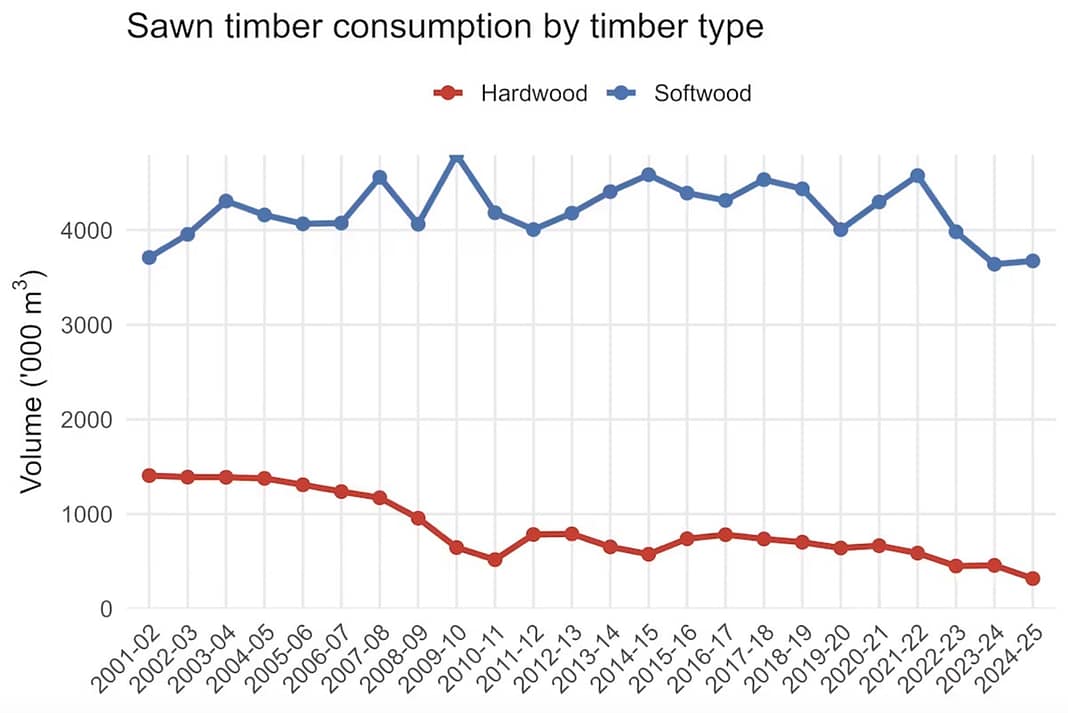
Native hardwood production fell by about 60 per cent between 2004 and 2014. The closure of native forest logging in Victoria and Western Australia from 2024 reduced national volumes further, taking production down roughly 80 per cent from 2004 levels. Meanwhile, Australian wood consumption has barely moved in absolute terms since 2000 and has fallen substantially per person.
The political debate is often framed as though Australia faces a stark choice: preserve forests or run out of timber. The report says that is the wrong fight. Most construction timber already comes from plantation softwood. Softwoods account for about three-quarters of construction use, around 60 per cent of domestic wood consumption and roughly 70 per cent of the sector’s value-added.
Native hardwoods, by contrast, are disproportionately used for lower-value products — woodchips, pulp, fuel and exports — even though a smaller share supplies valuable specialist products such as flooring, veneers and furniture.
In other words, the roof trusses in new Australian homes are not generally dependent on old native forests. They are overwhelmingly a plantation story.
The money is not in the chainsaw
The report’s economic picture is uncomfortable for anyone still imagining logging as the engine room of a prosperous timber economy.
Forestry and wood products contribute about $9 billion in value-added to the Australian economy and employ more than 50,000 people. But most of that value is generated after the trees leave the forest: in sawmills, engineered timber, paper products, furniture, panels, packaging and manufacturing.
Manufacturing accounts for roughly two-thirds of sector value-added. Milling adds another 15 per cent. Logging itself has relatively thin margins, estimated at about 3 per cent, compared with around 10 to 13 per cent in milling and manufacturing.
That does not make the workers in native forestry disposable. Quite the opposite. It makes the case for transition planning stronger.
Jobs tied to logging and primary processing are geographically concentrated. A mill closure or the loss of harvesting contracts can hit a small town far harder than a national spreadsheet suggests. The people most exposed are not abstract “industry participants”; they are contractors, truck drivers, machine operators, mill workers, families and communities built around the expectation that the next coupe would always be there.
A serious transition cannot simply hang a “forest closed” sign at the gate and congratulate itself.
Not All Environmentalists Agree
Louise Morris, a campaiugner at The Australia Institute doesn’t agree with Ken Henry, as she explains in this video. “The NSW and federal governments have delayed the creation of the Great Koala National Park, so that it can generate carbon credits. Carbon credits that fossil fuel companies will use to greenwash their emissions.”
The NSW and federal governments have delayed the creation of the Great Koala National Park, so that it can generate carbon credits. Carbon credits that fossil fuel companies will use to greenwash their emissions. #auspol @louisemorris.bsky.social
— The Australia Institute (@australiainstitute.org.au) 28 July 2026 at 11:36
[image or embed]
A new economy for living forests
Henry’s broader proposition is that native forests should be paid for the services they provide while standing.
Forests store carbon. They regulate water. They help protect soils and catchments. They provide habitat and wildlife corridors. They support recreation, tourism and cultural values. They also offer a buffer against the climate extremes already reshaping regional Australia.
The report notes that early attempts to measure forest “ecosystem services” have found that timber and firewood account for only a small share of total forest value. In comparable natural-capital assessments, the overwhelming value comes from recreation, carbon storage, water regulation, air quality, soils and other non-timber benefits.
That is where carbon credits and biodiversity markets enter the story. The idea is not simply to hand money to forest owners for doing nothing. It is to create a credible, independently verified system in which landholders, communities and forest managers can earn income for protecting and restoring native forests, improving habitat, reducing degradation risks and storing carbon that would otherwise be released or never accumulated.
Such markets must be designed carefully. Carbon accounting has to be real, additional and durable. Biodiversity credits cannot become decorative green stickers attached to business-as-usual destruction elsewhere. Fire risk, drought, permanence, leakage and Indigenous rights all matter. But the principle is difficult to dismiss: if society benefits from a standing forest, society should help pay for it.
At present, the market rewards the physical removal of timber far more reliably than it rewards the preservation of carbon, habitat and water. Henry’s argument is that this is not merely environmentally irrational; it is economically outdated.
Advertisement:
Plantations must do the heavy lifting
The report does not pretend a transition away from native forest logging can happen without investment in plantations.
Australia will continue to need timber. Housing demand remains substantial, and construction timber supply faces short-term pressure in several scenarios. New plantations planted today will not solve the immediate shortage of structural timber; trees are not a next-quarter delivery service. The report warns that supply, mill capacity, transport distances and housing demand have to be planned together.
That means expanding the right plantations in the right places, with sufficient processing capacity nearby. It means supporting local sawmills and engineered-wood manufacturing rather than merely exporting low-value fibre. It means protecting agricultural land and water systems from poorly designed plantation expansion. And it means avoiding a future in which Australia stops logging native forests only to import more timber from countries with weaker environmental protections.
The report says plantation investment has been sluggish, especially in hardwoods, because returns often look unattractive. Carbon-credit revenues and public investment could change that calculation, making new plantations more viable while helping support long-term timber supply.
The real task is not to replace every native-forest log with another log. It is to redesign the supply chain around better timber, better processing, smarter building design and more value from every cubic metre harvested.
Advertisement:
A transition, not a culture war
Forestry debates in Australia have become ritualised: green activists on one ridge, angry loggers on the other, each convinced the other side wants to erase their world.
Henry’s background complicates that caricature. The son of a logger is not arguing that forest workers do not matter. He is arguing that their future should not depend on an industry with declining volumes, low margins and a growing conflict with Australia’s climate and biodiversity commitments.
A credible transition would include income support, retraining, regional investment, assistance for small mills, support for high-value hardwood manufacturing where genuinely viable, expanded plantation forestry, Indigenous-led forest stewardship, ecological restoration crews, fire-management work, tourism and cultural enterprises.
The report specifically stresses that any phase-out of remaining native forest logging must protect the economic and social wellbeing of affected workers, businesses and communities. That is the difference between transition and abandonment. A transition says: the old model is fading, so let us build something durable before the last contracts vanish. Abandonment says: good luck with that.
The choice ahead
Australia’s native forests have long been valued as raw material. In the age of climate change, that is no longer enough. The living forest is not an economic void awaiting a chainsaw. It is a carbon store, a water system, a habitat bank, a tourism asset, a cultural landscape and, potentially, a source of long-term regional income.
The question is whether governments can build the policies, markets and regional institutions needed to recognise that value before the remaining native-forest industry simply collapses under its own declining economics.
From the ridges above the Manning Valley, the future may not look like a choice between timber and trees. It may look like a choice between clinging to an exhausted model — or paying forests, communities and workers properly for what comes next.
Dr Ken Henry’s Press Club Address
In July 2026, Dr Ken Henry addressed the National Press Club, calling for urgent reform of Australia’s faltering national environment laws. He argued that stronger standards and more effective protections are vital to reaching net zero and strengthening the economy against future shocks.
Related stories
Minns responds to Dr Henry’s Biodiversity Conservation review
Independent’s Forest Pledge to End Native Forest Logging
Transitioning Timber Workers to Sustainable Plantations
Midcoast Council tells Forestry: Save Bulga & Kirrawak Forests
The End of VicForests Begins New Era of Logging
Another $450,000 Fine: Is Forestry Corp NSW Still Fit for Purpose?
Australia’s elusive Quolls headed for extinction
Mistake State Forest: A Battle for Preservation
EPA Secures $34,000 Penalty Over Logging in Riparian Buffer Zone
A New EPA, Old Fears: Australia’s Environment Laws Get a Makeover
NSW Is Paying Millions to Log Forests That No Longer Exist
NSW Celebrates the Great Koala National Park (Mostly)
Forestry Corp 29 charges: Public Wants to End Native Logging
Using Sustainable Timbers in Furniture and Renovations
Rethinking Carbon Emissions in Australia’s Native Forests
NSW Forestry Corp Losses Double, Compliance Issues Mount
Loggers take a chainsaw to Great Koala National Park idea
Advertisement: