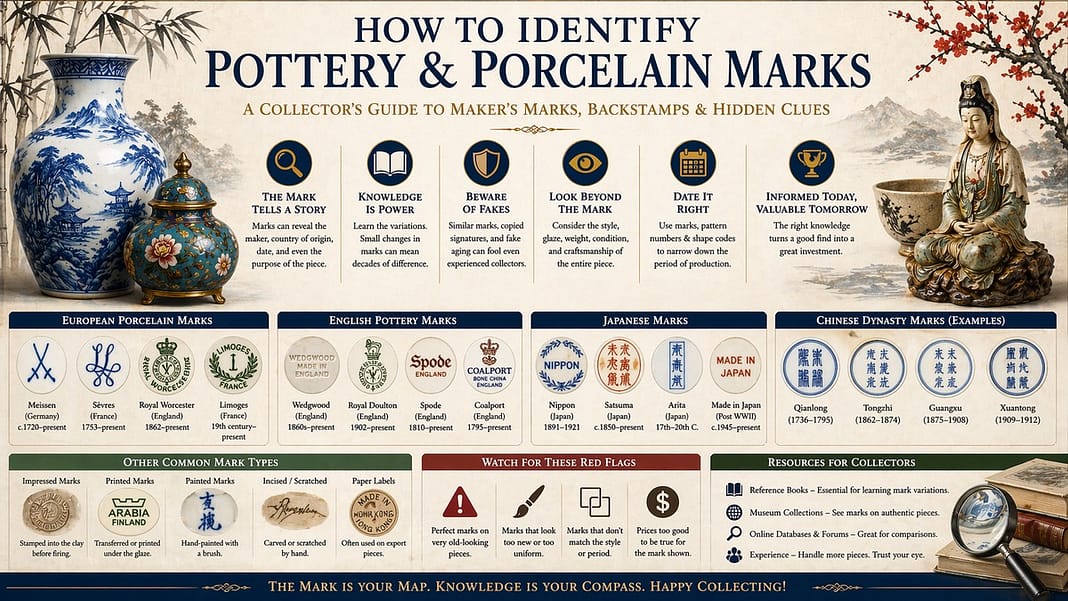
A Collector’s Guide to Maker’s Marks, Backstamps & Hidden Clues
If ceramics are the story, the mark is the signature—and sometimes the confession. Turn over almost any piece of pottery or porcelain and you’ll find a mark: stamped, painted, impressed, or occasionally scratched in as an afterthought. These marks are the closest thing collectors get to a paper trail. They can reveal the maker, the country of origin, the date, and—if you’re lucky—the difference between a $20 find and something worth locking in a cabinet.
The problem? Marks lie. Or at least, they mislead. The marks stamped or printed on the underside of a piece of pottery can be a trap for the unwary but will usually yield some useful information about where and when it was made.
The practice of identifying the maker of a pot by marking the base dates back to at least Roman times, but the first modern factory mark appeared in 16th century Europe. The crossed swords painted on Meissen porcelain from 1723 helped to spread the practice. In France, porcelain makers were required by law to register a mark from 1766 on, but in other countries marks had no official status.
Advertisement:
As a result, while the top makers usually, but not always, identified their pieces, others either left their wares unmarked, in the hope that they would be mistaken for something better, or shamelessly put on copies, or near relations, of famous marks.
The crossed swords of Meissen, interlaced L’s of Sevres and crescent of Worcester were all widely copied in the 18th century and beyond.
The firm of Samson of Paris reproduced a great deal of classic 18th-century porcelain in the second half of the 19th century, complete with versions of the appropriate marks. The gold anchor of later Chelsea porcelain is more often seen on Samson reproductions than on originals.
From the early 19th century on, factory marks were increasingly applied to all forms of pottery. There was a practical reason for this. The century saw a shift away from fairs and travelling peddlers towards retail stores as a means of selling; retailers used the information in the factory mark to re-order popular items.
As a result, printed marks of the period, particularly on useful wares, often contain the name of the pattern and shape as well as that of the maker.
What Is a Maker’s Mark?
A maker’s mark (also called a backstamp) is a symbol, name, or series of numbers applied by a manufacturer or artisan.
There are several ways of applying a mark. They can be incised, or cut freehand into the soft clay before firing; impressed into the soft clay with a special stamp or seal; painted at the time of decoration (this type includes stencilled marks); or printed.
More unusually, you will find a mark raised in relief; in almost every case, the piece will have been moulded and the mark cut into the mould.
There are a few exceptions, where a piece of shaped clay was added to the base before firing, but such marks were much too easy to fake; the rare raised anchor mark of Chelsea porcelain appears more often on fakes than the genuine article.
It might appear:
- Stamped into the clay before firing
- Printed or painted under the glaze
- Added later as an overglaze mark
Some are crisp and obvious. Others are faint, partial, or worn down by a century of washing-up.
Incised and painted marks are characteristic of small scale production. Incised marks are usually those of a modeller, so are usually seen on one-off pieces. They can be recognized by their free-hand look and sometimes sharp, but always raised edges. Impressed marks can be recognized by their regularity and smooth outlines.
The First Rule — The Mark Is Only the Beginning
Here’s the trap beginners fall into: they treat the mark as proof. It isn’t. The best collectors don’t just read marks—they read objects.
A mark should always be read alongside:
- The style and shape of the piece
- The glaze and colour
- The weight and feel
- Signs of age and wear
- A perfect mark on the wrong object is often a red flag, not a victory.
Advertisement:
Factory Marks — The Signatures That Built Empires
These are the marks most collectors chase—the official signatures of major makers.
Meissen
Founded in 1710 in Saxony, Germany, Meissen was Europe’s first true porcelain factory, cracking the closely guarded Chinese formula under royal patronage. It became famous for finely painted tableware and highly detailed figurines that set the standard for European ceramics. Its crossed swords mark—introduced in the early 18th century—is one of the most copied and forged marks in ceramics, making authentication critical for collectors.
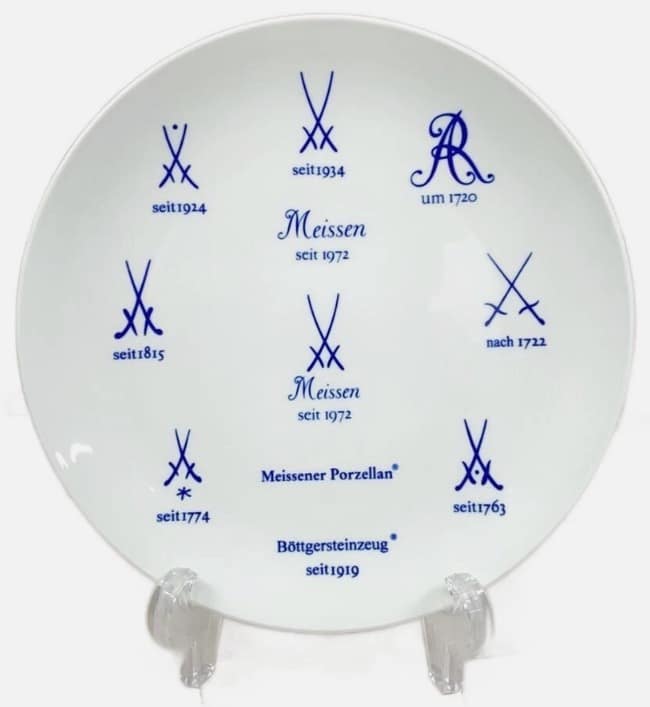
Meissen — crossed swords, one of the most copied marks in ceramics.
Sèvres
Established in 1740 and later moved to Sèvres near Paris under royal patronage, Sèvres became the leading porcelain factory of France, producing luxurious wares for the court of Louis XV and beyond. Renowned for richly coloured grounds, gilding, and finely painted decoration, Sèvres pieces were as much about prestige as craftsmanship. Its interlaced L’s mark—often enclosing date letters—remains one of the most recognisable identifiers in ceramics, and a key tool for accurately dating pieces.
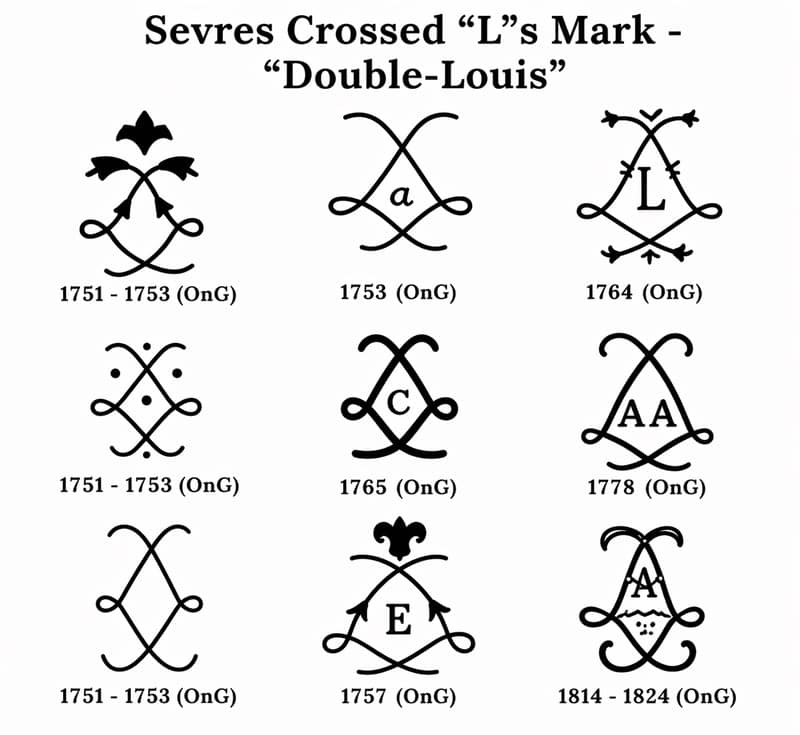
Sèvres — interlaced L’s, often paired with date letters.
Wedgwood
Founded in 1759 by Josiah Wedgwood in Staffordshire, Wedgwood became one of the most influential names in ceramics, producing everything from creamware and jasperware to fine bone china. Its marks evolved from simple impressed stamps in the clay to more elaborate printed backstamps, often including “England” (from the late 19th century) and later “Made in England.” These subtle changes in wording, layout, and technique are crucial for dating pieces accurately and distinguishing early wares from later production.
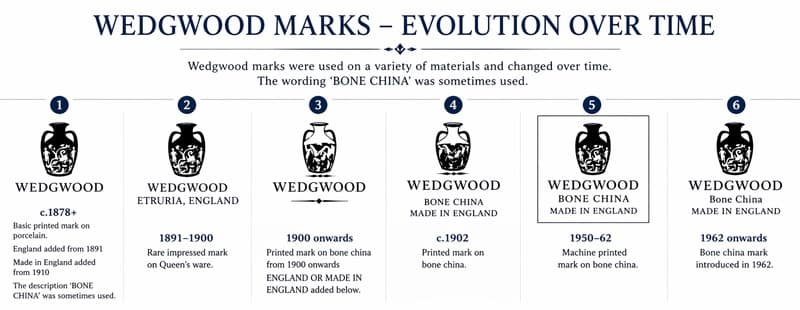
Wedgwood — impressed or printed marks that evolved over time
Royal Worcester
Founded in 1751 in Worcester, England, Royal Worcester became one of Britain’s most respected porcelain makers, known for fine tableware, hand-painted decoration, and richly gilded pieces. Its crown and circle marks—often incorporating a central symbol with surrounding text—evolved over time, with variations used to indicate production periods and, in some cases, specific years. For collectors, these subtle changes in the mark are key to dating pieces accurately and assessing both quality and rarity.
Royal Worcester’s standard mark centres on the number “51,” referencing its founding in 1751, and typically includes additional symbols or codes to indicate the year of manufacture. Early dating can be tricky, but from the late 19th century a system of letters, dots, and symbols was introduced—later combined with “Royal Worcester England” and then “Made in England”—allowing pieces to be dated quite precisely.
Over time, these codes became increasingly complex, evolving from letters (1860s–1880s) to dot systems, star marks, geometric shapes, and eventually letter-and-number combinations into the late 20th century. By the 1960s, date coding was used less consistently, and later marks often included lithographer numbers and design references, meaning collectors must interpret both the mark and the object itself to determine age accurately.
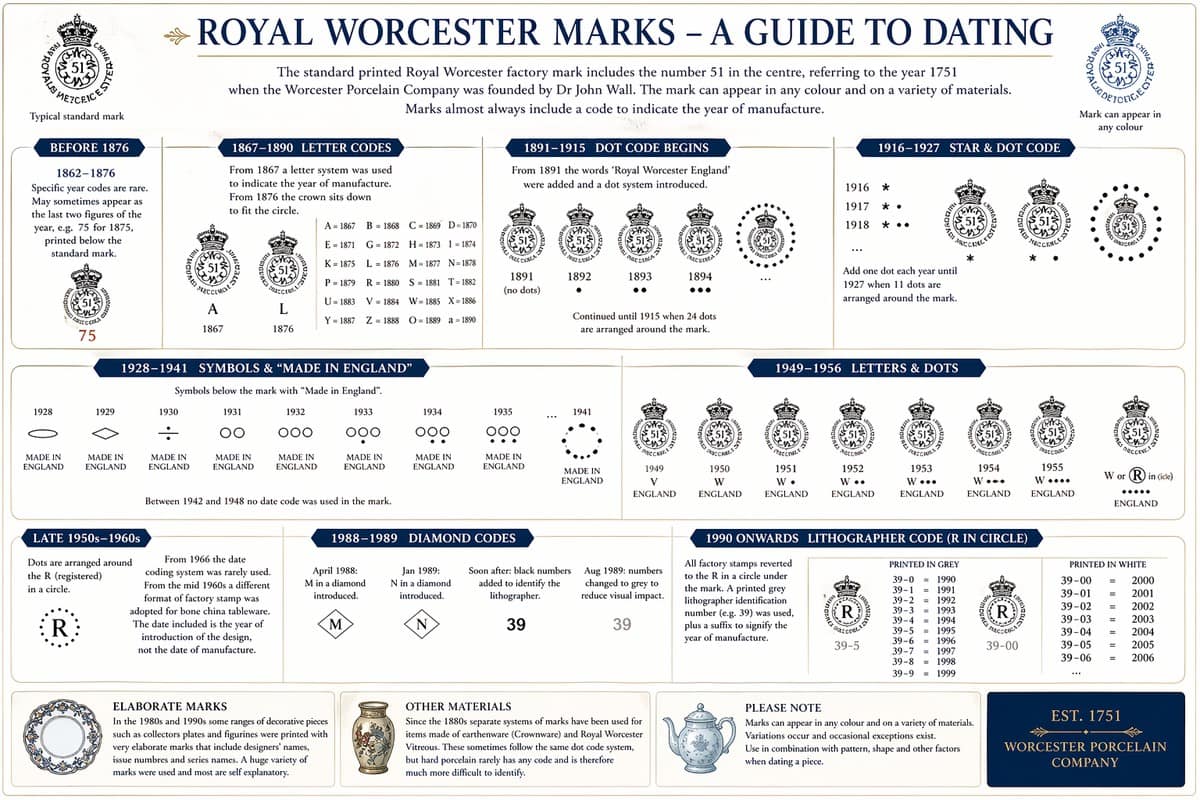
Royal Worcester — crown and circle marks indicating quality and period
Small variations in these marks can date a piece within decades—sometimes years. For a real-world example of provenance tied to marks:
👉 V&A acquires Wedgwood tea & coffee set from Karl Lagerfeld
Advertisement:
Country of Origin Marks — Dating in Plain Sight
Sometimes the most useful marks are the simplest.
- “Made in England” — typically post-1891 export ware
- “Germany” vs“West Germany” — helps pinpoint pre- and post-war production
- “Nippon” — Japanese exports from roughly 1891–1921
These marks were often required for international trade—meaning they follow historical timelines surprisingly well.
For deeper context on Japanese dating systems:
👉 Japanese Pottery: Satsuma & Japanese Era Names (Nengo)
Pattern Numbers & Shape Codes — The Collector’s Shortcut
These are the quiet achievers of identification.
Manufacturers often included Pattern numbers (design identification) and/or Shape numbers (form of the object)
Match these with catalogues and you can often date a piece more precisely than by the maker’s mark alone.
Advertisement:
Workmen’s, Artist & Decorator Marks — The Human Touch
Painted marks are usually applied by a decorator. They appear on studio pottery and also on factory-made pieces.
On the latter they usually take the form of workmen’s or tally marks, initials or cyphers that were put on by decorators to make sure they would be paid for every piece they worked on. These were often seen on early Worcester porcelain, for example.
Marks in gilt are almost always tally marks put on by gilders.
Marks could be painted or printed over or under the glaze. Those painted or printed in underglaze blue are usually genuine, at least in the sense that they were put there when the piece was made. Marks over the glaze in enamel colours are easily faked; always treat them with caution.
Dates in marks can often be misleading. Some factories date marked their pieces as a matter of course, but usually with some sort of code. Any four-figure date that appears, particularly on a printed mark, will almost certainly be the year the company was founded.
One base mark that can be particularly useful in dating a piece is the Registered Design or Patent Office mark, introduced in 1843 when manufacturers were permitted to ‘patent’ new shapes and patterns for a three-year period.
Between 1842 and 1883 the mark took the form of a diamond containing code letters and numbers giving the day the design was registered and its place in that day’s list.
Impressed or moulded diamond marks usually refer to the shape of the piece; printed ones to its decoration.
The day and list number are in figures, while the year and month are in code letters. The year letter was at the top of the diamond for the first 26 years, and was switched to the right corner in 1868, when the day of the month appeared at the top.
In both runs, the sequence of letters was X, H, C, A, I, F, U, S, V, P, D, Y, J, E, L, K, B, M, Z, R, 0, G, N, W, Q, T.
The coded date is the earliest the piece could have been made. It could, of course, have been made at any time after, but in practice, Registered Design marks were seldom added after the three-year period.
Registered Design marks are found on other materials than pottery. The circle on top of the diamond contains Roman numerals that identify the type of object and are known as class numbers. All ceramic pieces are IV.
In 1884, a simplified system was introduced which still applies today. Each new design was given a number in a single sequence, starting at 1. This number can give you the year of registration.
As a rough guide, 100,000 was reached in 1888, 250,000 in 1895 and 500,000 in 1907. After this, things slowed down somewhat, and a million was not reached until 1981.
Not all marks belong to factories. Hand-finished pieces may include:
- Painter’s initials
- Studio signatures
- Edition numbers
These can significantly increase value—but only if they’re authentic.
Advertisement:
The Traps — Where Collectors Get Burned
Wedgwood vs Enoch Wedgwood. Same surname, different company. Entirely different market value. One built a global brand. The other benefits from mistaken identity.
Reproductions & Forged Marks
Roseville Pottery is widely reproduced. Meissen marks are frequently copied. Artificial ageing is common. If the mark suggests rarity but the price doesn’t—trust the price.
How to Read a Mark Properly
Look at the Whole Piece First. Before flipping it over, ask: Does this feel right? If it doesn’t, the mark won’t rescue it.
Check the Quality of the Mark
- Crisp and clear — often earlier or well-preserved
- Blurred or uneven — later production or reproduction
- Suspiciously perfect — sometimes a warning sign
Learn the Variations
Even major makers changed their marks over time. Wedgwood alone used multiple fonts, layouts, and country marks. Those small changes are where the real dating happens.
Using Modern Tools (Without Fooling Yourself). Technology can help—but it won’t replace knowledge. 👉 Google Lens Can Help Determine the Worth of Old Collectibles Think of it as a second opinion, not a verdict.
Beyond Pottery — Marks Across Collectibles
The same identification logic applies across categories:
👉 Why Collect Asian Art? What to collect
👉 Are Collectible Japanese Netsuke valuable?
👉 Collecting Old European & Chinese Snuff Bottles
Once you start noticing marks, you’ll see them everywhere.
Final Thought — Train Your Eye
Marks matter. But instinct matters more. The best collectors don’t just read marks—they read objects. And when those two things agree, you’re usually onto something good.
Bagdade, Warman’s English & Continental Pottery & Porcelain.
Advertisement: