Brassaï: The photographer they called “The Eye of Paris”
For young photographers looking for inspiration, Brassaï shows how much a camera could do with curiosity, patience and a thoroughly unfashionable bedtime. He made night photography a major artistic language, helped turn the photobook into an immersive experience, and gave lovers, workers and people living outside respectable society a place in photography’s enduring history. His pictures suggest a useful starting point for anyone learning the craft: become interested in the world before becoming obsessed with the equipment.
Brassaï: Secret Paris at Heide Museum of Modern Art in Melbourne, Australia until 15 November 2026, brings together more than 150 original vintage prints, taking visitors into the streets, studios and nocturnal haunts of the French capital in the 1930s. There are atmospheric black-and-white views, intimate encounters and famous faces, all seen through the eyes of a photographer whose curiosity rarely respected closing time.
All photographs on this page are © Estate Brassaï Succession — Philippe Ribeyrolles, used with permission to promote the exhibition and to inspire the current generation of photographers.
Advertisement:
Brassaï: The Photographer
Born Gyula Halász in 1899, in Brassó, Transylvania—then part of Hungary within Austria-Hungary, now Brașov in Romania—he settled in Paris in 1924. His adopted name, Brassaï, meant “from Brassó”. The man who would help define Paris for generations of viewers arrived as an outsider, with an artist’s training and a journalist’s need to earn a living. His breakthrough book, Paris de nuit (Paris by Night, 1933), would establish his reputation; writer Henry Miller would call him the “eye of Paris”.
Brassaï’s Autoportrait, Boulevard Blanqui, Paris
In Autoportrait, Boulevard Blanqui, Paris (Self-portrait, Boulevard Blanqui, Paris, 1931–32), Brassaï presents himself ready for the night shift, standing behind a Voigtländer Bergheil folding plate camera. This was his principal camera during his early Paris years, producing detailed negatives on 6.5 × 9 cm glass plates, exposed individually.

A tripod supported the long exposures that helped turn dim streets and drifting fog into photographic theatre. He carried a box of 24 glass plates, while dark interiors could require magnesium flash powder. This was photography involving preparation, cooperation and the occasional highly conspicuous burst of light. Disappearing into the background was not always an option.
From the mid-1930s, he also used a Rolleiflex, producing square 6 × 6 cm negatives on roll film—a more portable companion for his explorations.
“After twenty years you can begin to be sure of what camera will do.” – Brassaï
Advertisement:
Brassaï: Education and Influences
Brassaï trained as a painter and sculptor in Budapest (Hungarian Academy of Fine Arts, now known as the Hungarian University of Fine Arts) and in Berlin (Berlin-Charlottenburg Academy of Fine Arts) before taking photography seriously around the age of 30.
In Berlin, Brassaï encountered prominent Bauhaus artists Wassily Kandinsky and László Moholy-Nagy, together with Oskar Kokoschka and the other artists gathered around Der Sturm—“The Storm”—the influential magazine and gallery founded by Herwarth Walden. This was one of the great meeting places of the European avant-garde, where Expressionism, Cubism and other radical approaches challenged the established rules of art. His contact with this restless circle placed him close to modernism’s experiments well before he began transforming Parisian nights into photographs.
In a 1970 interview with Tony Ray-Jones, he named Georges de La Tour, whose candlelit paintings suggested how concealed light sources could reveal forms within darkness. That is a useful connection when looking at Brassaï’s streetlamps, illuminated windows and figures emerging from shadow.
“Perhaps I was influenced a little in Paris by Night by the painter Georges de la Tour with his candlelight paintings which gave me an idea of what things can produce at night, the hidden things and concealed lights.” – Brassaï
Photography became his serious occupation around 1929–30, encouraged by his fellow Hungarian André Kertész. By then, he had spent years getting acquainted with the city. He knew something about its habits before asking it to pose. This was an excellent preparation. Paris had plenty of people prepared to admire it. Brassaï was prepared to stay up with it.
“André Kertész has two qualities that are essential for a great photographer: an insatiable curiosity about the world, about people, and about life, and a precise sense of form.” – Brassaï
Later, Picasso and the Surrealist circle helped stimulate his experiments across photography, drawing and sculpture. He contributed to Minotaure and shared Surrealism’s appetite for the uncanny, while maintaining his independence from the movement.
“I think education and intelligence is important, but not art. Not artistic education, because when you take a photograph you may be very influenced by what you have seen in paintings and this happened to me often.” – Brassaï
Advertisement:
Brassaï – Behind closed doors: cafés, clubs and brothels
His Paris could be romantic, lonely, theatrical or distinctly disreputable. Sometimes it managed the lot before sunrise. In cafés, clubs and brothels, he found people whose lives rarely appeared in polite family albums—and gave them the centre of the frame.
Lovers in a Small Café, Paris / Couple d’amoureux dans un petit café parisien, Place d’Italie, Paris
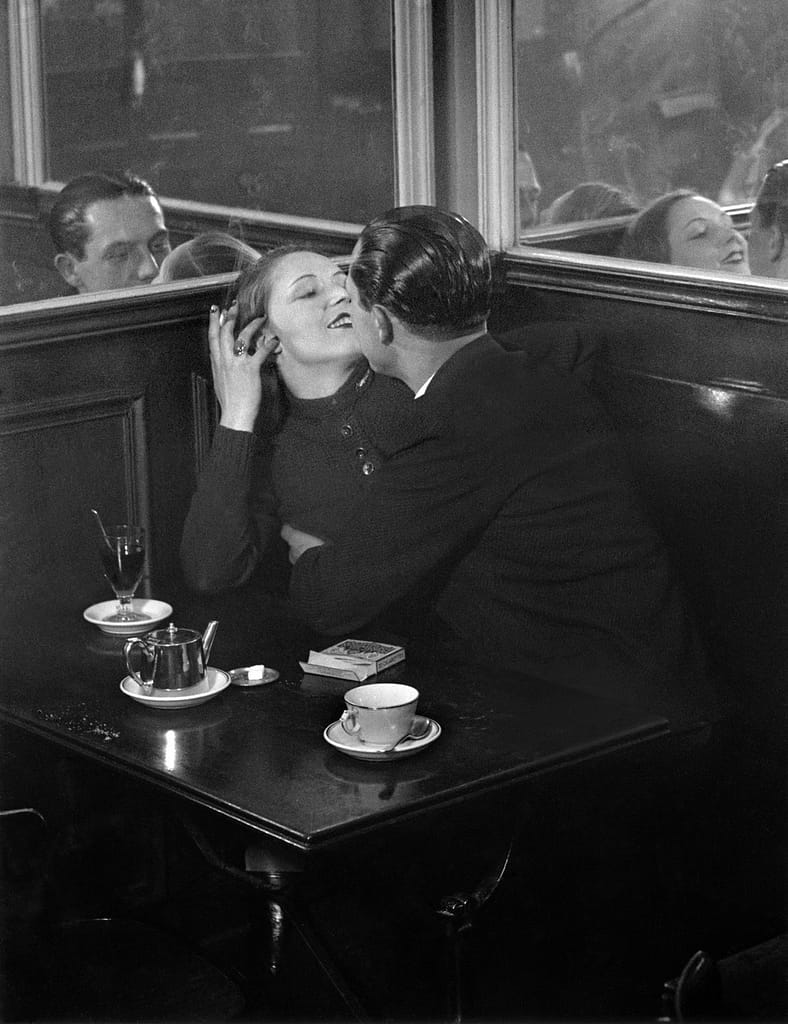
Look at Lovers in a Small Café, made around 1932. The couple’s intimacy seems effortless, while mirrors make the composition wonderfully intricate. Yet the Metropolitan Museum of Art identifies it as a staged photograph. Brassaï arranged many scenes that viewers might assume he had simply stumbled upon.
“I need the subject to be as conscious as possible that he is taking part in an event … in an artistic act. I need his active collaboration.” – Brassaï
For photographers, there is a rich lesson here about the relationship between spontaneity and collaboration. A subject’s awareness of the camera can become part of a picture’s energy. Brassaï could build a scene and still convey something recognisable about desire, awkwardness, performance or companionship.
“In any case, I always took people by surprise, for they never knew at what exact moment I was going to take the shot… In addition, given the kind of equipment available at that time, I often needed artificial light: so I would have someone to help me who would be holding a magnesium flare. As a result, no one knew when I was going to press the shutter.” – Brassaï
Advertisement:
Washing up in a brothel, rue Quincampoix, c.1932
Toilette dans une maison de passe, rue Quincampoix (Washing up in a brothel, rue Quincampoix, c.1932) brings us behind closed doors, shifting attention from spectacle to the practical business of bodies and personal care. The photograph broadens his account of nightlife to include its unglamorous everyday details.
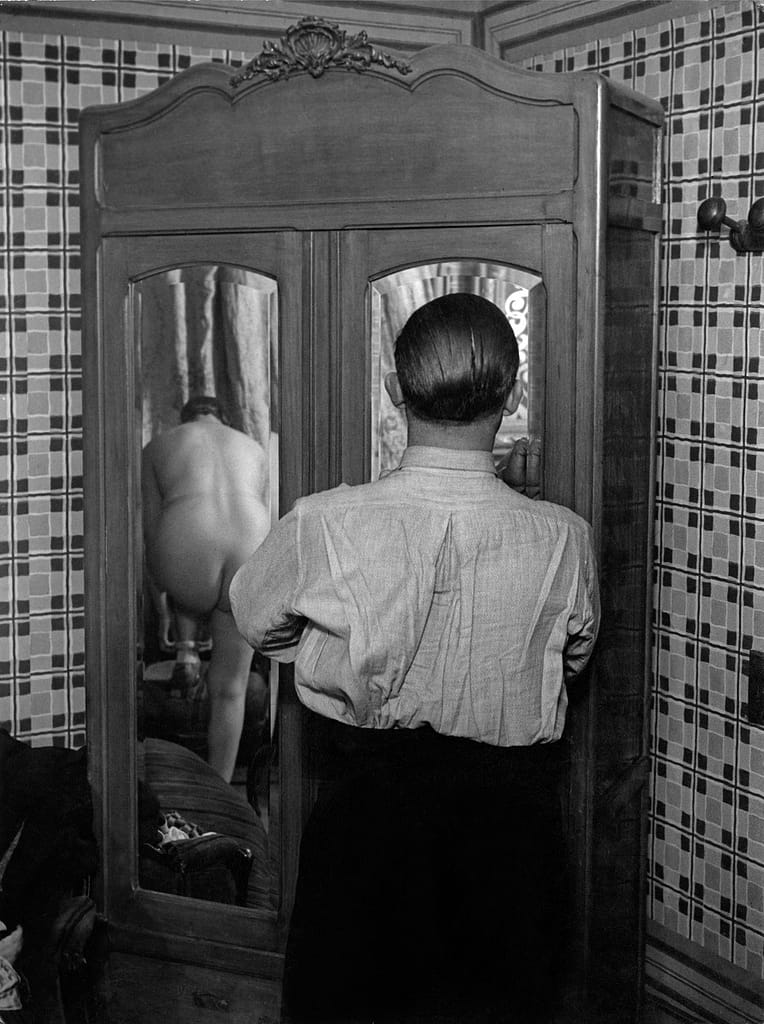
His brothel photographs formed part of the wider nocturnal world gathered in The Secret Paris of the 30s (1976). That later book brought together bars, sexual subcultures and private encounters that complicated the postcard version of the city.
“I’ve always felt that the formal structure of a photo, its composition, was just as important as the subject itself… You have to eliminate every superfluous element, you have to guide your own gaze with an iron will.” – Brassaï
Some scenes were carefully arranged. In Introductions at Suzy’s, the encounter between the clothed customer and the women was constructed for the camera. As with the café lovers, collaboration helped Brassaï convey the social theatre of the place.
Au Monocle, avec Lulu de Montparnasse, c. 1932
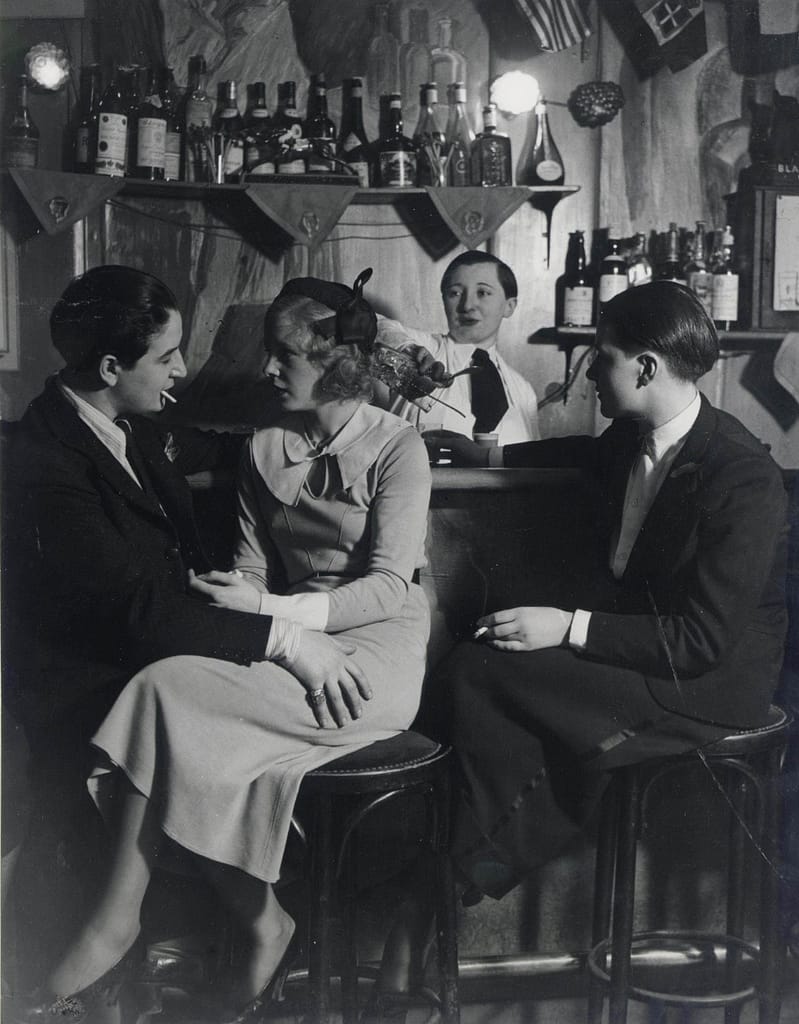
Le Monocle was a lesbian bar owned by Lucienne Franchi, also known as Lulu de Montparnasse, on the rue Edgar Quinet, Montparnasse. The acclaimed writer Colette described women in Montparnasse as “often affecting a monocle and a white carnation in the buttonhole”. A monocle was something of a lesbian “uniform” in the Roaring Twenties, much like keys or a carabiner clipped to a belt loop is today. Le Monocle closed during the Nazi occupation of Paris during WWII. The clothes and poses in these portraits are part of their subject, revealing how the club’s patrons presented themselves and occupied their own social world.
Brassaï – La Môme Bijou au Bar de la Lune, Montmartre
The extravagant La Môme Bijou, with her jewellery and finery, made a remarkable photographic presence. Alongside the portraits at Le Monocle, her picture preserves styles of dress, gestures and ways of occupying public space that written history can struggle to recover.
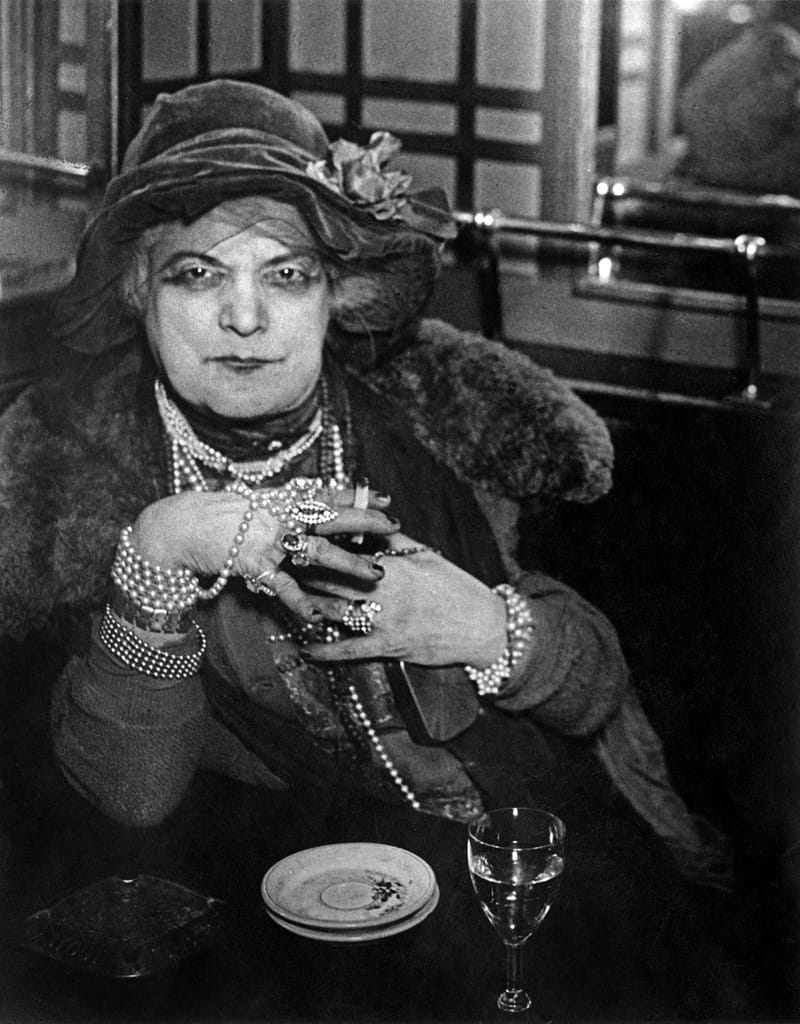
There is pleasure in them, but their interest extends beyond picturesque nightlife. They show people making lives and identities within a city that offered both freedom and exclusion. A sympathetic photograph cannot explain every social circumstance. It can, however, make someone difficult to dismiss.
“Chance is always there. We all use it. The difference is a poor photographer meets chance one out of a hundred times and a good photographer meets chance all the time.” – Brassaï
Advertisement:
Brassaï – Conversations with Picasso
The same curiosity took Brassaï into Paris’s artistic and literary circles. His friendships and working relationships extended well beyond photographing famous faces: he moved through rooms where modern art was being made. His relationship with Picasso became especially important: he photographed the artist and his sculpture, and later published Conversations with Picasso.
He would recall these relationships in The Artists of My Life (1982). They gave him more than an impressive address book. An artist’s studio contains evidence: unfinished work, tools, objects, clutter, the physical arrangements of a thinking life. Brassaï’s portraits help bring formidable cultural names back into the human world.
Brassaï’s photograph: Picasso au Café de Flore avec Sabartès 1939

Picasso at the Café de Flore with Sabartès
In Picasso au Café de Flore avec Sabartès (Picasso at the Café de Flore with Sabartés, 1939), Brassaï captures the artist in the company of Jaume Sabartés, his trusted friend, business secretary and administrator. Sabartés helped manage the practical demands surrounding Picasso’s prodigious output, providing a steady presence in an extraordinary life. The café setting brings the celebrated painter into an everyday social world, revealing the companionship behind the public reputation.
“Some people say one must work only with available light and that one should never light the subject. I don’t agree. If it is necessary, I light the subject.” – Brassaï
Henry Miller was another close associate and champion. The nickname he gave Brassaï suited a photographer who recognised Paris in both its grand personalities and its least advertised corners.
Brassaï – Salvador Dali 1932
Brassaï also photographed and spent time with artists including Salvador Dalí, Henri Matisse, Georges Braque, Pierre Bonnard, Alberto Giacometti and Germaine Richier.

Brassaï Salvador Dali 1932
“As a photographer, I never restricted myself to a particular subject. I photographed whatever happened to catch my attention: faces, street scenes, landscapes, or any one of the thousands of chance events of everyday life. Art and artists were a part of my own day-to-day life in Paris.” – Brassaï
For a photographer, these portraits offer a reminder that access grows from relationships. Knowing something of a person’s work and daily life gives the encounter a purpose beyond collecting a famous face.
Advertisement:
Le Bal de la Horde au Bullier, Montparnasse
The artistic life of Paris spilled beyond studios and cafés. At its balls, costume and performance became subjects in their own right.

Brassaï’s Le Bal de la Horde au Bullier, Montparnasse (The Horde’s Ball at Bullier, Montparnasse, c.1932) captures the bohemian revelry of an artists’ benefit ball at the celebrated Parisian dance hall. Here, his fascination with the theatre of nightlife finds an enthusiastic cast: artists and partygoers turning a night out into a performance of its own.
Brassaï Pré Catelan, Bal des Têtes, Marie-Laure de Noailles et Léonor Fini 1946
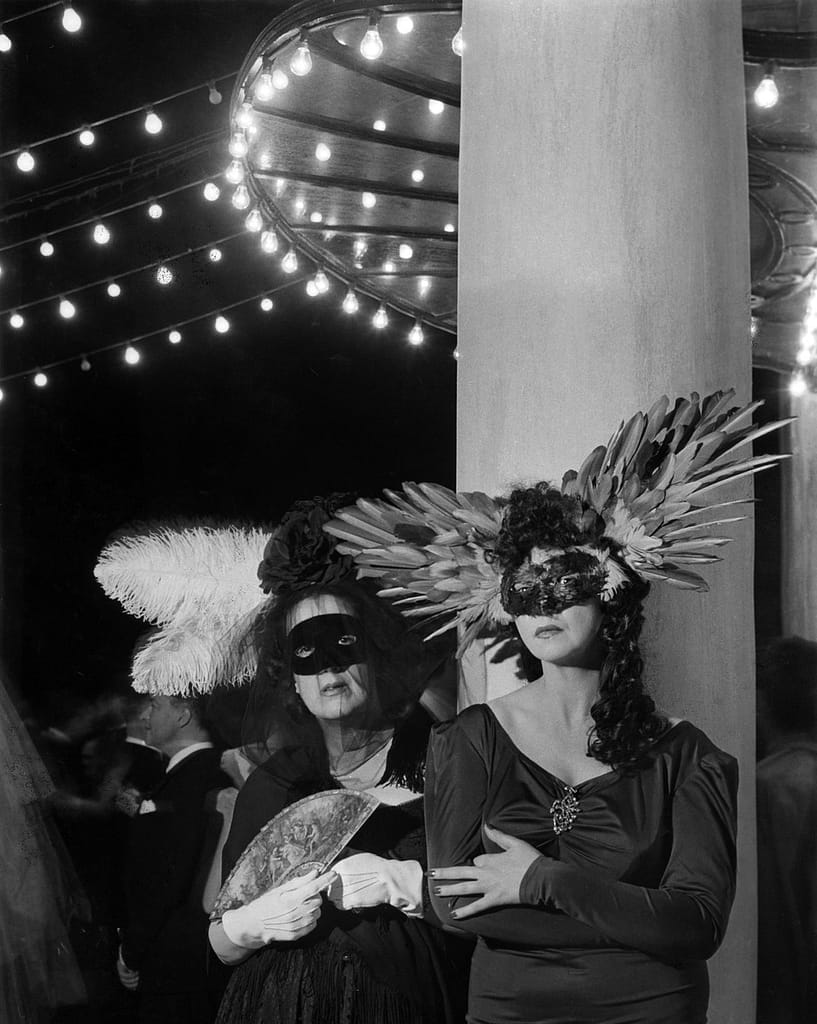
Fourteen years later, Brassaï’s Pré Catelan, Bal des Têtes, Marie-Laure de Noailles et Léonor Fini (1946)—translated as Pré Catelan, Masquerade Ball, Marie-Laure de Noailles and Leonor Fini—captures the art patron and the artist in elaborate disguise at a Parisian society ball. Bal des Têtes literally means “Ball of Heads”, an appropriately theatrical name for an occasion celebrating extravagant masks and headdresses.
Brassaï Pré Catelan Bal des Têtes Marie Laure de Noailles et Léonor Fini 1946
Here, Brassaï’s fascination with people playing out their fantasies finds a glittering setting: postwar Paris dressing up and rediscovering its appetite for spectacle.
Advertisement:
Paris after dark: Brassaï’s landscape photographs
Outside the crowded rooms, Paris offered another kind of theatre. Wet pavements caught the streetlamps, stairways disappeared into darkness, and a café window offered a small square of warmth. Brassaï photographed bridges, trees, fog and deserted streets with the same attention he brought to faces.
Although he also photographed by day, his celebrated nocturnal explorations took him through Paris after dark and into the early hours. Rain and fog offered possibilities: reflections extended the light, while mist softened distance and gave streetlamps a luminous halo.
La Colonne Morris dans le Brouillard / The Morris Column in the Fog
In photographs such as La Colonne Morris dans le Brouillard, an advertising column becomes a mysterious presence in the mist. The familiar street begins to look half remembered; an everyday piece of street furniture acquires the presence of a monument.

Brassaï understood that weather could transform the subject itself. That is one reason his work remains instructive. A location does not have one appearance. It has hundreds, depending on the hour, weather, light and human activity. Brassaï built a photographic world by returning to those possibilities.
“Night only suggests things, it doesn’t fully reveal them. Night unnerves us and surprises us with its strangeness; it frees powers within us which we were controlled by reason during the day.” – Brassaï
Brassaï – Escalier de la Butte Montmartre
Brassaï Escalier de la Butte Montmartre
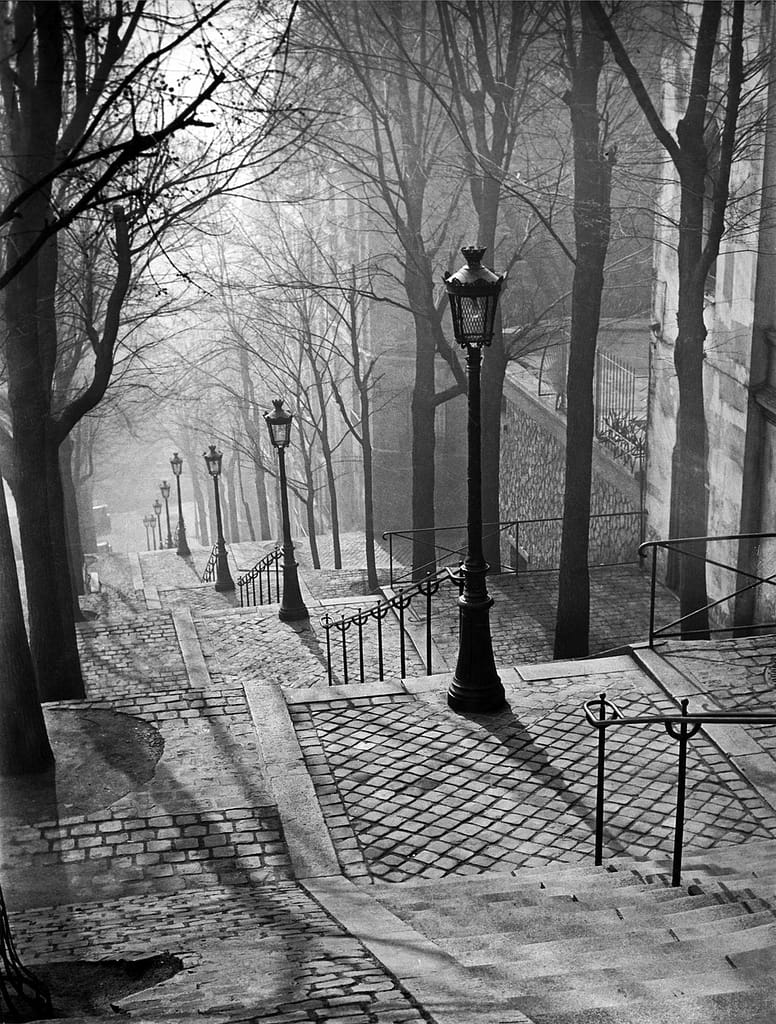
In Escalier de la Butte Montmartre (Steps of Montmartre), the descending staircase draws the eye into the picture, its railings and repeated steps creating depth and rhythm. Such carefully chosen viewpoints, combined with strong contrasts between illumination and shadow, give his urban landscapes an almost theatrical atmosphere—as though Paris were a stage, waiting for someone to enter.
Brassaï – Les Champs Elysées c.1937
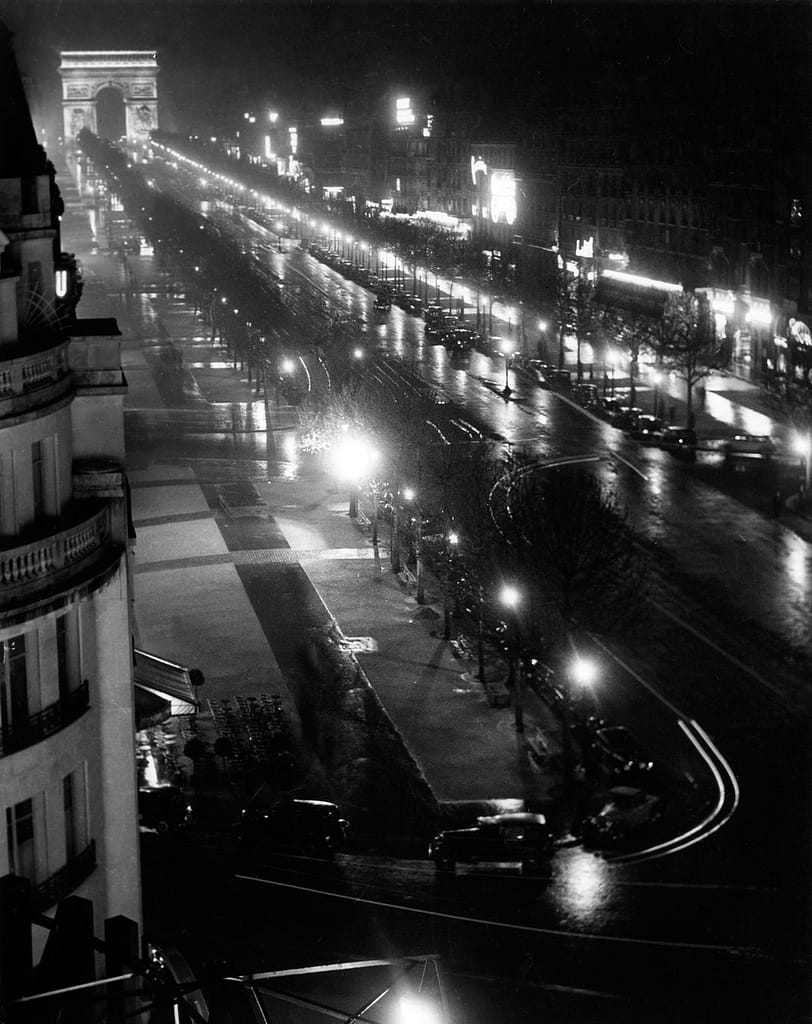
Les Champs Elysées (The Champs-Élysées, c.1937) extends this attention to the city’s spaces and geometry. Seen alongside the Montmartre steps, it invites photographers to consider how viewpoint organises a scene: where the eye enters, what carries it into the distance, and how light separates one plane from another.
Brassaï Les Champs Elysées c1937
Paris de nuit: a city between covers
His breakthrough book, Paris de nuit / Paris by Night, appeared in 1932–33; museums commonly catalogue it as 1933. Its deep blacks and luminous streets offered readers a journey through a city transformed by darkness. The book’s power came partly from the cumulative experience: each photograph encouraged the reader to enter the next.
A single atmospheric picture can be a lucky encounter. A book asks whether a photographer can sustain a way of seeing. Brassaï could.
Brassaï’s graffiti: art on the walls
Then there were the walls. Beginning in the early 1930s, he photographed graffiti: scratched faces, crude figures and anonymous marks cut into the city’s surfaces. Where a passer-by might see damage, Brassaï found visual invention. His photographs gave these fragile, unofficial images a new life. MoMA exhibited his graffiti photographs in 1956.
Brassaï – Graffiti — “Le Roi Soleil”, de la série IX Images primitives
In Le Roi Soleil (The Sun King), Brassaï transforms an anonymous carving on a Parisian wall into a commanding portrait. Deep holes become staring eyes, while gouged lines radiate like an extravagant crown. His close framing and the light catching the scarred surface give this improvised street creation the presence of an ancient mask.
This was a substantial expansion of photographic attention. Art could be encountered outside the studio and gallery; its maker might be unknown; its materials might be a wall and something sharp.
“I only make lasting images, not fashionable pictures.” – Brassaï

Brassaï Graffiti Le Roi Soleil de la série IX Images primitives
What Brassaï offers today’s photographers
His importance lies in that breadth. He helped establish nocturnal urban life as a serious photographic subject. He brought formal discipline to scenes that might otherwise have been treated as scandal, anecdote or visual clutter. And he showed how pictures could work together to create a sustained, personal account of a place.
He also complicates the familiar idea that street photography depends entirely on speed. Some of his strongest work grew from slowness: choosing a position, studying the light, making an arrangement, waiting. The resulting photographs feel alive because his attention was alive.
Nor was photography his only language. He drew, sculpted and wrote, retaining the wider curiosity of an artist throughout his career. Paris remained central to his identity long after the intense early years that produced his best-known night pictures. He died in southern France in 1984, aged 84, and was buried in Montparnasse Cemetery.
“Photography in our time leaves us with a grave responsibility. While we are playing in our studios with broken flowerpots, oranges, nude studies and still lifes, one day we know that we will be brought to account: life is passing before our eyes without our ever having seen a thing.” – Brassaï
For a young photographer, the most useful response to Brassaï is to explore somewhere familiar with fresh attention. Notice who appears when the shops close. Watch what rain does to an ordinary street. Ask what a room reveals about its occupant. Give a subject enough time to become more than a visual novelty.
Paris supplied Brassaï with magnificent material. His achievement was learning how to see it. The City of Light had an exceptionally good night shift.
Brassaï – A Lesson on Composition
“I think that there are photographers who compose very well but who have no understanding of life or human things. There are others who have much human understanding but no feeling for form. I feel that it is important to have both because one must convey a living thing with strong composition.
Form can be many things in photography.
Photography has nothing to do with painting, but even so there is a frame in which the photograph must be composed. Photography has one leg in painting and one leg in life but the two things must be combined.
I like well composed pictures: I don’t like disorder in a photograph.
Photography in the beginning began by imitating painting and then there was a revolution in different countries. Stieglitz in the United States and Emerson in England, and Atget in France. They all tried to do something different, they didn’t want photography to be taken for painting but wanted something especially for photography.” – Brassaï
Related stories
Let’s Look at Diane Keaton Photographer
Pulitzer Prize Photograph Winners: Images That Made History
Marilyn Monroe’s Final Photo Session by Bert Stern for Vogue
Bruce Davidson’s Circus Photos: Early Career Breakthrough
Vivian Maier’s Personal Photobook Library Shows Her Influences
What Can We Learn From Photographer, Susan Meiselas?
Photographer Robert Frank’s Revelations into The Americans
Sebastião Salgado lens on Humanity’s Struggle and Resilience
Lessons in photography by Josef Koudelka
Andre Kertesz, a pioneer of street & fine art photography
Dorothea Lange’s Pioneering Approach to Portraiture
Advertisement: