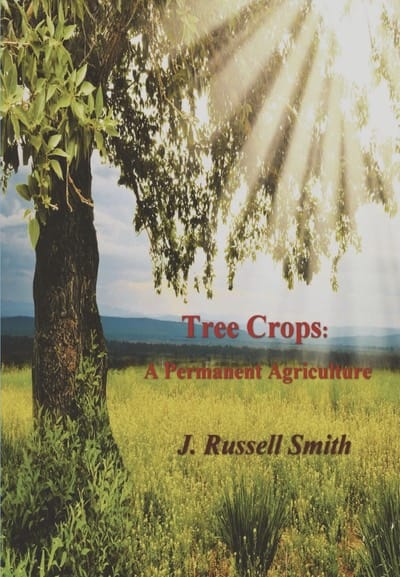
Tree Crops: A Permanent Agriculture by J. Russell Smith, Sc.D.. Introduction — by Wendell Berry
A Practical Visionary – by Wendell Berry
I first read J. Russell Smith’s Tree Crops perhaps fifteen years ago, and since then I have returned to it many times. Having just paid it another visit, I am pleased to say that I still like it as much as I ever did, and am just as much convinced by it.
This book contributed to a fundamental rethinking of agriculture in our century. It is a predecessor of Sir Albert Howard’s The Soil and Health, Wes Jackson’s New Roots for Agriculture, and Masanobu Fukuoka’s The One-Straw Revolution in its perception that in order for humans to know how to use the land of a particular locality, they must look to see how nature uses it. Agriculture, he wrote, must be “adapted … to physical conditions”; he insisted “that farming should fit the land.”
Smith begins his thinking with a fact that agricultural industrialists have made a convention of ignoring: that most land is vulnerable to erosion, and much land, especially hilly land, is extremely so. The normal condition of farming is not that of the deepest, flattest soils of the American grain belt. Much of agriculture, the world over, must take place on land that is not safely adaptable, or is not adaptable at all, to industrial assumptions and procedures.
It is remarkable that in most times, but never so much as in modern times, agricultural methods have presupposed optimum conditions. The result, as J. Russell Smith saw, was a catastrophic impropriety: “Man has carried to the hills the agriculture of the flat plain.” The catastrophe was, and is, soil erosion. The cycle of hill agriculture has thus too often been a one-time cycle: “Forest-field-plow-desert.”
What, then, are we to do with the enormous acreage of potentially usable and perhaps much-needed land that is too steep for the plow? The practices and plans of the agricultural industrialists apparently offer us only two choices: to abandon it entirely, or to continue to treat it as a minable resource until it has been completely ruined.
There is, of course, a good argument for abandonment — not all land should be used — but it is a limited argument because, for good economic and political reasons, we cannot afford to abandon all but the very best agricultural land. The argument for ruination, though it is never made, is implied in attitudes and methods, economies and technologies.
The counter-argument is a simple one: we have no right to ruin land, and we cannot afford to ruin it. We are stuck, therefore, with two daunting agricultural obligations: to use vulnerable land, and to preserve it.
The best solution to this dilemma that I know about is in Smith’s fundamental perception that “Trees are the natural crop plants for all such places.” Smith understood that the annuals, as agricultural plants, have a great fault in that they leave the soil exposed to erosion for much of the year. The steeper the land, the worse it is served by annuals.
Trees, on the other hand, are perennials; they “are a permanent institution.” For that reason, Smith said, “the crop-yielding tree offers the best medium for extending agriculture to the hills, to steep places, to rocky places, and to the lands where rainfall is deficient.”
He espoused, furthermore, the attractive idea of a “two-story agriculture” for the flatter lands, an agriculture consisting of “trees above and annual crops below.” This idea is attractive because it would diversify both the agricultural and. the natural life of the arable farmlands; it would make them more productive, more healthy, and more beautiful. It proposes a countryside as far as possible unlike the monocultural deserts that we have made in the prime lands of the present day.
But Smith’s mind was mainly on the hill lands, and the agriculture he proposed for them was “two-story” as well: trees above and pasture below, both stories here being perennial. He had a vision of what our hill lands should be. I would like to quote him at length on this, for it is a vision at once practical and lovely:
I see a million hills green with crop-yielding trees and a million neat farm homes snuggled in the hills. These beautiful tree farms hold the hills from Boston to Austin, from Atlanta to Des Moines. The hills of my vision have farming that fits them and replaces the poor pasture, the gullies, and the abandoned lands that characterize today so large a part of these hills.
These ideal farms have their level and gently sloping land protected by mangum terraces and are intensively cultivated — rich in yields of alfalfa, corn, clover, legumes, wheat, and garden produce. This plow land is the valley bottoms, level hill tops, the gentle slopes, and flattened terraces on the hillsides. The unplowed lands are partly shaded by cropping trees — mulberries, persimmons, honey locust, grafted black walnut, grafted heart nut, grafted hickory, grafted oak, and other harvest-yielding trees. There is better grass beneath these trees than covers the hills today.
The trees would produce food both for people and for foraging animals, protecting the slopes while increasing their yield.
Toward the realization of this vision, Smith contributed the incontrovertible argument “that farming should fit the land,” an agenda of work to be done, and a host of examples of successful tree-cropping systems from all over the world.
(One of the pleasures of this book is in its abundance of such information. It is a book to rummage in.)
Smith’s vision is inherently and necessarily a democratic one. What he is proposing is not simple; he would protect the hills and make them more productive, not by the mechanical and chemical simplifications that are associated with industrial agriculture, but by complicating the biological pattern of human use. For this, great care, knowledge, and skill would be needed.
The good agricultural solution thus presupposes the need for democratic land-ownership, not the plutocracy always implied in the economic and technological determinism of the industrialists. As Smith saw it, “the presence of the landowner is also needed. This is not a job for tenants. Let the tenant go down to the level land which carelessness cannot ruin so quickly.”
To describe this book, even so minimally as I have done here, is to reveal the reasons why its influence, so far, has been small. The minds that have dominated agriculture since 1929 when Tree Crops was first published, have been little interested in conserving either the land or the people on the land. They have, Heaven knows, seen no visions of “a million neat farm homes snuggled in the hills.”
A farming system in which millions of small landowners would manage devotedly and skillfully a diversified, locally-adapted system of tree crops, pastures, animals, and row crops has been simply unthinkable to them.
Tree Crops nonetheless sets forth a thinkable possibility. It is a book full of common sense, and of great love for a kind of knowledge and a kind of life, addressed forthrightly “to persons of imagination who love trees and love their country.”
In its last pages, it pleads for “a new patriotism,” expressing amazement at “patriots” who are willing to fight and perhaps die to defend from foreign threat a country that they themselves are destroying. The general run of patriots have always understood patriotism as love of a government.
Tree Crops is one of the best American attempts to define it — and enact it — as love of a country.
Further reading
The One-Straw Revolution: An Introduction to Natural Farming
Call it “Zen and the Art of Farming” or a “Little Green Book,” Masanobu Fukuoka’s manifesto about farming, eating, and the limits of human knowledge presents a radical challenge to the global systems we rely on for our food. At the same time, it is a spiritual memoir of a man whose innovative system of cultivating the earth reflects a deep faith in the wholeness and balance of the natural world. As Wendell Berry writes in his preface, the book “is valuable to us because it is at once practical and philosophical. It is an inspiring, necessary book about agriculture because it is not just about agriculture.”
Related stories
Use of Animals in Pest Control: A Permaculture Approach
Permaculture – Alternative economics of rural settlements
Permaculture – Wildlife Management & Pest Control
Permaculture Design Course – The Function of Animals in Organic Gardens
See our Guides for Keeping:
Alpacas ° Bees ° Chickens ° Cows ° Fish ° Goats ° Guinea Pigs & Rabbits ° Worms
° Attracting Butterflies, Birds & Beneficial Insects to Your Garden
° How to Build a Beneficial Bug Hotel for Your Backyard
° Beekeeping Supplies: A Guide to the Essentials