

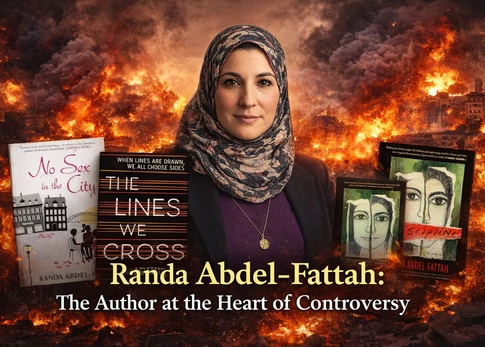
Who Is Randa Abdel-Fattah — and Why Are Festivals Cutting Ties?
Few Australian writers have managed to turn literary panels into headline news, but Randa Abdel-Fattah has done just that — and not by accident.
In recent weeks, Abdel-Fattah has found herself uninvited from events linked to the Bendigo Writers Festival and the Adelaide Festival, triggering a loud and bitter debate about free speech, activism, and where cultural institutions draw the line.
At issue is not her prose style, nor her popularity — but the politics she brings with her.
Advertisement:
The Writer Behind the Row
Abdel-Fattah is best known for young adult and children’s fiction that explores Muslim identity, racism, belonging, and the experience of growing up “othered” in Australia.
Her breakout novel, Does My Head Look Big in This?, became a staple in school reading lists, praised for its humour and accessibility while tackling Islamophobia head-on.
Over time, her work has expanded beyond fiction. She is now also an academic and essayist, writing polemical non-fiction, opinion pieces, and public commentary that is explicitly political.
Where her early books invited readers in gently, her recent public voice tends to kick the door open.
What She Writes — and Why It’s Provoking Backlash
The controversy centres on Abdel-Fattah’s outspoken activism around Israel and Gaza. In essays, speeches, and social media posts, she has described Israel as a settler-colonial state and accused it of apartheid and genocide against Palestinians.
She has also sharply criticised Australian institutions — including media, universities, and cultural festivals — for what she sees as complicity through silence or neutrality.
Supporters frame her writing as moral clarity in the face of atrocity. Critics argue it crosses into rhetoric that is inflammatory, exclusionary, or dismissive of Jewish concerns about antisemitism. That tension is the fault line festivals have found themselves standing on — usually while trying not to fall into it.
Advertisement:
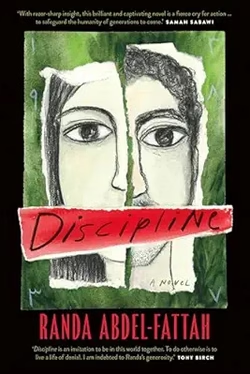
Discipline
Discipline is Abdel-Fattah’s most politically charged novel to date. Set in Sydney during May 2021, it follows two intersecting lives shaped by power, privilege, and moral compromise.
Ashraf, an academic facing professional ruin, sees the arrest of a Muslim high school student protesting a university’s links to an Israeli weapons manufacturer as a chance to resurrect his career.
Hannah, a young journalist and new mother, is fighting racism inside her newsroom while trying to honour the voices of her community.
As Israel’s assault on Gaza escalates through the final weeks of Ramadan, both characters are forced to confront the consequences of silence, ambition, and selective outrage.
Focused sharply on academia and the media, Discipline argues that neutrality is not benign — and that the cost of staying quiet is often paid by others.
Paperback – December 2, 2025
The Lines We Cross
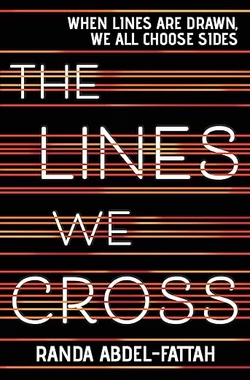
Written for young adults, The Lines We Cross explores how prejudice is learned — and unlearned. Michael is a suburban Australian teenager whose parents are active in anti-immigration protests.
Their worldview makes sense to him until Mina arrives at his elite private school: a sharp, funny Muslim refugee from Afghanistan on scholarship.
As the two form an unlikely friendship across protest lines, Michael begins questioning the beliefs he has inherited, while Mina navigates hostility, suspicion, and the constant pressure to protect her family.
The novel uses a dual-perspective structure to humanise both sides of the political divide, showing how ideology collapses when confronted with real people.
Paperback – August 28, 2018
Advertisement:
No Sex in the City
No Sex in the City is Abdel-Fattah’s early, lighter-toned breakout novel — a romantic comedy with cultural bite. Esma is a modern Muslim woman: educated, worldly, music-obsessed, and navigating dating while negotiating faith, family expectations, and desire.
Alongside her friends Ruby, Lisa, and Nirvana, she forms the tongue-in-cheek “No Sex in the City Club” while searching for Mr Right — or at least Mr Not-Entirely-Wrong.
Humorous and self-aware, the novel playfully dismantles stereotypes about Muslim women while poking fun at modern dating, identity politics, and the messy business of love.
The Arc of Her Work
Taken together, these books trace Abdel-Fattah’s evolution from sharp social observer and romantic satirist to openly confrontational political novelist. What once arrived wrapped in humour and accessibility now lands with intent — and that shift helps explain why her work, and her presence, has become so contested.
Advertisement:
Why Festivals Stepped Back
Festival organisers have been cautious in their public explanations, citing concerns about safety, community cohesion, or the risk of panels becoming flashpoints rather than conversations. Behind the scenes, pressure has reportedly come from sponsors, partner organisations, and community groups worried about reputational damage or protests.
To Abdel-Fattah and her supporters, this looks like censorship: a writer being sidelined for expressing unpopular political views. To organisers, it is risk management in an environment where a single speaker can dominate coverage and derail an entire program.
In short: nobody wants their literary festival remembered as “that one that went viral for the wrong reasons.”
The Bigger Picture: Literature Meets the Culture Wars
Abdel-Fattah’s case sits squarely in a wider struggle over whether writers are invited to speak as authors or as public intellectuals. When a novelist’s politics become louder than their books, institutions are forced to decide whether they are hosting stories — or stances.
For some, excluding her confirms fears that Australian cultural life is increasingly timid, unwilling to tolerate dissent that challenges powerful interests. For others, continuing to platform her would alienate parts of the community and turn arts festivals into ideological battlegrounds.
Either way, Abdel-Fattah has become more than a writer on a program — she is now a symbol. And symbols, as history shows, are far harder to manage than panels, book signings, or polite Q&A sessions.
Advertisement:
Abdel-Fattah & the Streisand effect
Ironically, the attempts to sideline Abdel-Fattah have amplified her voice. Her work is being shared more widely, her name is better known than ever, and debates about free expression in Australian cultural institutions are back in the spotlight.
Whether this leads to more invitations — or fewer — remains to be seen. But one thing is certain: Randa Abdel-Fattah is no longer just writing about controversy.
She’s living inside it.
Related stories
Australian media coverage of the Israel Palestine War
Reuters Photojournalist Resigns Over Gaza Coverage
2025 World Press Photo Contest Winners & Finalists
In Memory of Fatma Hassona: A Voice Silenced, A Vision Eternal
A War on Witnesses: Remembering Gaza’s Fallen Journalists
Advertisement: