

When Your Car Knows Too Much: How Smart Vehicles Became the New Battleground in Domestic Abuse
The modern car can parallel-park itself, call emergency services before you reach for your phone, and warm the seats with the kind of precision usually reserved for Michelin chefs.
But under the glossy promise of convenience sits a darker truth: the smartest object in your garage may also be the easiest to weaponise.
Australia’s eSafety Commissioner is now sounding the alarm — because while smart cars are sold as freedom machines, some are being turned into rolling surveillance devices.
And the problem isn’t limited to men controlling women or vice-versa. Technology doesn’t discriminate, and neither does misuse. Anyone can be targeted. Anyone can abuse it.
Advertisement:
When “Trip History” Becomes a Tripwire
eSafety reports frontline workers are seeing a rise in people being tracked, intimidated, micromanaged — even frozen in place — through their own vehicles.
Smart cars are now equipped with:
- GPS trip logs
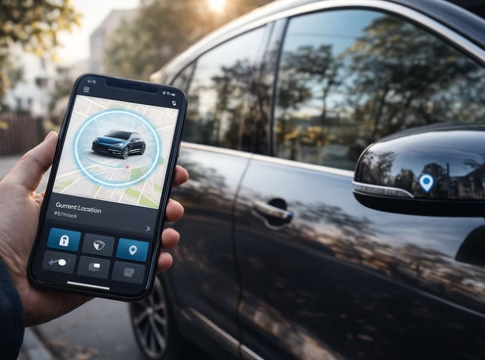
- Real-time location tracking
- Geofencing alerts
- Remote lock/unlock features
- Climate control
- Engine kill switches
Pair all that with cloud-synced companion apps or shared accounts and you’ve got the kind of omniscience that would make Orwell mutter “steady on.”
“Domestic violence abusers can exploit these modern features to spy on and gaslight their partners,” eSafety Commissioner Julie Inman Grant said.
“We’re hearing of cases where people are tracked via trip histories, locked inside their own cars, or prevented from leaving town by remote kill switches. An asset that’s crucial for escape becomes a mechanism to trap and control.”
Smart cars were meant to set us free. No one imagined they’d become electrified cages.
The New Frontier of Coercive Control
These incidents aren’t isolated glitches. They’re part of a broader swell of technology-facilitated coercive control — a term that captures the growing web of smart surveillance devices now misused to manipulate and intimidate.
From smart fridges to smart light bulbs, the Internet of Things can quickly feel like the Internet of Threats.
eSafety’s newest advisory dives into the risks smart devices pose for people experiencing domestic and family violence. You can read it here:
From smart cars to tracking devices: technology’s increasing role in coercive control and family and domestic violence
➡️ https://www.esafety.gov.au/newsroom/blogs/from-smart-cars-to-tracking-devices-technologys-increasing-role-in-coercive-control-and-family-and-domestic-violence
The interconnected nature of our devices creates a seamless ecosystem — great for convenience, terrible when someone with harmful intent has access.
Learn more about technology-facilitated coercive control here:
➡️ https://www.esafety.gov.au/key-topics/domestic-family-violence/coercive-control
Advertisement:
A National Wake-Up Call
The issue was spotlighted at a 16 Days of Activism Against Gender-Based Violence event attended by eSafety Commissioner Julie Inman Grant, Social Services Minister Tanya Plibersek, Domestic, Family and Sexual Violence Commissioner Micaela Cronin, and Domestic Violence Crisis Service ACT CEO Sue Webeck.
Learn more: ➡️ https://www.unwomen.org/en/get-involved/16-days-of-activism
Minister Plibersek said, “When someone arrives at a shelter, the first thing that happens is a thorough check of their phone, car, smartwatch and personal belongings to identify and destroy tracking devices or software.”
It’s not paranoia. It’s procedure.
As Webeck points out, “People aren’t used to assessing their safety based on what smart fridge, doorbell or tablet they use. But this is the world frontline services are navigating every day.”
The Industry Has Homework to Do
With forecasts suggesting that more than 90% of new cars in Australia will have embedded connectivity by 2031, eSafety is pushing for the automotive industry to finally have its “seatbelt moment.”
They’re calling for:
Emergency lockouts and safe transfers
A simple, documented, safe way to revoke access or transfer ownership during separation.
User-visible audit logs
Clear histories of account access and remote commands — something the victim can screenshot and, if needed, take straight to police.
Dealership accountability
Every dealership must reset accounts when ownership changes — and staff should know how to do this in a way that protects those fleeing abuse.
“These are solvable design issues,” Inman Grant said. “Manufacturers just need to build safeguards in from the start.”
What You Can Do If You’re Worried About Your Car Being Used Against You
Before making any changes, experts stress the importance of getting professional support — for your safety and evidence protection.
With a trained service, steps may include:
- Setting up a new main account on a clean device
- Changing passphrases and enabling two-factor authentication
- Removing shared accounts or old keys
- Asking a dealer to reset telematics and re-issue digital keys
- Revoking access to apps on all linked devices
And remember: in immediate danger, call Triple Zero (000).
Help Is Available
1800RESPECT (1800 737 732)
Confidential support 24/7.
eSafety’s online advice
Practical steps on technology-facilitated abuse, including smart cars, smart homes, and digital safety planning.
Frontline worker support service
Specialised consults for those assisting people experiencing abuse.
Advertisement:
Smart Cars Are the Future — But Safety Has to Come With the Package
Smart vehicles promise convenience, autonomy, efficiency… but none of that matters if the people using them aren’t safe.
Connectivity shouldn’t be a trap. A car shouldn’t betray the person sitting in it. And technology shouldn’t be designed as if only “good people” will ever touch it.
We’ve lived through seatbelts, airbags, ABS, lane assist and collision detection.
Now we’re heading into the next era of automotive safety — one where the most important feature might not be under the bonnet, but inside the software.
A car used to get you out of harm’s way. With better design, it still can.
How to Secure Your Smart Car
Smart cars are brilliant — until they’re not. If you’ve ever wondered just how much your vehicle knows about you, the answer is usually: a lot. Here’s how to lock things down before anyone else does it first.
Start With a Clean Device
If you suspect your accounts have been accessed, set up a new main profile using a clean phone or laptop, a private email address, and a new phone number if possible.
This stops old logins from syncing across devices like unwanted digital glitter.
Change Every Passphrase
Update all passwords for:
- The car’s primary account
- Companion apps
- Your Apple ID / Google account
- Phone lockscreen
- Wi-Fi networks
Then turn on two-factor authentication. Think of it as a deadbolt for your digital garage.
Audit Your Access List
Open your car’s app or web portal and review:
- Shared users
- Digital keys
- Synced accounts
- Cloud backups
- Valet/fleet/service profiles
If you don’t recognise a name, device, or login time, revoke it. Quickly.
Reset the Vehicle at the Dealership
Dealers can:
- Reset telematics and factory settings
- Remove old accounts
- Re-issue digital keys
- Confirm no hidden access remains
Ask them to document the reset. A proper wipe is your car’s version of changing the locks.
Log Out Everywhere
Most companion apps let you see all active sessions. Select “Log out all devices” — especially if a former partner ever had access to your phone, computer, or car keys.
Review Location Settings
Turn off or adjust:
- Real-time tracking
- Geofencing alerts
- Trip history logs (if possible)
- Remote climate, lock, and engine controls
Keep only the features you genuinely use. If it feels like overkill, it probably is — and that’s the point.
Check Shared Tech at Home
Smart cars often link with:
- Home Wi-Fi
- Smart speakers
- Shared tablets
- Smartwatches
- Cloud services
Unlink anything you don’t trust. A car connected to a compromised home network is still a compromised car.
Get Expert Support Before Making Big Changes
Frontline domestic, family and sexual violence services can help you decide what steps are safe and appropriate for your situation.
If you’re in immediate danger, call Triple Zero (000).
For confidential support, 1800RESPECT (1800 737 732) is available 24/7.
What Your Smart Car Knows About You
Modern cars don’t just drive — they remember. Every trip, every stop, every song you played while pretending not to sing. Here’s the data your vehicle quietly collects while you’re thinking about fuel prices.
Your Real-Time Location
Smart vehicles track exactly where you are — down to the street, the dot on the map, and sometimes the lane.
This location data is often stored in the cloud or synced to multiple devices.
Your Trip History
Every journey can be logged:
- Routes
- Stops
- Time and date
- Speed
- Distance
It’s a digital diary of your movements — even the ones you forgot you took.
Your Patterns & Habits
Cars can infer:
- Your workplace
- Your home
- Regular routines
- Favourite late-night stops
- When you’re usually away
It doesn’t take AI for someone to piece together your life from your commute.
Who Has Access
Smart cars store:
- Secondary drivers
- Shared accounts
- Digital keys
- Previous owners
- Technician or valet profiles
If the account was never reset, someone else may still be holding the spare digital key.
What You Do in the Cabin
Some cars monitor:
- Interior cameras
- Seat usage
- Door activity
- Voice commands
- Climate preferences
- Bluetooth pairs (phones, tablets, watches)
They may not judge your music taste, but they definitely catalogue it.
Your Phone’s Data
Once paired, your vehicle can access:
- Contacts
- Call logs
- Text previews
- Calendar events
- App notifications
If you ever synced a phone you no longer use — or someone else’s — the data may still be there.
Your Car’s Remote Controls
Most smart vehicles expose:
- Remote unlock and lock
- Engine start/stop
- Cabin temperature
- Horn and lights
- Geofencing alerts
Convenient when you’re lost in a car park. Dangerous when someone else can trigger it remotely.
The Cloud Copies
Even after you wipe the console, copies of your data may still live on:
- Manufacturer servers
- Smartphone apps
- Shared family cloud accounts
- Old devices you forgot about
That’s why experts recommend a full telematics reset and new login credentials.
Related stories
Air Taxis Coming to Australia: A New Era in Urban Mobility
New AI Tool Protects Nature During Infrastructure Development
Smarter Ageing: How Tech and Training Will Redesign Care
The Rise of Smartphone Photography
Smart Energy Council Calls for Massive Investment in Renewable Energy Storage
Australia’s eSafety Commissioner’s legal notice to Twitter
Australia’s Illicit Drug Consumption Hits Record High
Raising the Age: NSW Faces a Defining Test on Youth Justice
Bunnings CCTV Dilemma – Security versus Privacy
Advertisement: