The Last Working Harbour: Why Losing Rozelle Bay Would Sink Sydney’s Maritime Soul
There are places in a city you can replace, and places you absolutely can’t. Rozelle Bay is firmly in the second category.
Tucked into Sydney Harbour, this stretch of water is not a lifestyle backdrop or a developer’s blank canvas. It is the last working harbour site left in Sydney — a place where ships are repaired, skills are passed on, and history quite literally floats. If Rozelle Bay is rezoned for apartments, Sydney doesn’t just lose a view. It loses its maritime memory.
At the heart of this fight is the Sydney Heritage Fleet, a volunteer-powered organisation that keeps some of Australia’s most important historic vessels alive and seaworthy. This includes the magnificent James Craig, launched in 1874, and the world’s oldest operating steam tug. These are not static museum pieces. As the Fleet proudly says, they are a museum that goes to sea.
Advertisement:
“You Can’t Put a Price on This”
Bruce Hail has been part of the Fleet for nearly 20 years. On any given day, he might be guiding a tug, assisting the James Craig off the wharf at Darling Harbour, or bringing her safely home again. For him, the Fleet is one of Sydney’s great intangibles.
Think Taronga Zoo. Think the Opera House. These places don’t just exist — they enrich life, define the city, and shape how people feel about where they live. The Heritage Fleet does the same, quietly and without fuss, from the waterline up.
And Rozelle Bay matters because this is how the harbour actually works. The Fleet’s neighbours repair wharves, move barges for fireworks, service ferries, and keep shipping ticking along. Cruise liners still arrive. Tankers still dock. Barges still move. Sydney may like to pretend it’s all cafés and kayaks now, but the harbour remains a working system — and Rozelle Bay is its last engine room.
A Skills Factory, Not a Relic
Former general manager John Simpson spent years trying to find something like the Sydney Heritage Fleet elsewhere in the world. He couldn’t. It simply doesn’t exist.
What happens at Rozelle Bay is rare: ordinary people doing extraordinary things. Volunteers learn to rivet steel plates, fire coal-powered steam engines, rebuild mechanical systems with no spare parts available anywhere on Earth. The people who originally knew these skills are gone. Without the Fleet, the knowledge goes with them.
Andy Muns, who started volunteering at 17, now trains the next generation. On one recent morning, he inducted another 17-year-old — proof that this isn’t nostalgia. It’s a living, working apprenticeship in Australia’s industrial and maritime past.
“There is nowhere else in Australia that does marine steam at this level,” he says. That’s not pride talking. It’s fact.
Advertisement:
Rebuilding the Unbuyable
Walk through the sheds and docks and you’ll see objects that can’t be replaced with a credit card. A steering wheel rebuilt from scratch. A binnacle restored at a volunteer’s home. Entire systems remade because the corner shop stopped stocking 1912-vintage ferry parts some time ago.
One of those vessels is Canangra, built in 1912 for Sydney’s ferry network and named from an Aboriginal word meaning “beautiful view.” She worked through World War I, the Depression, the opening of the Harbour Bridge, and World War II. Restoring her will take around 15 years — all by volunteers. When finished, she’ll tell the story of Sydney’s ferries in a way no plaque ever could.

“We’re Rapidly Losing the Working Harbour”
Gordon Robertson joined the Fleet after retirement, looking to stay busy and useful. He found more than that. He found purpose.
Around Rozelle Bay, he sees what’s left of Sydney’s working waterfront disappearing fast. Take this away, he says, and there’s nowhere for boats to go. Nowhere to fix them. Nowhere to maintain the infrastructure that makes the harbour function at all. Lose this, and even the superyachts won’t have anywhere to hide.
And for the Fleet? There is nowhere else. No spare dock. No backup harbour. No plan B.
Advertisement:
Apartments or Heritage — You Can’t Have Both
This is the real choice facing NSW. Short-term gain from a handful of apartments, or long-term cultural, economic, and educational value that benefits generations.
As a former regional economic development manager, I know this much: not every “opportunity” delivers lasting benefit. The Sydney Heritage Fleet does. Every sail, every open day, every TV shot of those ships gliding across the harbour reminds people that Sydney was built on the water — and still belongs to it.
Trash the boats and the area becomes poorer, blander, and oddly less desirable. Save them, and Sydney keeps something no amount of glass balconies can replace.

What You Can Do
You can make your voice heard right now.
Please write to Paul Scully, NSW Minister for Planning and Public Spaces, and tell him you support reserving Rozelle Bay for industrial maritime use and granting the Sydney Heritage Fleet a long-term lease.
👉 Send your message here:
https://www.nsw.gov.au/nsw-government/ministers/minister-for-planning-and-public-spaces
If you need inspiration, feel free to adapt this message in your own words:
Mate, please grant the Sydney Heritage Fleet a long-term lease at Rozelle Bay. You can rezone it for apartments, or you can save one of Sydney’s most important pieces of living heritage. The ongoing economic and cultural benefits of the Fleet far outweigh the short-term gains of development. The Fleet belongs to future generations — not a demolition schedule.
Sydney still has a chance to do the right thing. But harbours, like ships, don’t wait forever.
👉 Send your message here:
https://www.nsw.gov.au/nsw-government/ministers/minister-for-planning-and-public-spaces
Advertisement:
The Ships of the Sydney Heritage Fleet
Under restoration are the 1912 ferry Kanangra, the 1950s wooden speed boat Kookaburra II and the 1927 pilot vessel John Oxley.
Lady Hopetoun (1902) – Steam Launch
Built in Sydney in 1902, the vice-regal steam launch Lady Hopetoun is a beautifully preserved example of Edwardian elegance, combining refined lines with the quiet authority of steam-era craftsmanship.

Lovingly maintained in full working order by volunteers from the Sydney Heritage Fleet, Lady Hopetoun continues to do what she was built for — carrying passengers on scheduled Fleet cruises and private charters across Sydney Harbour.
Lady Hopetoun is one of five fully operational Heritage Fleet vessels now more than a century old — not a museum piece behind glass, but living history, still under steam.
Advertisement:
James Craig (1874) – Tall Ship
Launched in 1874, the barque James Craig is one of the world’s great surviving square-riggers — and Sydney’s only 19th-century tall ship still capable of sailing. Her extraordinary return to full working condition culminated in 2003 with the award of the World Ship Trust’s prestigious Maritime Medal, recognising one of the most authentic maritime restorations ever undertaken.
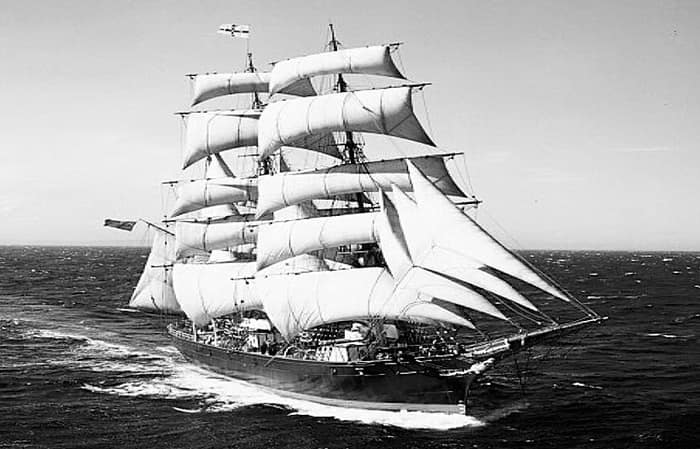
Rescued from dereliction at Recherche Bay in far southern Tasmania, James Craig was rebuilt over nearly three decades at a cost approaching A$30 million. In 2001, she hoisted all 21 sails for the first time in almost 80 years and sailed triumphantly through Sydney Heads — a moment widely regarded as one of the great achievements of modern maritime conservation.
Today, James Craig regularly puts to sea with up to 80 passengers, offering the public a rare chance to experience life aboard a true deep-water sailing ship. When not sailing, she is open for inspection at her berth at Wharf 7, 58 Pirrama Road, Pyrmont, and is also available for private charter.
There are only four 19th-century barques left in the world still capable of sailing. James Craig is the only one in the Southern Hemisphere — and the only one that routinely takes members of the general public to sea.
Owned and operated by the Sydney Heritage Fleet, a community-based, not-for-profit organisation dedicated to preserving Australia’s maritime heritage, James Craig is not a static exhibit. She sails regularly on weekends, undertakes occasional interstate voyages, and undergoes ongoing maintenance to keep her seaworthy.
To confirm opening hours, sailing schedules, or availability on the day of your visit, see the Sydney Heritage Fleet website:
https://shfmember.org.au/explore-the-fleet/our-operational-vessels/james-craig-1874-tall-ship/
Advertisement:
Waratah (1902) – Steam Tug
Built in 1902, Waratah is a working steam tug from the era when harbours ran on coal, muscle, and precision — not diesel and automation. Steam tugs like Waratah were the unseen workhorses of ports, using immense low-speed pulling power to manoeuvre sailing ships, ferries, barges and liners safely through confined waters.
They operate via coal-fired boilers driving a reciprocating steam engine, a system now almost entirely extinct. That makes Waratah exceptionally rare. Very few operational steam tugs survive anywhere in the world, and fewer still are maintained in working condition.
Operated and preserved by the Sydney Heritage Fleet, she represents skills, engineering knowledge, and maritime practices that simply cannot be recreated once lost.
So should we save her — or throw her away for a handful of apartments? If the choice is between a globally rare, working piece of industrial heritage and more harbourfront real estate, the answer shouldn’t require steam pressure to reach full boil. Save the tug. Apartments are replaceable. Waratah is not.
Advertisement:
Related stories
Melbourne’s Heritage Fleet Battles the Bureaucratic Tide
Tallships Nave Amerigo Vespucci and Villaggio Italia in Darwin
19th-Century Ship’s Figurehead of First Nations Woman
Captain Cook’s ship Endeavour confirmed found in Newport Harbour, USA
Final report on James Cook’s Endeavour from Rhode Island
Sail the Endeavour on the 2025 Voyages – Amazing Adventure!
Capt. Cook’s Journal 1-18 Apr.1770 New Zealand – New Holland
The Steel family of Newcastle and the suburb Jesmond