


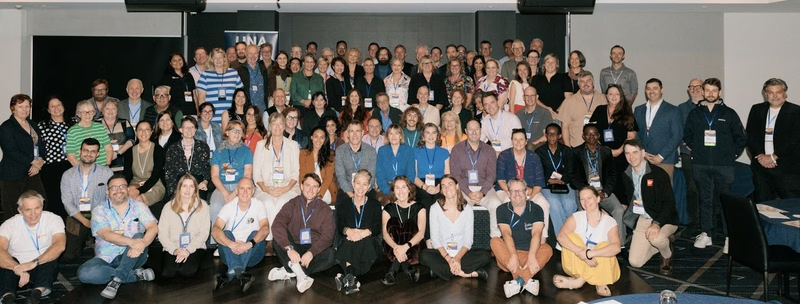
There’s something reassuring about a room full of journalists who aren’t trying to conquer the world—just determined to cover it properly, one postcode at a time. This week, that room happens to be in Murray Bridge, South Australia, where the Local & Independent News Association has gathered its tribe for the 2026 Summit.
And yes, 1EarthMedia is in attendance—because if you’re serious about where journalism is heading, this is where the conversation is happening. The news is not in the glass towers of the national news corporation’s city head office. The news is happening on the ground, on the streets in the towns where we live and work. That is where the journalists and photographers must be to tell the story. Do you agree?

Advertisement:
Local Media Is Not Dead Yet—Not Even Close
“Local news not going anywhere” isn’t just a headline—it’s a quiet rebuke to years of predictions about the death of journalism outside capital cities. “Local media isn’t finished – we’ve just fallen out of the habit of consuming it.”
After decades dealing with the rise of the US social media giants monopolising reader’s time, and the decline of the legacy media who reacted to the new paradigm and bottom line by laying off their most experienced media professionals, those people left in the media industry are taking stock and figuring out how we can rebuild and provide a valuable service to our local communities.
More than 170 independent publishers now sit under the LINA umbrella, a remarkable rise considering the organisation only welcomed its first member newsroom in 2022 – at the height of the Covid pandemic. What began as a support network has become something closer to an ecosystem—part newsroom collective, part survival guide, part group therapy for people who willingly chose deadlines over sleep.
As LINA Executive Director Claire Stuchbery put it, many members are “the only journalists reporting in their area.” Which is both heroic and slightly terrifying—like being the last firefighter in a bushfire season.

Advertisement:
A Campfire for the Independents
LINA’s strength has always been its ability to bring together publishers who might otherwise be working in isolation. These are people embedded in their communities—covering council meetings, court cases, and local issues that never trend but always matter.
The Summit, co-hosted by Murray Bridge News, turns that scattered network into a physical gathering. It kicked off with practical workshops—impact-driven scaling, revenue-ready newsletters, video journalism—followed by a welcome dinner along the Murray River. Journalism, it turns out, pairs nicely with a decent meal and a chance to compare notes.
Managing editor Peri Strathearn summed it up neatly: it’s a week to “network with amazing people, swap knowledge and feel supported in what can be a challenging operating environment.” Translation: you’re not the only one wrestling WordPress at midnight while wondering if anyone reads council minutes anymore.
The Rise of the Independent Media
LINA didn’t appear out of nowhere. It grew in the gaps left behind as traditional media pulled back—closing regional bureaus, cutting staff, and consolidating voices into fewer and fewer hands even further away from where the story was happening.
Into that vacuum stepped a new breed of publishers. Some were former journalists who’d had enough of newsroom shrinkage or had their life’s work made redundant by a temporary bean counter in head office. Others were community advocates, photographers, or editors who simply refused to let their towns become news deserts.
LINA became their campfire. Formed to support Australia’s independent publishers, the organisation now represents hundreds of outlets—digital natives, revived mastheads, niche publications, and hybrid models that blur the line between journalism and community service.
What sets LINA publishers apart isn’t scale—it’s proximity. These outlets don’t parachute in for headlines. They live the stories. Their readers aren’t abstract “audiences”; they’re neighbours, business owners, councillors, sometimes even relatives. That closeness demands a different kind of journalism—less noise, more nuance.
And in an era where trust in media can feel like a leaky bucket, that connection matters. Readers know who’s writing the story. Often, they can bump into them at the supermarket and ask why.
Try doing that with a multinational media conglomerate or a news corporation that sacks their journalists and photographers en masse because it doesn’t suit their profit and loss statement.
We’re hearing from comparatively well-funded startups such as The Australia Institute’s The Point and The Conversation, independent investigative reporters like The Klaxon and Michael West Media, niche media outlets including Croakey, and community news champions Murray Bridge News.
Advertisement:
The Business of Survival (and Growth)
Of course, passion alone doesn’t pay hosting bills or software subscriptions. It doesn’t even pay the coffee tab. A major focus of the Summit is sustainability—how small publishers not only survive, but deal with ‘economies of scale’ without losing their identity.
LINA provides members with practical tools: tech support, legal advice, revenue programs, templates, training. The Summit builds on that with sessions covering advertising strategies, not-for-profit structures, working with content creators, and reporting during emergencies.
There’s also an international perspective, with speakers like David Grant sharing insights from hundreds of newsrooms worldwide. The message is clear: independent doesn’t mean isolated—it means adaptable.
More Than a Conference
Events like this do more than exchange ideas—they set direction. The Summit shapes LINA’s priorities for the year ahead, from strengthening newsroom sustainability to raising awareness of journalism’s role in civic life and democracy. In a fragmented media landscape, that coordination is invaluable.
Because while each outlet serves its own patch, collectively they form something much larger: a distributed, resilient layer of reporting that keeps communities informed when no one else will.
Trust in an Age of Noise
At a time when trust in media is wobbling like a pub table with a missing leg, LINA’s model offers something refreshingly stable: transparency, accountability, and a clear sense of who is telling the story—and why.
Readers increasingly want to know where their news comes from. LINA publishers can answer that in a sentence, often with a first name attached.
There’s no illusion of neutrality in the abstract sense—just a commitment to fairness, accuracy, and serving a defined community. It’s journalism that doesn’t pretend to float above the world, but instead plants its boots firmly in it.
You’ll Miss Your News When Its Gone
It’s easy to overlook local news—until it disappears. Then the council decisions go unchallenged. The court cases go unreported. The small stories that define a place vanish into silence.
LINA’s members are making sure that doesn’t happen. And standing here in Murray Bridge, watching publishers swap ideas, argue over strategy, and quietly plot the future of their newsrooms, one thing becomes clear: journalism doesn’t need to be big to be powerful. It just needs to show up.
And here’s the Call To Action … Reader’s need to step up and support their local news provider by clicking an ad, sharing the story to their friends on social media, dropping a comment or question below – even if it challenges the narrative, and God Forbid, subscribing and signing up for the newsletter.
The future of our local community depends on it.
Advertisement:
Related stories
Landscape photography in colonial Australia and New Zealand
Advertisement:


