


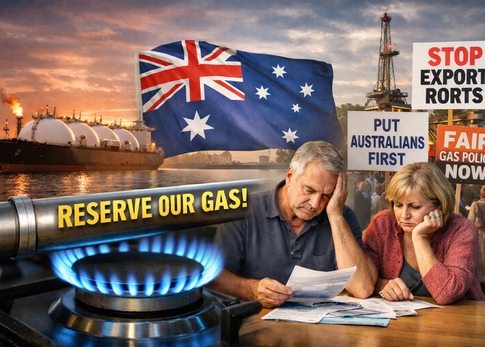
“Reserve our gas” finally goes national
Canberra, December 2025 — Australia has confirmed a federal domestic gas reservation policy after years of intense lobbying by unions, economists and activists, and politicians ducking the issue.
The Albanese Government says LNG exporters will be required to set aside 15–25% of production for Australian use, with the settings to be finalised after consultation and the scheme expected to commence in 2027.
The pitch is simple: if you’re shipping Australian gas overseas, you don’t get to pretend Australians are just another “market segment”. You make room at home first — households, industry, and gas-fired generation that still props up the grid at crunch moments.
Advertisement:
Why did this take a decade?
This didn’t come out of nowhere. The east-coast gas fight has been simmering since Queensland’s LNG export boom linked domestic prices to international LNG netback pricing — effectively turning local users into price-takers in their own backyard. The Reserve Bank has noted that east-coast wholesale gas prices became linked to LNG export prices once the export option was available.

Back before exports rearranged the furniture, east-coast wholesale gas was typically around $3–$4/GJ (generally below $5/GJ), says The Australia Institute (pdf).
Now the “normal” in recent years has looked more like $13–$15/GJ on contracted supply (ACCC figures) depending on buyer type and timing — comfortably four-ish times the old world.
That price shock is why the words reservation and sovereignty have been turning up in the same sentence for years.
Does this LNG policy go far enough?
The cheers for a domestic gas reserve were loudest from those who’ve been copping the sharp end of the energy bill — and the Australian Council of Social Service (ACOSS) wasted no time reminding Canberra why this fight mattered in the first place.
As ACOSS put it bluntly, Australia doesn’t have a gas shortage — it has a system that lets multinational exporters ship around 80% of our gas overseas, pocket enormous profits, and leave households slugged with prices that have tripled.
The result? People on low incomes skipping meals, delaying medical care, and making grim choices no one should face in an energy-rich country.
Advertisement:
ACOSS welcomed the policy as overdue but warned it’s no silver bullet — especially with a 2027 start date. Their message was essentially: great, but people need help now. That means targeted support to electrify homes (particularly for First Nations people, renters and low-income owners), shifting renewable costs off power bills and into the federal budget, energy debt relief, and lifting JobSeeker.
ACOSS also sharpened the knife with a call for a 25% gas export levy, arguing that if companies are profiting from public resources, they should finally pay a fair share. In short: fewer subsidies for gas giants, more relief for people who can’t just “shop around” for cheaper power.
Gas Reservation locks in gas use
From the environmental flank, Greenpeace Australia Pacific struck a more wary note. Yes, the reservation policy reins in some export rorts — but Greenpeace warns it risks becoming a backdoor justification for more gas, not less.
Their concern is that without hard guardrails, reserving gas could entrench dependence on a fossil fuel Australia doesn’t actually need more of, especially when new offshore exploration (like the Otway Basin) is still being waved through.
Greenpeace’s argument cuts to the long game: if the policy works as intended, no new gas projects should be necessary at all. Opening fresh fields now only locks Australia into decades of pollution, delays the shift to cheaper renewables, and keeps households hostage to a fuel that’s already proven it can’t be trusted with the keys.
Or, as one might translate it from activist-speak: reserving gas is fine — but using it as an excuse to keep digging is like quitting smoking while buying a carton “just in case.”
Advertisement:
Unions (and some states) didn’t whisper about it — they campaigned
The Australian Workers’ Union has been one of the loudest backers, calling today’s move a long-overdue win for manufacturing workers — basically, “the best time was years ago; the next best time is now.”
On the state front, the politics has always been awkwardly split. Western Australia’s long-running reservation model has been the living counterexample to industry doom-saying — exporting gas while still making sure locals aren’t paying international scarcity pricing by default. Today’s federal plan explicitly leans on that WA precedent.
And on the east coast, pressure has been building from governments and business groups worried about forecast shortfalls and price volatility.
A note to the gas lobby: spare us the violins
The gas industry and its lobby groups have spent years warning that anything resembling reservation would “wreck investment certainty” — which is a fascinating argument from companies that have enjoyed the certainty of exporting vast volumes while domestic users copped the volatility.
Let’s call the central tension what it is: export pricing power. The gas cartel has been fixing the price.
When producers can sell into international markets, they have a strong commercial incentive to keep domestic supply tight enough that local prices float up toward export parity. That’s not a conspiracy; it’s basic bargaining leverage.
But when it produces an outcome where Australians pay multiples of the pre-export era for Australian gas, it stops being “market efficiency” and starts being a policy failure with a very expensive electricity bill attached.
The government’s stated logic — slightly oversupply the domestic market to put downward pressure on prices — is essentially an attempt to break that leverage.
Advertisement:
The farce of import terminals in a gas-export superpower
One of the clearest symbols of how warped the east-coast market has become is this: Australia, one of the world’s major LNG exporters, has been progressing plans that could see it import LNG from 2027 via multiple proposed terminals.
Port Kembla is the poster child. The project has been described as built/ready in parts of the coverage, yet its start date has slipped — and more broadly, Reuters has reported four import terminal projects in development along the east coast with start dates spanning 2027 onward.
When a country rich in gas starts pricing itself into importing its own product in liquefied form, something has gone structurally wrong — not geologically wrong.
And yes, Japan can onsell “our” LNG
Then there’s the extra twist in the plot: Japan — not an LNG-producing nation — can and does resell LNG cargoes, including cargoes sourced from Australia, into third markets when it suits. The IEEFA estimates Japan onsold at least 600 PJ (potentially ~800 PJ) of Australian LNG in 2024, and the AFR has also reported similar onselling volumes. IEEFA+1
So Australians are squeezed by international pricing dynamics, while cargoes sourced here can be flipped offshore like concert tickets outside the venue. If that doesn’t sharpen the argument for a domestic-first rulebook, nothing will.
Advertisement:
What changes now — and what doesn’t
This policy is prospective (it doesn’t rewrite existing contracts), and it’s not immediate (commencement targeted for 2027). So it won’t magically fix every current supply headache or every industrial renegotiation tomorrow morning.
But politically and structurally, it’s a line in the sand: exporting Australian gas is no longer treated as automatically more important than powering Australian homes and keeping Australian factories open.
And for a country that’s spent a decade arguing over whether we’re allowed to look after ourselves first, that’s not nothing.
Related stories
Turning Down the Gas for Australian Manufacturing’s Future
Meet the Frackers: Gas explorers in Australia
LNG Exports Killed Australian Manufacturing
The Fight for Beetaloo: Protecting Country Against Fracking
Unmasking Greenwashing: ACCR Takes Santos to Federal Court
CSIRO Reports 20% Increase in Methane Emissions Over 20 Years
APEC Warns AI Will Double Electricity Demand by 2060
Advertisement: