From Tjuntjuntjara to Gramercy Park, Manhattan
The art world’s centre of gravity is quietly shifting this month from the red sands of Western Australia’s Great Victoria Desert to the polished floors of Gramercy Park in Manhattan, New York City, as two senior Spinifex artists—Timo Hogan and Kunmanara Patju Presley—present landmark solo exhibitions at the storied National Arts Club in New York.
It’s not a group show. Not a side room. Not a polite inclusion. It’s the big stage.
Organised by ReDot Fine Art Gallery in partnership with the Spinifex Arts Project Aboriginal Corporation, the dual exhibitions—Kaṉparkanya – The Wanampi (Hogan) and Paltjuliri (Presley)—run March 4 to April 23 and are free to the public.
That accessibility matters. Because what’s arriving in Manhattan isn’t decorative “desert art.” It is Tjukurpa—ancestral law, creation narratives, sacred geographies—translated through contemporary abstraction without losing an ounce of cultural authority.
Advertisement:
Timo Hogan: The Sacred Lake as Cosmos
Tim Hogan is custodian of Lake Baker (Pukunkura), a vast sacred salt lake in his Country. Presley, who has recently walked on, was a senior lawman whose canvases carried the kinetic pulse of emu migrations, Wanampi (water serpent) beings and ancestral journeys etched into the desert’s metaphysical map.
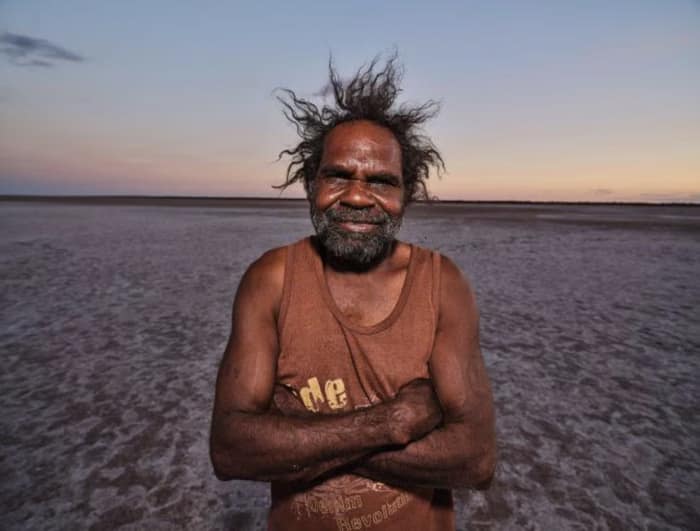
right Timo Hogan on a recent trip to Lake Baker © Photos courtesy of the Spinifex Arts ProjectDuncan Wright
Timo Hogan on a recent trip to Lake Baker. © Photos courtesy of the Spinifex Arts Project/Duncan Wright.
Winner of the prestigious 2021 Telstra National Aboriginal and Torres Strait Islander Art Award, Hogan has risen rapidly on the global stage—but nothing about his paintings feels hurried.
Working largely in restrained, meditative palettes, he layers tone upon tone until Lake Baker seems less a place than a presence. The surface hums. The salt lake expands and contracts like breath.
Advertisement:
Timo Hogan has said of this New York moment:
“Palya (yes), this is a big story! And everyone will see it, everyone will know Kaṉparkanya and ngayuku ngura (my home) Lake Baker.”
There is quiet confidence in that statement. Not bravado—certainty.
Timo Hogan’s canvases invite comparisons to Western abstraction, yet they are not chasing it. If anything, they remind the New York audience that mapping sacred space through colour fields long predates modernist studios.
Advertisement:
Kunmanara Patju Presley: The Electric Lawman
Where Hogan is contemplative, Presley was explosive.
His fields of rhythmic dotting cascade across the canvas in vibrating sequences. Emus traverse ancient pathways. Water serpents coil. Creation narratives surge forward in shimmering chromatic shifts.
As the Spinifex Arts Project’s Art Centre Manager Olivia Sproull and Studio Manager Riley Adams Brown note:
“These paintings carry the profound Tjukurpa of Spinifex Country—stories of sacred sites, ancestral journeys, and unbreakable connections to the land that have sustained Pila Nguru for generations.”
Presley’s passing lends this exhibition particular resonance. Assembled over four years, the show honours his cultural legacy while presenting the most expansive overseas display of his work to date.
For many New Yorkers, this will be their first encounter with Spinifex Country. It will not be a minor introduction.
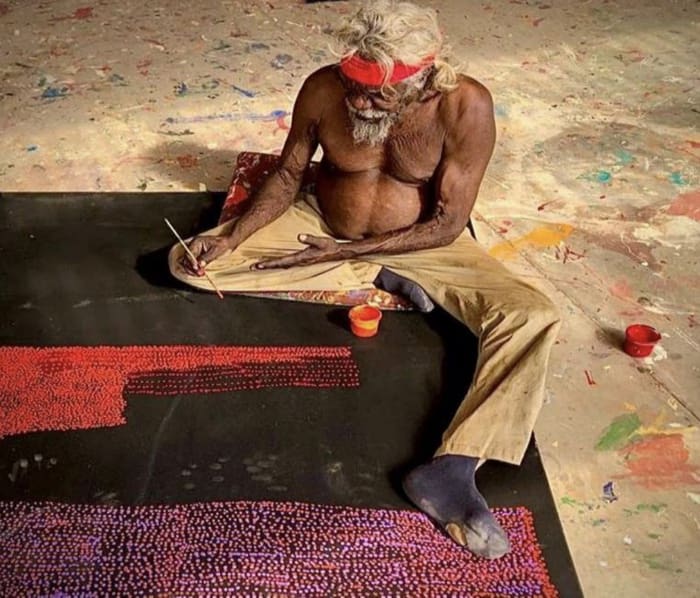
Kunmanara (Patju) Presley at work in Tjuntjuntjara, in Western Australia. © Photos courtesy of the Spinifex Arts Project/Duncan Wright.
Advertisement:
Spinifex Arts Project
The Spinifex Arts Project began in 1997 as part of the evidentiary process supporting the Spinifex people’s Native Title claim over their lands in the Great Victoria Desert. The claim was ultimately successful.
The earliest paintings were created to demonstrate the claimants’ deep knowledge of Tjukurpa (law) and their enduring connection to Country. These works mapped sacred sites and ancestral narratives embedded in the landscape, serving both as cultural testimony and legal documentation.
Since that time, the project has evolved far beyond its original legal purpose. Artists continue to paint stories of kinship, custodianship, and Country, strengthening cultural continuity while contributing significantly to the broader Western Desert art movement.
Today, Spinifex painting stands as both a powerful assertion of sovereignty and a major force within contemporary Australian Indigenous art.
Advertisement:
The Market Moves West: Auction Records and Why U.S. Collectors Are Paying Attention
The institutional embrace of Spinifex art in New York is not happening in a vacuum. Over the past decade, the secondary market for senior Western Desert artists has matured significantly, with steady upward movement for major canvases carrying strong provenance and cultural authority.
Works by Timo Hogan have achieved six-figure Australian dollar results at auction, particularly large-scale depictions of Pukunkura (Lake Baker), his custodial Country. His win at the Telstra National Aboriginal and Torres Strait Islander Art Award accelerated international interest, and museum acquisition has further tightened supply.
Monumental, monochromatic works with clear documentation from the Spinifex Arts Project Aboriginal Corporation are especially sought after.
The late Kunmanara Patju Presley, whose works now carry the additional weight of legacy, has also seen strong auction performance. Large canvases featuring Wanampi and epic Tjukurpa narratives have achieved robust mid- to high-five-figure results, with top examples pushing higher depending on scale, date, and exhibition history.
As is often the case, the passing of a senior lawman-artist sharpens focus on major works still in private hands.
Zooming out, the broader Western Desert movement has long demonstrated market resilience. Senior figures from nearby desert communities—names familiar to collectors of Papunya Tula, Tjala Arts, and other art centres—have repeatedly achieved six- and seven-figure results internationally.
The market has matured beyond novelty; it now distinguishes sharply between early career works, late major statements, and museum-scale masterpieces.
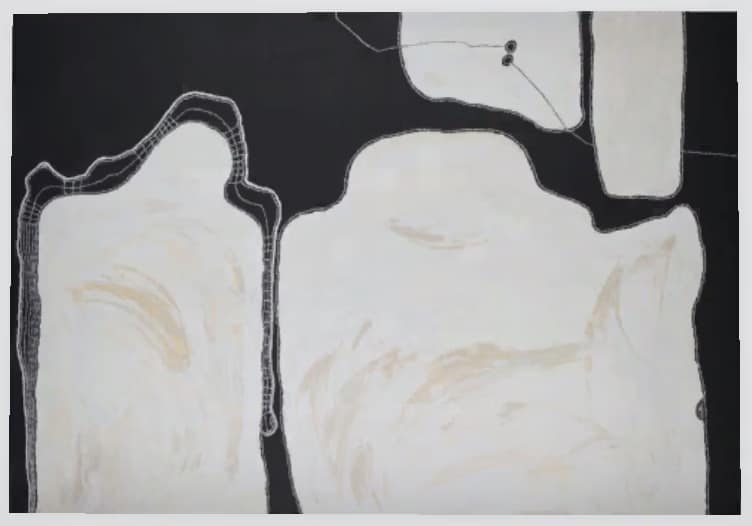
Winning painting of the prestigious 2021 Telstra National Aboriginal and Torres Strait Islander Art Award by Tim Hogan
Advertisement:
Why This Matters for U.S. Collectors
For American collectors, the significance is twofold: cultural and structural.
First, this is not decorative abstraction—it is legally and spiritually anchored painting. Each major canvas is tied to specific custodial rights and Tjukurpa narratives. That grounding gives the work conceptual depth that resonates strongly with U.S. collectors already attuned to Abstract Expressionism and Color Field painting. The visual language may feel familiar; the ontological framework is entirely different—and compelling.
Second, the supply chain is unusually transparent. Works emerging through established Aboriginal art centres such as the Spinifex Arts Project come with community endorsement, ethical frameworks, and clear provenance. In a global market increasingly wary of forgery and misattribution, that structure is reassuring.
Third, institutional validation in the United States—particularly exhibitions at venues like the National Arts Club—often precedes broader market expansion. Historically, once American museums and collectors commit meaningfully to a movement, secondary market benchmarks tend to recalibrate upward.
There is also a generational shift underway. Younger U.S. collectors are seeking art that carries political and historical weight alongside aesthetic power. The story of the Pila Nguru—exile during nuclear testing, return through Native Title, cultural survival—adds layers of narrative gravity that align with contemporary collecting priorities.
In practical terms, major Spinifex works remain comparatively undervalued against blue-chip Western abstraction of similar scale. For collectors accustomed to paying eight figures for mid-century American canvases, six-figure desert masterpieces with museum exhibition history can look, frankly, rational.
Which brings us back to New York.
When desert Tjukurpa occupies walls in Gramercy Park, it signals more than cultural exchange. It places Spinifex painting squarely within the global contemporary market conversation.
For U.S. collectors paying attention, this isn’t a trend. It’s a long horizon.
Advertisement:
A Community’s Return
The story behind the paintings is as powerful as the surfaces themselves.
The Pila Nguru (Spinifex People) were exiled from their nomadic homelands during British nuclear weapons testing in the 1950s. Removed, resettled, displaced. Yet in the twenty-first century, they successfully pursued Native Title recognition and returned to Country.
This art is not simply aesthetic achievement. It is cultural continuity after rupture.
When Giorgio Pilla, founder of ReDot, describes the exhibition as “a long-held dream,” he is speaking not only of logistics but of persistence—years of collaboration between desert community, Singapore gallery, and New York institution.
And for the National Arts Club—established more than a century ago—the hosting of these exhibitions expands its mission to amplify artistic voices historically sidelined in global narratives.
Desert Modernism Meets Manhattan
There is something quietly poetic about Spinifex Tjukurpa arriving in Manhattan’s modernist heartland.
Abstract Expressionism once sought the sublime through scale, gesture, and immersion. These paintings arrive already carrying a cosmology thousands of years deep. They do not search for transcendence; they embody it.
Yet what makes this moment significant is not comparison—it is presence.
Two senior Pitjantjatjara artists from Tjuntjuntjara in one of the most remote regions of Australia now occupy gallery walls in Gramercy Park. Their work speaks of salt lakes, ancestral serpents, sacred journeys, and cultural law. And it does so without translation into something more palatable.
It simply stands.
Advertisement:
Why This Matters
For Australian art, this is more than a headline about desert painters “making it big.”
It signals maturity in the global conversation around Indigenous contemporary practice. These are not ethnographic artefacts. They are monumental, conceptually rigorous works commanding the same architectural space as any international contemporary master.
For New York audiences, it is an invitation to encounter Country—not as landscape, but as living law.
And for Spinifex community members back home in the Great Victoria Desert, it is a reminder that stories carried in red sand can travel far, even to the grid of Manhattan, and still remain grounded in ngura—home.
The desert has always been vast. This time, it stretches all the way to the Big Apple.
Related stories
Warlimpirrnga Tjapaltjarri, artist, the Pintupi Nine
Murujuga Art listed as Australian Cultural World Heritage site
Artist and Activist, Uncle Bruce Shillingsworth
Archibald Prize winner Blak Douglas mural shows coal damage
TRUE: The Life, Art and Legacy of Kevin Gilbert (1933–1993)
Sacred Larrakia Cultural Objects Repatriated from the USA
It’s time to tell the truth – David Marr’s Killing for Country
The Role of ‘Welcome to Country’ & ‘Acknowledge Country’
Martha Graham inspired Bangarra Dance Theatre
Advertisement: