


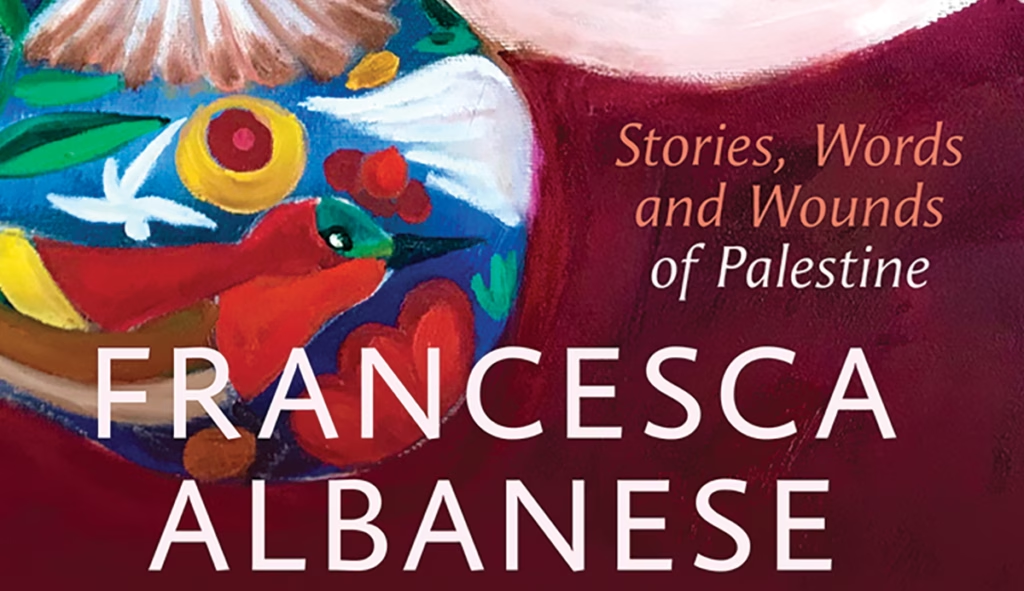
New Book by Francesca Albanese — When the World Sleeps
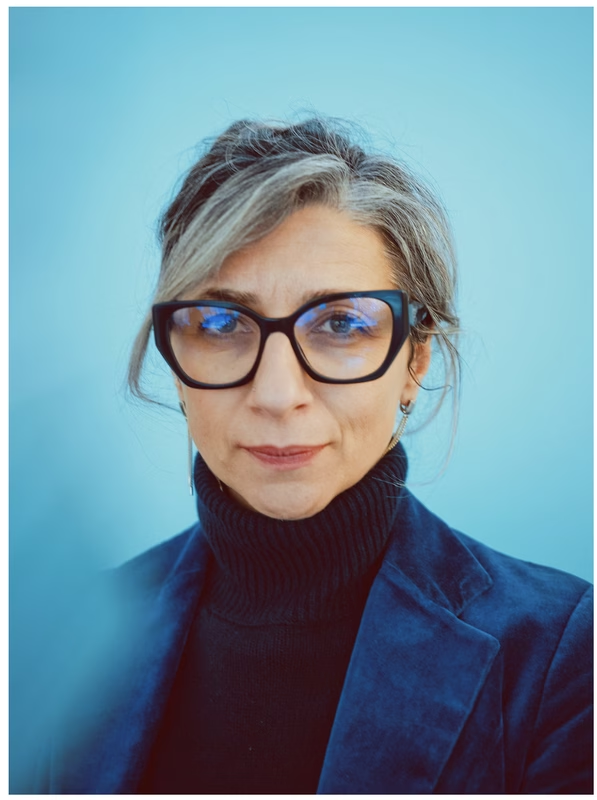
There are jobs that come with prestige, and there are jobs that come with consequences. The role held by Francesca Albanese belongs firmly in the latter category.
As the first woman appointed United Nations Special Rapporteur on the occupied Palestinian territories, she occupies a role where every sentence is examined, every conclusion contested, and silence is rarely an option.
Now, with the release of her new book When the World Sleeps, Albanese steps beyond the formal language of UN reports and into something far more personal—and arguably, more dangerous. She tells the real stories of real people affected by this crisis.
When the World Sleeps is available from Amazon, our affiliates in the USA. We may earn a small commission if purchased through this link.
Advertisement:
The Job No One Can Do Quietly
Working under the United Nations Human Rights Council, Albanese’s mandate sounds clinical: investigate and report on human rights conditions in the occupied Palestinian territories. In reality, it is anything but.
She operates independently—unpaid, unscripted, and often unwelcome. Her reports land in a geopolitical minefield where law collides with identity, history, and power. Every finding is amplified, dissected, and, depending on who’s reading, either applauded or condemned.
It is a role that demands legal precision in a world that often prefers political convenience.

Advertisement:
From Legal Briefs to Human Stories
What makes When the World Sleeps such a striking extension of her work is its shift in tone. Where UN reports must remain structured and evidentiary, the book allows Albanese to do something more revealing: tell stories.
Across ten chapters, she moves through encounters, testimonies, and moments that have shaped her understanding of Palestine—not as an abstract “issue,” but as a lived reality.
“The spirit of a place lies in the people who inhabit it,” she writes in essence through the book’s framing, drawing readers away from statistics and toward something harder to dismiss: human experience.
Or, as Albanese puts it more directly:
“I aim to grapple with the past and present of Palestine, with the hope of imagining a better future for all who share the land.”
That last line matters. It signals something often lost in the noise—this is not just documentation, but an attempt to carve out the possibility of coexistence.
Advertisement:
Bearing Witness Has a Cost
To understand the weight of the book, you have to understand the weight of her day job.
Albanese’s work is grounded in international humanitarian law, the same post-war frameworks designed to prevent the worst excesses of human conflict. But applying that law to one of the most entrenched and emotionally charged conflicts in modern history guarantees friction. Plenty of it.
Her reports have drawn strong support from human rights advocates who see her as a necessary voice of clarity. They have also triggered sharp criticism from governments and commentators who dispute her conclusions or question her framing.
That tension doesn’t disappear when she writes a book—it intensifies. Because while reports can be filed and archived, these real stories linger.
When the World Looks Away
The title When the World Sleeps is not subtle. It speaks to a broader frustration embedded in Albanese’s work: the sense that global attention is inconsistent, selective, and often fleeting. Crises surge into headlines, then recede, leaving those living through them in a kind of suspended visibility.
Her book pushes against that cycle. It refuses the idea that this is just another distant conflict to be summarised, debated, and eventually replaced by the next news cycle.
Instead, it presents what the press release describes as “a gallery of stories, characters, and places,” grounding the political in the personal. It’s harder to look away from a person than from a statistic.
Advertisement:
A Voice That Forces Engagement
If Albanese has shifted anything during her tenure, it is the tone of the conversation.
Her approach—both in official reports and now in her writing—leans toward clarity rather than diplomatic ambiguity. That has made her a focal point in global discussions around Israel and Palestine, whether people agree with her or not. And that, perhaps, is the point.
In an era of information overload and selective outrage, impact is often measured not by consensus, but by attention. Albanese’s work demands it.
Beyond the First
Yes, she is the first woman to hold this position. That matters. But what defines her tenure is not the milestone—it’s the friction that comes with it.
She is a jurist, a lecturer, a scholar with more than a decade of experience across the UN system, including work with the Office of the High Commissioner for Human Rights and the UN agency for Palestinian refugees.
She has advised governments, taught across continents, and helped shape legal thinking on displacement and the broader Question of Palestine.
In short, she knows exactly what she’s doing. Which makes the pushback she receives less surprising—and more telling.
Advertisement:
The Uncomfortable Necessity of Witnesses
There is a quiet assumption in international affairs that neutrality means distance. Albanese challenges that idea.
Her work suggests that proximity—to people, to stories, to consequences—is not a weakness, but a requirement for understanding.
When the World Sleeps extends that philosophy. It doesn’t replace her reports; it complements them. Where one documents, the other humanises.
And in doing so, it asks an uncomfortable question of its readers: What does it mean to know—and then look away anyway? Albanese doesn’t offer easy answers.
That’s not her job. Her job is to make sure the question is asked in the first place.
When the World Sleeps is available from Amazon, our affiliates in the USA. We may earn a small commission if purchased through this link.
Other books by Francesca Albanese
When the World Sleeps: Stories, Words, and Wounds of Palestine, 2026
Palestinian Refugees in International Law 2nd Edition by Francesca Albanese
Torture and genocide – Report of the Special Rapporteur on the situation of human rights in the Palestinian territories occupied since 1967 – Advance unedited version
Francesca Albanese’s new report on the torture inflicted on Palestinians by Israel.where she says that torture has become a component of genocide and apartheid.
The report argues that since 7 October 2023, Israel has engaged in widespread and systematic torture of Palestinians in both detention and everyday conditions of occupation. It claims these practices are not isolated incidents but part of a broader, coordinated system of control and punishment affecting men, women, and children.
According to the report, this includes custodial abuse alongside large-scale displacement, killings, deprivation, and destruction of basic living conditions—creating ongoing physical and psychological harm. It concludes that these actions form a sustained regime of collective suffering and intimidation, which it characterises as meeting the legal threshold for genocide under international law.
Advertisement:
Related stories
Australian media coverage of the Israel Palestine War
Who Is Randa Abdel-Fattah — and Why Are Festivals Cutting Ties?
Reuters Photojournalist Resigns Over Gaza Coverage
In Memory of Fatma Hassona: A Voice Silenced, A Vision Eternal
A War on Witnesses: Remembering Gaza’s Fallen Journalists
2025 World Press Photo Contest Winners & Finalists
A Rolling Memorial: The Journalists of Gaza
Noam Chomsky: A Life of Thought and Activism
Advertisement: