


Ancient Trees, Modern Penalties: Is Forestry Corporation Still Fit for Purpose?
The illegal logging of ancient trees in New South Wales state forests has once again landed the state-owned Forestry Corporation of NSW in court, raising renewed questions about whether the agency responsible for managing public forests is still fit for purpose.
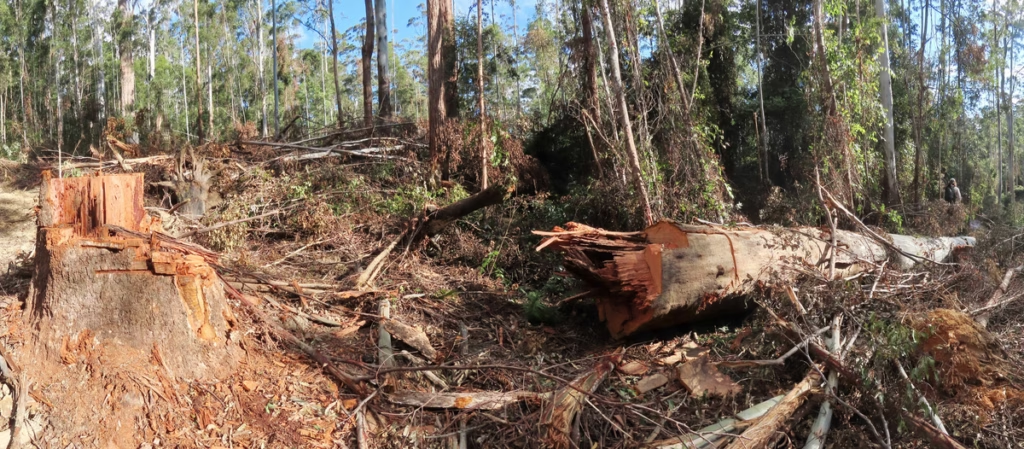
In a judgment delivered in March 2026, the NSW Land and Environment Court ordered Forestry Corporation to pay $450,000 after the illegal logging of six giant trees and three hollow-bearing trees in Wild Cattle Creek State Forest in 2020.
The trees, some estimated to be more than 300 years old, were described by campaigners as irreplaceable relics that pre-dated European colonisation of Australia.
The prosecution was brought by the NSW Environment Protection Authority, which argued that the logging operation caused harm to koala habitat and cultural damage to the Gumbaynggirr people, whose traditional lands include the forest.
Justice Rachel Pain ruled that the payment would not go to the government as a conventional fine. Instead, the funds will be directed to the Yurruungga Aboriginal Corporation, which will oversee remediation works, cultural mapping, and the creation of a Gumbaynggirr Guardians ranger program.
The ruling followed what the EPA described as a landmark restorative justice conference between the regulator, the forestry agency and traditional custodians.
Advertisement:
A Forest Already Under Scrutiny
The case centres on logging operations carried out in June and July 2020 within Wild Cattle Creek State Forest, near Dorrigo.
Under forestry rules governing native forests, trees larger than 140 centimetres in diameter — except certain species — are classified as “giant trees” and must be retained because of their ecological importance. Hollow-bearing trees are also protected because they provide essential nesting habitat for species such as the Greater Glider and other hollow-dependent wildlife.
Yet inspectors found that six giant trees and three hollow-bearing trees had been felled by contractors working for Forestry Corporation.
Environmental group North East Forest Alliance (NEFA), which had monitored the logging operation, said the damage extended beyond the initial findings.
“These illegally logged trees are over 300 years old, priceless relics predating European colonisation,” NEFA spokesperson Dailan Pugh said after the ruling.
“They are irreplaceable.”
NEFA had earlier alerted regulators after protests in the forest in July 2020 prompted an EPA inspection that discovered two illegally logged giant trees. Logging continued for another nine days before a stop-work order was issued.
A subsequent audit by campaigners found additional giant trees had been cut down, as well as damage to hollow-bearing habitat trees and koala feed trees.
Advertisement:
Cultural Harm Recognised
One of the most significant aspects of the ruling was the court’s recognition that the offences caused cultural harm to traditional custodians.
EPA chief executive Tony Chappel said the judgment made clear that the loss of these trees had consequences beyond environmental damage.
“The loss of these giant and hollow-bearing trees caused real harm, not only to koala habitat but also to the cultural fabric of the Gumbaynggirr people,” he said.
The restorative justice process allowed Gumbaynggirr representatives to describe the cultural impact of the logging directly to Forestry Corporation officials — something rarely seen in environmental prosecutions.
The court also ordered Forestry Corporation to undertake several reforms, including commissioning an independent audit of staff training and procedures for identifying protected trees before logging operations begin.
“The destruction of koala habitat in forests that hold deep cultural significance for the Gumbaynggirr people is a profound harm that should never have occurred in our publicly owned forests. For the first time in NSW, an interested third party joined the sentencing proceedings as a friend of the court and called for the court to make restoration orders on the Forestry Corporation, which the court did,” Greens MP, spokesperson for the environment and Solicitor Sue Higginson said.
“The Court has directed the nearly half a million dollar penalty to the Yurruungga Aboriginal Corporation so that restoration work can begin to repair the harm caused to Country. This is a welcomed initiative however, it is an incredibly broken system when Traditional Custodians will now be repairing their lands that the Forestry Corporation illegally desecrated,” Sue Higginson said.
Advertisement:
A Long History of Penalties
The Wild Cattle Creek case is not an isolated incident.
In 2022, Forestry Corporation was also convicted over separate offences in the same forest, resulting in fines and costs totalling $285,600 after trees were felled inside exclusion zones meant to protect koala habitat.
Environmental groups argue that the repeated prosecutions reflect systemic problems in the management of native forest logging in New South Wales.
Critics say enforcement often occurs years after the damage is done, allowing operations to continue in the meantime.
In this case, nearly six years passed between the illegal logging and the final court ruling. For campaigners, that delay highlights a deeper question about governance.
A Corporation Under Pressure
Forestry Corporation of NSW occupies an unusual position in Australian environmental policy.
It is a state-owned corporation tasked simultaneously with running a commercial timber business and managing public forests on behalf of the community.
Supporters argue that the agency provides regional jobs and timber supply from both plantation and native forests.
But critics say the dual role creates a structural conflict between profit and conservation.
The Wild Cattle Creek forest itself now sits within the planned footprint of the Great Koala National Park, a project that has become a major political flashpoint in NSW.
Environmentalists argue that repeated breaches and fines suggest the current model of native forest logging is no longer workable.
Advertisement:
The Bigger Question
The latest ruling may bring some financial restitution and new training requirements, but it does not bring back the trees.
Giant trees and hollow-bearing habitat structures take centuries to form. Once removed, they cannot be replaced within a human lifetime.
For that reason, the case raises a broader policy question now circulating in environmental and political circles:
If the state-owned forestry agency continues to incur penalties for illegal logging in public forests, is the system itself still fit for purpose?
For communities, traditional custodians, and wildlife that depend on these forests, the answer may shape the future of native forest logging in New South Wales.
Related stories
$34,000 Fine For Logging in Riparian Buffer Zone
A Pattern, Not a Slip-Up: Inside NSW Forestry Corp’s Rising Fine Tally
Our coverage of the Forestry issue, and the extinctions of Koalas & other wildlife
Our Forestry stories
Greater Glider heading for extinction
Livestream Greater Gliders Capturing Hearts & Changing Minds
EPA Changes Rules to Protect Greater Gliders, again
Open Invitation to come see endangered Greater Gliders
NSW Celebrates the Great Koala National Park (Mostly)
Illegal Logging Greater Glider Habitat in Styx State Forest
Independent’s Forest Pledge to End Native Forest Logging
Transitioning Timber Workers to Sustainable Plantations
Advertisement: