Israel’s nuclear arsenal is modern diplomacy’s worst-kept secret
Israel’s nuclear arsenal is modern diplomacy’s worst-kept secret: neither officially acknowledged nor formally denied, yet widely understood to exist.
Despite decades of UN resolutions and sustained international pressure to join the Nuclear Non-Proliferation Treaty, Israel remains the Middle East’s only undeclared nuclear power—operating outside the very system designed to prevent the spread of such weapons.
Open-source estimates from the Federation of American Scientists and SIPRI (Stockholm International Peace Research Institute) put Israel’s arsenal at about 90 nuclear warheads, making it the only state in the Middle East widely believed to possess nuclear weapons.
Because Israel maintains deliberate “nuclear opacity,” every number comes with uncertainty, but the broad consensus among serious arms-control researchers is that the arsenal is real, mature, and long established.
Advertisement:
How many warheads, and what kind?
The most widely cited estimate is around 90 warheads. NTI says Israel has roughly that number and enough plutonium for significantly more; FAS likewise lists Israel among the nine nuclear-armed states and describes its inventory as relatively stable.
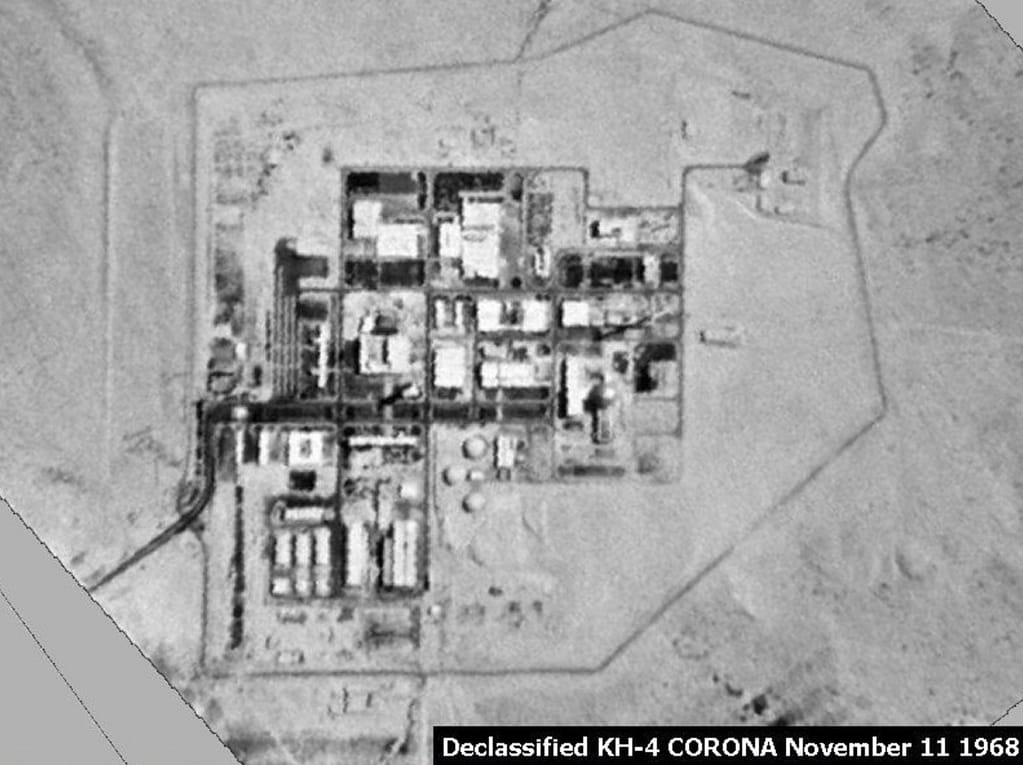
Analysts generally assess the warheads to be plutonium-based, produced through the Dimona/Negev nuclear complex. Plutonium-based nuclear warheads use plutonium—typically the isotope plutonium-239—as the core fissile material, enabling a compact design capable of releasing immense explosive energy through nuclear fission. Plutonium-based warheads are very effective and widely used because they can be made compact and reliable, especially in modern designs.
How could Israel deliver their nuclear bombs?
Open-source analysts generally describe Israel as having a de facto nuclear triad: aircraft, land-based missiles, and a sea-based option. The commonly cited delivery systems are:
Israel’s Air Force
Analysts have long assessed that Israeli combat aircraft such as F-15s and F-16s could deliver nuclear gravity bombs.
As of early 2026, the Israeli Air Force maintains a substantial combat fleet, with roughly 174 to 196 F-16 Fighting Falcons, between 66 and 83 F-15 Eagles and Strike Eagles, and more than 48 F-35I Adir stealth fighters. These aircraft are extensively deployed across air-to-air combat, strike operations, and long-range intelligence missions.
Israel fields a relatively compact but highly advanced combat fleet of around 300 aircraft. Its advantage lies in cutting-edge avionics and continual upgrades, highly trained pilots, extensive combat experience, and tight integration between intelligence and strike operations.
In short, it’s a case of quality over quantity — a smaller force engineered to deliver outsized impact.
Israel’s Land-based Missiles.
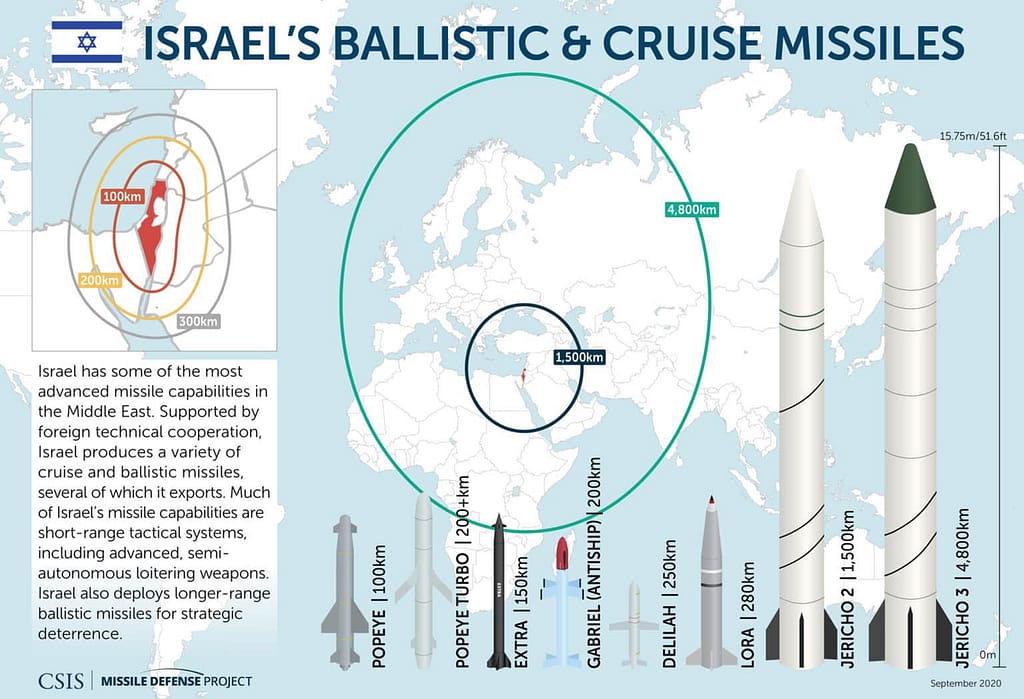
Israel has the following cruise and ballistic missiles: Delilah, EXTRA, Gabriel, Harpoon, Jericho 1, Jericho 2, Jericho 3, LORA and Popeye.
Israel is widely believed to field the Jericho missile family, with the longer-range Jericho III often described as the top end of that force. NTI lists a potential Jericho III range of roughly 4,800–6,500 km.
Developments in Israel’s Jericho missile program are closely linked to its Shavit and Shavit II space launch vehicles, which are believed to have evolved from the Jericho II missile and paved the way for the longer-range Jericho III. Analysis by the Lawrence Livermore National Laboratory suggested that Shavit technology could be adapted for intercontinental use, potentially delivering a warhead over long distances.
Further clues about the program emerged through South Africa’s RSA missile series, widely considered to be based on Jericho/Shavit designs. After South Africa dismantled its nuclear weapons program, these rockets were repurposed and marketed as satellite launch systems — inadvertently making key technical specifications public.
Israel’s Sea-based Nuclear Capability
Jane’s Defence Weekly and open-source assessments point to Israel’s Dolphin-class submarines as a second-strike leg of the arsenal, believed capable of launching nuclear-armed cruise missiles. NTI notes six Dolphin boats and describes them as believed capable of launching nuclear-armed cruise missiles.
These diesel-electric submarines were developed for Israel and built in Germany by Howaldtswerke-Deutsche Werft for the Israeli Navy’s Shayetet 7 flotilla. Each vessel is equipped with six standard 533 mm torpedo tubes and four larger 650 mm tubes. The oversized tubes are particularly versatile, capable of deploying mines, swimmer delivery vehicles, or larger cruise missiles, and can be adapted for standard munitions as well.
Each submarine can carry a mix of torpedoes and submarine-launched cruise missiles, commonly identified as the Popeye Turbo. These missiles are believed to have a range of at least 1,500 kilometres and, according to open-source defence analysis, may be configured to carry nuclear warheads.
The Federation of American Scientists and GlobalSecurity.org have reported that the larger torpedo tubes are capable of launching these missiles. A test observed by the U.S. Navy in the Indian Ocean, covering a similar range, has been cited as further evidence of this capability.
Earlier, in 2000, the Clinton administration declined an Israeli request to purchase Tomahawk long-range cruise missiles, citing Missile Technology Control Regime constraints — a decision that likely accelerated reliance on Israel’s own missile systems.
Advertisement:
Did Israel sign the NPT or the nuclear ban treaty?
No. Israel is not a party to the Nuclear Non-Proliferation Treaty (NPT), and it has not signed or ratified the Treaty on the Prohibition of Nuclear Weapons (TPNW) either. The IAEA notes that Israel is one of the few non-NPT states with only item-specific safeguards, not full-scope safeguards across all nuclear activities.
Pressure on Israel to sign the Nuclear Non-Proliferation Treaty has come through the UN General Assembly, the IAEA, and repeated diplomacy around a Middle East zone free of nuclear weapons and other weapons of mass destruction.
A December 2025 UN General Assembly resolution (pdf) again reaffirmed the importance of Israel joining the NPT and placing all its nuclear facilities under comprehensive IAEA safeguards. The IAEA has also continued to note that Israel is the only state in the region outside the NPT.
“Pressure” is not the same as “consequences.” Israel has faced decades of criticism, but not the kind of coercive international regime imposed on some other states. That gap is one reason critics talk about a giant non-proliferation double standard with the subtlety of a brick through a window.
Who helped Israel build the bomb?
The historic answer is: primarily France, with crucial help from Norway, and a degree of camouflage enabled by broader Cold War politics.
Declassified material published by the Wilson Center and National Security Archive shows that Israel made a secret national decision in the 1950s to pursue a weapons option; struck a secret bargain with France for the Dimona project; and obtained heavy water from Norway via the United Kingdom under a cloak of secrecy.
The same archival material shows U.S. officials later concluded that plutonium production for weapons was a major purpose of the Dimona complex.
Was the program secret, and when did it begin?
Yes — very much so. The archival record indicates the Israeli leadership moved toward a weapons option in the mid-1950s. Construction at Dimona began in the late 1950s, while Israel publicly claimed the project was for peaceful purposes and development of the Negev. U.S. archival sources show Washington discovered the scale of the secret much later than Israel would have liked, and by 1969 the Nixon administration had effectively reached an understanding with Golda Meir under which the United States accommodated Israel’s undeclared nuclear status.
The program’s public mask slipped decisively in 1986, when former technician Mordechai Vanunu provided detailed information and photographs from Dimona to The Sunday Times, giving the world the clearest look yet at what had long been suspected.
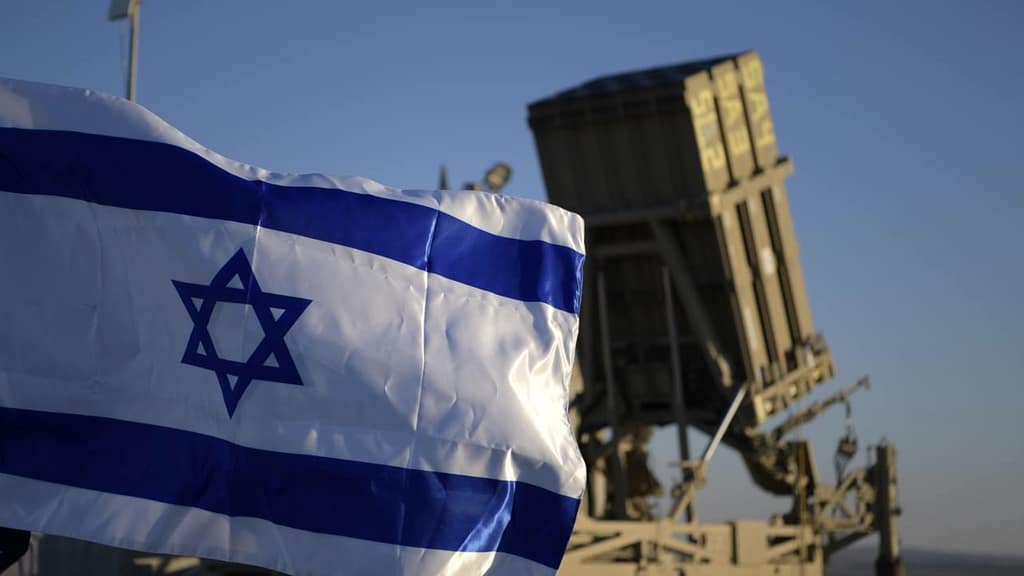
The Iron Dome air defence system during operational trials following the conclusion of Operation Shield and Arrow, May 14, 2023.
(Photo credit: Israeli Ministry of Defense)
Where are Israel’s missiles housed?
The short answer is that the precise basing, storage, and readiness arrangements are secret, and that secrecy is the point. Public arms-control analysis suggests Israel likely relies on hardened, dispersed, and at least partly underground storage and handling arrangements for some of its missile force, while the sea-based leg gives it survivability at sea. SIPRI has described bunker and tunnel-type infrastructure associated with Israel’s missile force in open-source imagery analysis.
Hans Kristensen, director of the Federation of American Scientists’ Nuclear Information Project, estimates that there are 25-50 nuclear-capable Jericho missile launchers located at Sdot Micha Airbase near Beit Shemesh. While Jericho missiles are designed to be equipped with nuclear warheads, the warheads themselves are likely kept at a separate location, Kristensen said.
Advertisement:
How many wars has Israel been involved in since 1947?
That depends on whether you count only major interstate wars or every intifada, incursion, Gaza campaign, and Lebanon operation. If you mean the major Arab-Israeli wars, Britannica identifies seven major conflicts: 1948–49, 1956, 1967, 1973, 1982, 2006, and the war that began in 2023 and continues in some form today.
Who started those wars?
That question is politically explosive because “who fired first” is often simpler than “who created the conditions.” Still, the proximate triggers of the major wars are broadly described in the historical record like this:
The 1948 war followed the civil war in Mandatory Palestine after the UN partition plan and then the invasion by Arab states after Israel declared independence. Britannica notes the partition plan was accepted internationally but rejected by Arab parties, and that war followed as Britain withdrew.
In 1956, Israel invaded Egypt’s Sinai, in coordination with Britain and France during the Suez Crisis.
In 1967, Israel launched the first major strikes, describing them as preemptive amid Egyptian mobilization and blockade.
In 1973, Egypt and Syria launched the opening surprise attack on Yom Kippur.
In 1982, Israel invaded Lebanon, after an attempted assassination of its ambassador in London by a Palestinian splinter group and amid ongoing cross-border conflict.
In 2006, the war followed a Hezbollah cross-border raid that killed Israeli soldiers and abducted two others.
The 2023 Gaza war was triggered by the Hamas-led October 7 attack on Israel, after which Israel launched a full-scale war in Gaza.
That does not settle the deeper argument over occupation, siege, settlements, refugees, or prior cycles of violence. It only identifies the immediate match dropped into the petrol.
Arms Control Association analysis says Israel has generally maintained public silence and, notably, even during the 1973 Yom Kippur War resisted issuing explicit nuclear threats. Scholars and declassified-history researchers have long argued that Israel’s nuclear arsenal had a role in crisis signaling.
There is evidence of a nuclear dimension in 1967 and 1973, including discussion of demonstrations or alerts, but the best current scholarly reading is that these episodes were more limited and more restrained than sensational “Samson Option” mythology often suggests.
Israel’s Nuclear Capability Summary
Israel is widely assessed to have about 90 nuclear warheads, probably plutonium-based, deliverable by aircraft, ballistic missiles, and likely submarine-launched cruise missiles. Its program was built largely in secret from the 1950s onward, with key foreign assistance from France and Norway, shielded by a doctrine of nuclear opacity and later tolerated by the United States.
Israel has signed neither the NPT nor the TPNW, has faced decades of international pressure to do so, and yet remains outside the full inspection and disarmament framework that much of the world says should apply to everyone else.
Related stories
Trump Orders USA Nuclear Testing to Resume
Perth approved for AUKUS nuclear waste dump
Palm Sunday Peace Rally and March for Nuclear Disarmament
Nuclear Reactors: A Disastrous Climate Gamble for Australia
Cost Comparison of Nuclear, Coal, Gas and Renewable Energy
What are the risks of Australia becoming a nuclear target?
Advertisement: